Travelling via Dubai airport? Know how many mobile phones you can carry before you fly
From mobile phone limits to liquid rules, here’s what DXB passengers must know
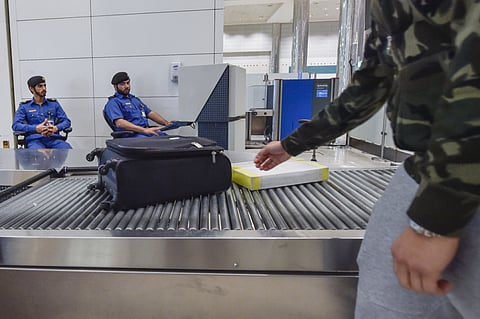
Dubai: Passengers travelling through Dubai International Airport may be surprised to learn that they can carry up to 15 mobile phones in their luggage — but only under strict conditions.
Moreover, as passenger numbers continue to rise — with Dubai welcoming 17.55 million visitors in 2025 alone — the message from authorities is clear: follow the rules, prepare your bags properly, and allow extra time.
Behind the trays and metal detectors, AI and advanced scanners are working to keep queues moving — but knowing the basics could save you far more time.
As Dubai prepares for another busy travel season, here are some security reminders to help travellers avoid delays at screening checkpoints.
The 15 mobile phone rule
According to Dubai Airports’ security guidance, passengers may pack a maximum of 15 mobile phones in their luggage (excluding their personal device). However, the phones must be in the manufacturer’s original packaging. Otherwise, they may be confiscated.
The rule is linked to lithium batteries, which pose a potential fire risk to airport facilities and aircraft if not properly stored or declared.
Key security rules to remember at DXB
Authorities have urged passengers to follow these guidelines:
Security procedures before boarding are for the safety of all travellers.
Follow instructions from security officers to avoid missing your flight.
Avoid wearing metal objects where possible. If you do, remove them before passing through screening and place them in the designated trays
Do not carry prohibited items such as lighters, flammable containers or toy weapons.
Say goodbye to family and friends at home to ease congestion at the airport.
Never leave luggage unattended.
Do not carry bags for people you do not know.
Carry prescriptions for any medication, and a medical certificate if you have an implanted metal medical device.
Security screening remains one of the most time-sensitive parts of the airport journey, particularly during peak travel periods such as Eid and summer holidays.
AI, 3D scanners behind the scenes
While passengers are reminded of the rules, airport authorities are also investing heavily in technology to improve screening efficiency.
Ahead of the Dubai Airport Show, officials highlighted how airports are using artificial intelligence to forecast security demand and even create virtual replicas of operations to simulate peak-hour scenarios.
Airports are also acquiring next-generation Computed Tomography (CT) scanners, which produce high-resolution, 3D rotatable images of cabin baggage. The technology is designed to detect explosives and threats more accurately and could eventually reduce restrictions on liquids and electronics in hand luggage.
Bag scanners at DXB
In Dubai, Dubai Aviation Engineering Projects (DAEP) recently signed a multi-year deal with Smiths Detection to install next-generation CT scanners across DXB’s terminals. The systems include automated tray return, smart lane management and object recognition software.
Brigadier Expert Engineer Marwan Singel, Assistant Director General of the General Department of Airport Security, said that Dubai adopts a proactive approach to safe, seamless travel by integrating advanced technologies.
“In the UAE, security authorities continue to adopt new airport screening technologies to detect and overcome threats. We have been pioneers in achieving a balance between high-level threat detection and improving the security standards of the passenger experience,” he said.
May Ismail, Event Manager at RX Middle East, organisers of the Airport Show, said airport security is benefiting from new surveillance and screening technologies that make passenger and cargo checks more secure and efficient.
According to industry projections, the global airport security market is expected to exceed $38 billion by 2035. In the UAE, the market is forecast to reach $3.2 billion by 2030, driven by rising passenger traffic and infrastructure investment. The 25th edition of the Airport Show will be held at the Dubai World Trade Centre.


