Why frozen iguanas are falling from trees in Florida right now
Imagine walking through Florida and have a 10-pound reptile drop from a tree on your head
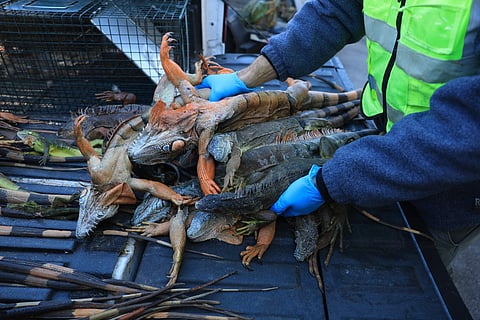
Dubai: It's raining iguana's in Florida.
Imagine walking through Florida and having a 10-pound reptile drop from a tree onto your head.
Welcome to iguana falling season.
Green iguanas aren't supposed to be in Florida. They arrived in the 1960s and quickly made themselves at home. Now they're everywhere. You'll spot them basking on garden walls, swimming through canals, and chomping through flower beds. Most of the time, they mind their own business despite looking like mini dinosaurs with their sharp teeth and whip-like tails.
But when temperatures plunge, things get strange..
Why do iguanas fall from trees?
Unlike us, iguanas can't control their own body temperature. They rely entirely on their surroundings to stay warm. When Florida gets a cold snap, their bodies essentially go into shutdown mode.
Wildlife biologist Natalie Claunch explains to National Geographic, that their heart rate and breathing slow right down. They enter a state called torpor, which is like hitting pause on their entire system. On the ground, this just means they become sluggish and vulnerable. But iguanas love lounging in trees, and when torpor kicks in, they lose their grip. Gravity does the rest.
This wouldn't happen in their native habitat. It's purely because they're living somewhere they shouldn't be.
What temperature causes this?
The critical temperature is around 10 degrees Celsius. Once it drops below that, iguanas start tumbling. Smaller ones fall first because they lose heat faster. How quickly the temperature drops also matters.
Scientists haven't studied this properly in labs yet. Everything we know comes from watching wild iguanas during actual cold weather.
Unless an iguana falls from a great height or lands badly, it's probably fine. Tree-dwelling animals are adapted to survive occasional tumbles.
The bigger danger comes from staying cold too long. "Prolonged exposure to cold temperatures can be detrimental to reptiles in that they become more susceptible to infection whilst their immune system is slowed down," says Claunch.
Cold-stunned iguanas also become easy targets for predators and pets.
What are the people doing?
They are advised to keep their pets away and let the iguanas warm up naturally. They also shouldn't try to 'rescue' them by bringing them indoors.
As green iguanas aren't native, Florida doesn't monitor their removal. It's legal to take them from your property or even kill them, if done humanely.
Some adventurous Floridians eat them. In the Caribbean, where iguanas are native, they're called "pollo de los árboles" or chicken of the trees. The meat is high in protein and omega fatty acids.
Whilst having bowling-ball-weight reptiles drop on your head sounds terrifying, there's an upside. The fact that green iguanas can't handle cold is the only thing keeping them from spreading across the entire United States.
Just watch out for the sky.
Areeba Hashmi is a trainee at Gulf News.


