Artemis II is a big deal: First 'Moon swing' mission since 1972 on a new spacecraft, but why is it delayed?
Step-by-step: Hardware, flight path planned for the first manned Moon mission in 53 years
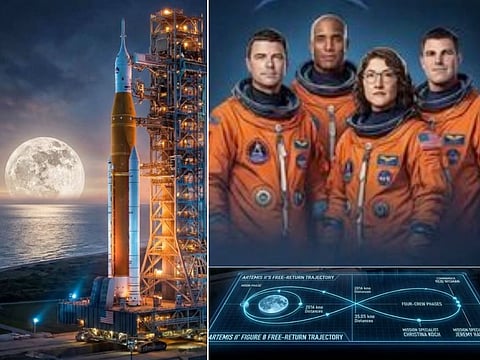
The upcoming Artemis II mission is dubbed a huge leap in human space exploration, building directly on the uncrewed Artemis I success in 2022.
Here's why: It proves not only that humans can safely operate these systems far from Earth, but also marks the first time astronauts will venture to the Moon's vicinity since the Apollo 17 mission in 1972 — more than half a century ago.
So it's not just another spaceflight.
The challenges to pull it off are many.


Delays
Artemis II has experienced multiple delays over the years: a total of ~5 so far. These had been caused by major changes (from initial conceptual dates through 2024/2025 revisions and the current February to March 2026 slip).
Timeline of Artemis II delays:
Original planning (2010s) — Initial date forecasts were for much earlier, before 2021, but were pushed as the program evolved.
2024 delay — NASA postponed the mission from late 2024 to September 2025 due to engineering work on the Orion spacecraft (life support, heat shield, etc.).
Late 2025 / early 2026 reshuffle — Officials shifted the target to April 2026 to allow more time for testing.
Acceleration attempt — In 2025, there was an internal push to move up to February 2026, and that became the target date.
Recent wet dress rehearsal delay — The February 8 launch window was scrubbed and replaced by a new target no earlier than March 2026 after the rehearsal findings.
Once the mission gets going, though, it's set to shatter records by sending humans farther from Earth than ever before.
The crew will travel approximately 4,600 nautical miles (about 5,300 miles or 8,500 km) beyond the far side of the Moon, surpassing the distance achieved by Apollo 13 in 1970.
Why is it such a big deal?
The Artemis II mission underscores Nasa's renewed commitment to deep space travel.
This would test critical systems for future lunar landings and Mars expeditions, while fostering international partnerships.
Beyond the record-breaking distance, Artemis II is a pivotal test flight for Nasa's next-generation hardware: the Space Launch System (SLS) rocket — the most powerful ever built for crewed missions — and the Orion spacecraft, designed for long-duration deep space journeys.
Strategically, it signals a shift from the Cold War-era space race to a collaborative, sustainable approach to exploration, involving partners like the European Space Agency (ESA), which provides Orion's service module, and the Canadian Space Agency (CSA).
This diversity extends to the crew itself, featuring the first woman, first person of colour, and first non-American to journey beyond low Earth orbit, symbolising inclusivity in space exploration.
Crew
The four astronauts bring a mix of experience and firsts:
Reid Wiseman (NASA, Commander): Veteran astronaut with 165 days on the International Space Station (ISS); former Chief of NASA's Astronaut Office.
Victor Glover (NASA, Pilot): First African American on a long-duration ISS mission; logged 168 days in space.
Christina Koch (NASA, Mission Specialist): Holds the record for the longest single spaceflight by a woman (328 days on ISS); will be the first woman on a lunar mission.
Jeremy Hansen (CSA, Mission Specialist): Canadian astronaut and former fighter pilot; will be the first non-American to fly on a lunar mission.
Mission
Primary goal: Conduct a crewed test flight to validate the SLS rocket, Orion spacecraft, and supporting ground systems for deep space missions. This includes testing life support, navigation, communication, and propulsion in the harsh environment beyond Earth's protective magnetic field.
Key tests: Crew will evaluate manual handling, proximity operations (like spacecraft maneuvering), and automated systems during the 10-day journey. Radiation exposure and microgravity effects on humans will also be monitored to inform future missions.
No landing: Unlike later Artemis missions, this is a flyby only—no lunar orbit or surface activities. It's designed as a "dress rehearsal" for Artemis III, which aims to land astronauts near the Moon's South Pole.
Timeline and launch
New Launch Date: No earlier than March 6, 2026, from Kennedy Space Center's Launch Complex 39B in Florida. (Note: Dates could shift based on technical reviews.)
Duration: Approximately 10 days, covering about 1.3 million miles (2.1 million kilometers) round trip.
Current Status (as of February 3, 2026): The mission is in final preparations, with the SLS rocket and Orion spacecraft undergoing integration and testing. CubeSats (small satellites) will hitch a ride for secondary science experiments.
Engineers conducted a first run at terminal countdown operations during the test. However, the countdown stopped at 5 minutes left due to a spike in the liquid hydrogen leak rate. Crew safety remains the highest priority.
Mission Profile
Here’s the step-by-step trajectory, a figure-eight path leveraging gravity for efficiency.
Here's a breakdown of the 15 key phases:
| Phase | Description |
|---|---|
| 1. Launch | Astronauts lift off from Pad 39B at Kennedy Space Center atop the SLS rocket. |
| 2. Jettison | Solid rocket boosters, fairings, and launch abort system are discarded. |
| 3. Core Stage Main Engine Cut Off | Core stage separates after burnout. |
| 4. Perigee Raise Maneuver | Apogee raise burn to enter high Earth orbit; 23.5-hour spacecraft checkout begins. |
| 5. Orion Separation | Separates from Interim Cryogenic Propulsion Stage (ICPS), followed by manual handling assessment (up to 2 hours). |
| 6. Prox Ops Demonstration | Proximity operations demo to test spacecraft control. |
| 7. Orion Upper Stage Separation | Begins high Earth orbit; direct checkout of life support and habitation equipment. |
| 8. Perigee Raise Burn | Trans-Lunar Injection (TLI) by Orion's main engine; initiates lunar free-return trajectory with European service module. |
| 9. Outbound Transit | To Moon trajectory; Outbound Trajectory Correction (OTC) burns as needed; travel time ~4 days. |
| 10. Lunar Flyby | Passes 6,479 miles (10,427 km) above the lunar farside (mean altitude). |
| 11. Trans-Earth Return | Return Trajectory Correction (RTC) burns to aim for Earth's atmosphere; travel time ~4 days. |
| 12. Crew Module Separation | Separates from service module. |
| 13. Entry Interface (EI) | Enters Earth's atmosphere. |
| 14. Splashdown | Ship recovers astronauts and capsule in the Pacific Ocean. |
| 15. (Additional) | ICPS Earth disposal and other post-separation events. |
This trajectory ensures a safe return even if propulsion fails after the flyby, using the Moon's gravity to propel the spacecraft home.
Lunar presence
Artemis II isn't just about records — it's a cornerstone for sustainable lunar presence. It paves the way for Artemis III's 2028 landing, the Lunar Gateway station, and eventual Mars missions in the 2030s.
By including international crew and tech, it contrasts with China's more insular program, emphasising global cooperation.
Economically, it boosts jobs in aerospace and inspires STEM education. Challenges like radiation, psychological isolation, and precise re-entry will be addressed, advancing human spaceflight for generations.
In short, people might not fully grasp it yet, but Artemis II is humanity pushing boundaries again — reigniting the spirit of exploration while laying groundwork for a multi-planetary future.


