Giant phantom jellyfish the length of a double-decker bus spotted off Argentina coast: All you need to know
The elusive deep-sea creature was filmed during a major ocean expedition
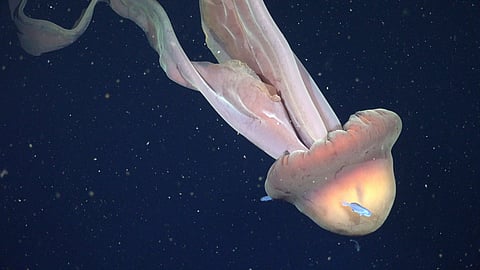
Dubai: Deep beneath the ocean's surface, something extraordinary appeared. Scientists aboard a research vessel off Argentina's coast encountered one of the ocean's most elusive creatures: the giant phantom jellyfish.
The sighting happened during an expedition exploring Argentina's continental shelf. What the team discovered surprised even seasoned marine researchers.
A creature from the deep
The giant phantom jellyfish, officially called Stygiomedusa gigantea, is massive yet incredibly rare. Its bell, the dome-shaped part of its body, can grow up to 1 metre across. But the truly impressive part is its four arms, which can stretch up to 10 metres long.
That's roughly the length of a double-decker bus, all dangling beneath a single jellyfish.
The name comes from Greek words that roughly translate to "giant jellyfish of the underworld." Appropriate, given where it lives.
Unlike many jellyfish, this species has no stinging tentacles. Instead, it uses those long arms to catch prey, including plankton and small fish.
During this week's expedition, ROV pilots, people operating underwater robots, filmed the phantom jelly at 250 metres depth. Juvenile fish were swimming around its bell, seemingly unbothered by the enormous creature.
Why this sighting is special
Scientists first pulled up a specimen of giant phantom jellyfish at the end of the 19th century. The species was officially named in 1910.
Despite their enormous size, encounters remain shockingly rare. Since 1910, there have been only 126 recorded sightings worldwide. That includes individuals brought up in fishing nets.
That's barely more than one sighting per year across the entire planet for over a century.
Why so few encounters, well, these jellyfish live primarily in extreme depths, generally between 1,000 and 3,000 metres down. They've been known to roam more than 6 kilometres below the surface.
The Southern Ocean is an exception, where they've been observed at shallower depths between 0 and 1,000 metres.
They've been spotted in the Atlantic, Pacific, Indian and Southern Oceans. Basically everywhere except the Arctic. But 'spotted' is generous. Finding one is exceptionally difficult.
What we don't know
As sightings are so rare, scientists know remarkably little about giant phantom jellyfish.
Their full distribution remains unclear. Their behaviour is mostly a mystery. Environmental preferences, died and reproductive cycle are all unknown and still being figured out.
"It is therefore important for the scientific community to seize any new opportunity to directly observe this species in its natural habitat," researchers noted in a 2023 study by Daniel M. Moore and colleagues.
Every encounter provides valuable data that helps piece together the puzzle of how these creatures live.
An expedition full of surprises
The phantom jellyfish sighting was just one highlight from the Argentinian-led science expedition aboard Schmidt Ocean Institute's R/V Falkor.
The team travelled along Argentina's entire coastline, from Buenos Aires in the north to waters offshore from Tierra del Fuego in the south.
What they found exceeded expectations. The expedition documented the largest known Bathelia candida coral reef in the global ocean. They also discovered several other rich reef complexes.
Perhaps most exciting: 28 suspected new species. These include worms, corals, sea urchins, sea snails and sea anemones that science has never identified before.
Dr María Emilia Bravo of the University of Buenos Aires served as the expedition's chief scientist. Her reaction captured the team's amazement.
"We were not expecting to see this level of biodiversity in the Argentine deep sea, and are so excited to see it teeming with life," she said in a statement.
"Seeing all the biodiversity, ecosystem functions, and connectivity unfolding together was incredible. We opened a window into our country's biodiversity only to find there are so many more windows left to be opened."
What this tells us
The Argentine deep sea remains largely unexplored. This expedition revealed thriving ecosystems that scientists didn't know existed.
The giant phantom jellyfish sighting reminds us how little we truly know about our own planet. These creatures have existed for over a century of scientific study, yet we've barely seen them.
They drift through the deepest parts of the ocean, mostly unseen and unstudied. Every rare encounter provides a glimpse into a world that remains profoundly mysterious.
As technology improves and expeditions venture deeper, perhaps phantom jellyfish sightings will become less rare. For now, each encounter remains a special event worth celebrating.
The ocean still holds countless secrets. Windows are opening, but as Dr Bravo noted, so many more remain closed, waiting for curious scientists to peer inside.
Areeba Hashmi is a trainee at Gulf News.