US secret 'Compass Call' jets that hack enemy skies – EA-37B's electronic warfare nightmare revealed
Cutting-edge aircraft dubbed a “major leap” in airborne electronic firepower
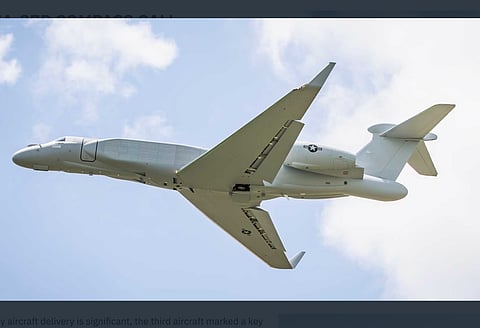
As tensions simmer in the Middle East, a brand-new electronic attack aircraft now forms part of the US arsenal could that be called in at a moment's notice, say military experts.
Much of the EA-37B power output, waveform details, and full system performance are classified.
The EA-37B is a cutting-edge electronic warfare (EW) aircraft, dubbed a “major leap” in airborne electronic firepower. Five copies of this infowar machine are already in service.
Classified war kit
The aircraft, developed for the US Air Force, is designed to disrupt enemy command, control, communications, radars, and navigation systems.
Often referred to simply as “Compass Call”, it represents a major “upgrade” from the aging EC-130H platform, transitioning the mission to a modified Gulfstream G550 business jet airframe.
This makes EA-37B a critical enabler in the event of a military conflict. This shift enhances speed, range, and survivability, making it a pivotal asset in modern electromagnetic battlespace dominance.
Electronic attack platform
Development began in 2017 when L3Harris (formerly L3 Technologies) secured a contract to rehost up to 70% of the EC-130H's mission equipment onto the G550.
The first airframe arrived for testing in September 2023, with operational deliveries starting in August 2024 at Davis-Monthan Air Force Base, Arizona, according to Global Defense News.
In November 2023, it was redesignated EA-37B from its previous name (EC-37B), to emphasise its offensive electronic attack role.
By May 2025, the first training sortie was conducted by the 43rd Electronic Combat Squadron at Offutt Air Force Base, Nebraska.
As of early 2026, five of the planned 10 aircraft have been delivered to the USAF, operated by the 55th Electronic Combat Group under Air Combat Command.
Internationally, Italy signed a $300 million deal in July 2025 to acquire two EA-37B systems, converting their own G550s, marking the platform’s first export.
What we know about the EA-37B
Deployments
Recent deployments include transatlantic flights to Ramstein Air Base in Germany in January 2026, potentially signaling repositioning to the Middle East amid escalating tensions.
Specs
Key specifications, based on published documents, highlight its advanced design. The aircraft measures 96 feet 5 inches in length, with a 93 feet 6 inches wingspan and 25 feet 10 inches height.
It has an empty weight of 48,300 pounds and a maximum takeoff weight of 91,000 pounds, powered by two Rolls-Royce BR700-710 C4-11 turbofans delivering 15,385 pounds of thrust each.
Speed, range
Performance includes a top speed of 767 mph (Mach 0.82), a range of 4,410 nautical miles, and a service ceiling of 45,000 feet.
Crew comprises two pilots and up to seven mission specialists, including electronic warfare officers and cryptologic linguists.
Mission systems feature BAE's Small Adaptive Bank of Electronic Resources (SABER), software-defined radios, conformal antenna arrays, and open architecture for rapid upgrades against emerging threats.
Information warfare
The EA-37B’s importance lies in its role in suppressing enemy air defenses (SEAD) and countering peer adversaries like China or Russia in contested environments.
By jamming networks and disrupting C5ISRT (command, control, computers, communications, cyber, intelligence, surveillance, reconnaissance, and targeting), it theoretically protects allied forces, enabling air superiority without kinetic strikes.
With initial operating capability slated for fiscal year 2026, the Compass Call is transforming electronic attack, making it indispensable for future conflicts.
EA-37B: Electronic firepower
The EA-37B, aka “Compass Call”, represents a major leap in airborne electronic firepower, serving as a wide-area, long-range standoff electromagnetic attack platform.
Its “firepower” stems from advanced jamming and disruption capabilities rather than kinetic weapons.
This enables it to deny, degrade, and disrupt enemy systems across the electromagnetic spectrum with the following gear:
Full-spectrum, long-range standoff jamming: Delivers high-powered, directional electromagnetic emissions to jam enemy radars (including early warning and acquisition types), communications networks, navigation systems (e.g., GPS-denial), and radio-controlled threats from extended standoff distances, enhancing survivability in contested environments like Anti-Access/Area-Denial (A2/AD) zones.
Precision multi-target engagement: Supports simultaneous jamming of multiple frequency bands and emitters, with increased target capacity and precision through mission system upgrades (classified), allowing focused disruption of specific threats rather than broad-spectrum denial.
Software-defined electronic attack core (SABER technology): Incorporates BAE Systems' Small Adaptive Bank of Electronic Resources (SABER), shifting from hardware-limited systems to software-defined radios (SDRs) for flexible, waveform-agile jamming; enables rapid reprogramming to counter emerging threats without hardware changes.
High-power conformal antenna arrays: Features large, fuselage-mounted “cheek” arrays (derived from CAEW configurations) for powerful, directional transmission of jamming signals, providing enhanced effective radiated power and coverage compared to the legacy EC-130H.
Counter-C5ISRT and SEAD support: Used in offensive counter-information warfare by breaking enemy “kill chains” — disrupting command-and-control (C2), intelligence gathering, sensor fusion, and integrated air defense networks — supporting Suppression of Enemy Air Defenses (SEAD) operations without kinetic strikes.
Rapid adaptability and spiral upgrades: Built on open architecture (SWORD-A) for quick insertion of new capabilities via "plug-and-play" quick-reaction options, ensuring sustained relevance against evolving peer-adversary technologies (e.g., advanced comms and radars).
Enhanced operational endurance: Higher altitude (up to ~45,000 ft), speed, and range than predecessors allow prolonged “loiter” time in the battlespace, maximising electronic attack persistence while improving crew situational awareness through upgraded SATCOM, data links, and multi-asset coordination.
Is EA-37B the “discombobulator”?
There is no evidence connecting the EA-37B Compass Call to this “discombobulator” or capability in any official sources, military fact sheets, or aviation reporting.
The term "discombobulator" appeared in recent reports as a colloquial or informal name used by President Donald Trump to describe a classified, non-kinetic weapon system allegedly used in a January 2026 US military operation (Operation Absolute Resolve) to capture former Venezuelan leader Nicolas Maduro.
It reportedly rendered enemy equipment (like rockets and systems) inoperable without physical destruction.
Military analysts say it likely involves high-powered microwave (HPM) or electromagnetic pulse effects—possibly linked to systems like HiJENKS (a successor to CHAMP cruise missiles).
The EA-37B's mission focuses on standoff electronic attack and jamming, not a singular "wonder weapon" for rendering hardware inert in the way described.
As tensions rise in the Middle East, the US military has shot down an Iranian drone that approached the USS Abraham Lincoln aircraft carrier in the Arabian Sea, a US official told Reuters on Tuesday.
The Iranian Shahed-139 surveillance drone was reportedly flying towards the carrier and was shot down by an F-35C Lightning ll with Marine Fighter Attack Squadron 314 (VMFA-314).
Iranian media claims the USS Abraham Lincoln (CVN-72) has "retreated from Chabahar Port", to an area around 1,400km from Iran's coast.
The carrier strike group, including destroyers and submarines, is now operating in the Gulf of Aden near Yemen's Socotra Island, double the distance from days earlier, according to Nour News, Fars News Agency, and WANA.
US Central Command has not confirmed the position.
The reports come as US envoys Steve Witkoff and Jared Kushner prepare for nuclear talks with Iranian Foreign Minister Abbas Araghchi in Istanbul on Friday (February 6, 2026).


