UAE reveals Emirates Mars Mission's Hope Probe captured 3I/ATLAS in never-before-seen moment
Check how Mars orbiter saw interstellar comet break apart which Earth telescopes couldn't
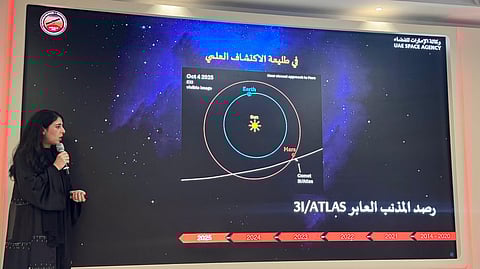
Dubai: When comet 3I/ATLAS, a rare visitor from beyond our solar system, made its closest pass to the sun last October, every telescope on Earth went blind. The comet had slipped behind the sun, out of reach. But the UAE's Hope Probe, orbiting Mars on the same side of the solar system, had a front-row seat — and it caught something Earth telescopes couldn't.
The UAE Space Agency on Tuesday released the first findings of its Emirates Mars Mission (EMM) from those observations of 3I/Atlas, only the third confirmed interstellar object ever detected passing through our solar system.
The results, released during the announcement of the extension of the Emirates Mars Mission till 2028, offer a rare window into the chemistry of another star system, seen in real time as the comet was being torn apart by the sun.
What is 3I/Atlas?
Discovered on July 1, 2025, comet 3I/Atlas is a visitor from beyond the gravitational reach of our sun and only the third such object ever detected, following 'Oumuamua in 2017 and 2I/Borisov in 2019. Travelling at up to 153,000 miles per hour, it tore through our solar system on a trajectory so steeply hyperbolic it barely curved but did not pose any harm to the Earth.
What makes it especially compelling is its composition. Unlike comets born in our own solar system, 3I/Atlas carries a different chemical fingerprint, one that hints at formation in a completely alien planetary system, making it a rare opportunity to study the building blocks of other star systems.
Conscious call
What made the observation possible was not just geography. It was a conscious call made well in advance. When word spread through the global Mars science community in early 2025 that an interstellar comet would pass near the Red Planet, the UAE Space Agency moved quickly to seize the moment, a senior official told Gulf News.
“Anyone in the Mars community knew about this comet coming by. So, to us, it was an opportunity: how can a programme focusing purely on Mars atmosphere be repurposed to support even more? It was an easy decision to go ahead and do it. We saw the value of this and how it can support the science community,” said Mohsen Al Awadhi, director of the Space Missions Department at the UAE Space Agency.
Al Awadhi said the observation also reflects a broader ambition: using the UAE's space programme to give back to the global scientific community. And critically, he noted, what Hope Probe captured is not simply another data point among many. According to Al Awadhi, it stands apart.
“The observation that we have is very unique compared to the other programmes and what has been publicly published so far, especially that the payload that we have is also different. It provides a different type of data set,” he said.
Why Hope Probe could witness it
In October 2025, the Hope Probe expanded its scientific reach beyond Mars by capturing a series of images of the comet in visible and ultraviolet wavelengths, using its EXI and EMUS instruments.
In a dedicated campaign, the spacecraft directed its instruments away from Mars and toward the star-filled sky in an attempt to capture the interloping visitor. The comet made its closest approach to Mars on October 3, 2025, passing within approximately 0.2 astronomical units (around 30 million kilometres) of the Red Planet, giving Mars spacecraft a unique vantage point due to their proximity.
That proximity proved critical. As the comet subsequently reached its closest point to the sun later, it slipped entirely out of view from Earth. “When it got to that point, it was pretty much impossible to see it from Earth. That's why the only missions that could actually take pictures of it were the missions that are around Mars," Dr Nora Al Saeed, principal investigator of the EMM, told Gulf News.
“This is a very rare event in the solar system to have a visitor from outside the solar system that we can actually point our scientific instruments to and understand and study,” she explained.
What it found
Dr Nora said the Hope Probe detected hydrogen and oxygen extending hundreds of millions of kilometres from the comet's nucleus. But the standout finding was carbon monoxide, observed at the precise moment the comet was actively breaking apart near the sun, a level of detail the mission says was unique to its instruments and position.
“The most important and unique part of the observation is that we were able to see it while it was actually disintegrating itself next to the sun, when it was reaching right next to the sun, the closest approach to the sun,” said Dr Nora.
Why it matters
Because 3I/Atlas originated outside our solar system entirely, its chemical makeup is essentially a message from another star system. “This data is going to be really useful for anyone who's trying to understand what other solar systems outside our own look like," said Dr Nora.
Full scientific papers are expected in the coming months. The Hope Probe, originally designed to study Martian atmosphere and now in its extended mission phase, was built with no interstellar comet in mind. But ended up in exactly the right place at the right time to witness one of the rarest astronomical events of the century with the right decision taken by the UAE Space Agency.


