Six months into the Iran war, Hormuz is still a chokepoint under siege — and uncertainty grips energy markets
Global trade disrupted as tankers avoid Gulf route amid escalating tensions
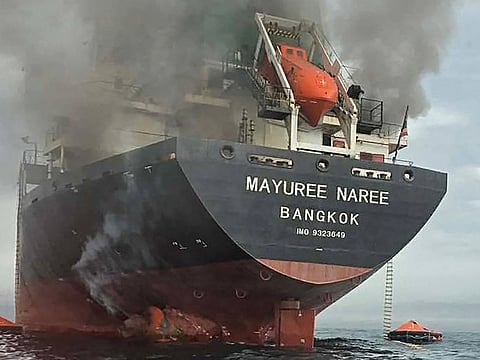
Six months after the United States and Israel launched their war against Iran, the conflict has evolved.
The war began on Feb. 28, 2026, when the United States and Israel launched major strikes against Iran under the US military operation known as "Operation Epic Fury".
The missiles-and-drones campaign has evolved into a grinding war of attrition, with energy, shipping and economic pressure becoming the new battlegrounds.
Critical artery
Six months on, the world’s oil gateway is still nearly shut. Instead, the Strait of Hormuz has become one of the conflict's most consequential battlefields.


The waterway remains a critical artery for global energy supplies, but commercial traffic has fallen dramatically amid the tit-for-tat, both kinetic and on social media.
Fewer than 20 commodity vessels crossed the strait over the weekend of Aug. 22-23, according to maritime tracking data from Kpler. On Sunday, only four were recorded. Weekly traffic remained about 90% below prewar levels.
Get it: Fast, verified news for FREE ... download the Gulf News app — simply click here
Why Hormuz matters
Before the war, roughly one-fifth of the world's oil and liquefied natural gas shipments passed through the Strait of Hormuz.
The waterway is narrow (about 39-km wide at its narrowest point, up to 97-km wide at its widest point), strategically exposed and difficult to bypass at scale.
When Iran effectively shut the strait on March 1, commodity-vessel traffic collapsed.
According to an AFP analysis of Kpler data, the average number of commodity transits fell from about 95 a day in February to just 10 a day after the closure.
A temporary improvement followed a US-Iran agreement in June. Traffic rose to about 36 commodity transits a day. But the recovery did not last.
After fighting resumed in July, the average fell again to roughly 15 daily transits through Aug. 22. More recent Kpler data suggests the deterioration has continued.
Iran tightens the rules
The danger escalated again this week. Iran has threatened dozens of tankers with fines, detention or cargo confiscation for allegedly violating its transit rules.
Reuters reported on Aug. 24 that Iran had "blacklisted" 45 tankers, including vessels linked to major operators from the Gulf and Asia, reinforcing Tehran's claim that ships passing through Hormuz must comply with Iranian rules.
That creates a direct challenge to the traditional international maritime regime.
For shipowners, the calculation becomes increasingly difficult: Do you follow Iran's instructions and risk confrontation with Washington — or follow international routes and risk Iranian action?
The human cost
Behind the shipping statistics are thousands of people who cannot simply leave.
The IMO says approximately 6,000 seafarers remain stranded in the region, with its evacuation plan currently suspended.
The IMO has also recorded deaths among seafarers and dockworkers during the conflict.
The agency previously launched a scheme to move trapped crews and vessels out of the Gulf.
In June, ships began leaving under the UN-backed arrangement, with several vessels making the journey and dozens more preparing to follow. The effort was disrupted after another vessel was attacked.
IMO is monitoring more than 20,000 seafarers across the wider Middle East.
The result is a strange "new normal": the war has become quieter in some places, but the world's most important energy chokepoint remains dangerously constrained.
The problem now: It's no longer simply whether oil can move; it is whether commercial shipping can operate in a war zone without turning crews into hostages to geopolitical risk.
The 'dark' ships problem
One of the biggest changes is not simply how many ships cross Hormuz, but how difficult they have become to track.
Then there are ships that effectively disappear from public tracking systems.
Since the July collapse of the ceasefire, about two-thirds of recorded transits have become what Kpler describes as "dark" or unidentified, compared with less than 1% before the war.
That does not necessarily mean those vessels are secretly carrying prohibited cargoes.
A ship can disappear from tracking because its automatic identification system is switched off, signals are jammed or satellite imagery is unavailable.
But the effect is the same: the world's ability to see what is moving through one of its most important shipping lanes has deteriorated.
A chokepoint nobody fully controls
The Strait of Hormuz is not necessarily "closed" in the traditional sense.
Ships are still moving. Oil is still moving. But the old system of predictable, high-volume commercial navigation has been badly damaged. That distinction matters.
A chokepoint does not need to be physically sealed to disrupt global trade.
It only needs to become sufficiently dangerous, expensive and unpredictable that shipowners decide the risk is no longer worth taking. That is what appears to be happening.
Kpler's latest figures show traffic around 90% below the prewar baseline.
The uncertainty is amplified by conflicting claims.
Washington says significant oil volumes are still moving through the strait, while commercial ship trackers report far lower visible traffic.
Some of the discrepancy may be explained by vessels switching off tracking systems or moving under conditions that make them difficult to observe.
Oil routes that bypass Hormuz
Saudi Arabia: The East-West Pipeline, also known as Petroline, moves crude from the Eastern Province to Yanbu on the Red Sea — avoiding the Strait of Hormuz.
UAE: The Habshan–Fujairah pipeline, or ADCOP, carries Abu Dhabi crude to Fujairah on the Gulf of Oman, outside Hormuz.
Limited alternatives: Saudi Arabia and the UAE are the only Gulf exporters with operating crude pipelines that directly bypass the strait.
Capacity gap: Even at high utilisation, bypass pipelines cannot fully replace normal oil volumes shipped through Hormuz.
Most exposed exporters: Kuwait, Qatar, Bahrain and much of Iraq remain reliant on Hormuz-bound tanker traffic.
Operational constraints: Red Sea and Fujairah exports still require functioning terminals, tankers, insurance and secure sea lanes.
What happens next?
Three questions now matter.
#1: Can shipping normalise without a political settlement?
Probably not fully. As long as shipowners face the possibility of attack, detention or confiscation, many will continue to avoid the waterway.
#2: Can alternative routes compensate?
Only partially.
Pipelines, ports and alternative maritime routes can reduce the impact, but they cannot instantly replace the enormous volume of energy historically passing through Hormuz.
#3: Will Iran continue using shipping as leverage?
Recent threats against dozens of tankers suggest that Tehran sees control of the waterway as one of its strongest remaining strategic cards.
Military balance vs geography
The military balance may have shifted against Iran. But geography has not. And six months into the war, the Strait of Hormuz demonstrates why.
Iran does not need to destroy every ship — or permanently seal the waterway — to impose enormous costs.
It only needs to make the world's most important energy corridor too risky to use normally.
That is the strategic paradox of the war's second half: Iran's military may be weakened, but its geography remains powerful.
And until ships can move through Hormuz with something approaching the confidence they had before Feb. 28, the war will continue to be felt far beyond the battlefield — in oil markets, freight rates, insurance premiums, supply chains, our pockets and the lives of thousands of sailors still waiting for a safe way home.


