Is Iran's parliament speaker Qalibaf the ‘mystery man’ in US talks?
Veteran hardliner’s name emerges in reports, even as both sides offer conflicting signals
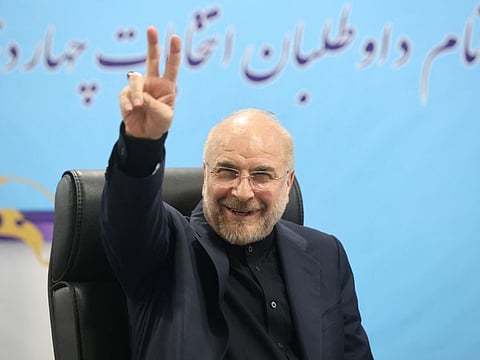
Dubai: As Israeli and US strikes continue to erode Iran’s political and military leadership, one figure is increasingly moving to the centre of power in Tehran: parliament speaker Mohammad Bagher Qalibaf — a veteran insider now seen as a crucial link across the Islamic Republic’s fractured system.
With much of Iran’s top leadership either killed, sidelined or operating under strain, Qalibaf has emerged as one of the few remaining figures with deep roots across the country’s political, military and clerical institutions.
An Israeli official and a source familiar with the matter said he has even been involved in contacts with the United States as the conflict escalates, though Tehran has denied any negotiations are taking place.
Qalibaf: At a glance
Key role: Iran’s parliament speaker, now emerging as a central figure amid leadership losses
Security background: Former commander in the Islamic Revolutionary Guard Corps (IRGC) and ex-police chief
Political career: Served as Tehran mayor for over a decade; multiple-time presidential candidate
Power links: Long seen as close to Ali Khamenei and his successor Mojtaba Khamenei
Dual image: Hardliner with a record of cracking down on protests, but also seen at times as pragmatic
Current relevance: Name has surfaced in reports as a possible backchannel contact with the US, though Iran denies talks
US President Donald Trump has said Washington is in contact with a “respected” Iranian official but declined to identify him, warning that revealing the person’s name could endanger his life.
That dual role — hardline insider and potential interlocutor — underscores his growing importance at a moment of acute uncertainty.
Long seen as a protégé of the late Supreme Leader Ali Khamenei and close to his successor Mojtaba Khamenei, Qalibaf has spent decades building influence across Iran’s power structure. A former commander in the Islamic Revolutionary Guard Corps, national police chief and Tehran mayor, he represents a rare bridge between the country’s security establishment and its political leadership.
His rise comes as Iran faces what analysts describe as one of the most severe leadership disruptions in its history, following weeks of strikes that have targeted senior figures and command structures.
Reputation as hardliner
In public, Qalibaf has struck a defiant tone. Following the killing of Khamenei, he vowed retaliation against Israel and the United States, warning of “devastating blows” in response to the attacks.
That rhetoric is consistent with his long-standing reputation as a hardliner deeply committed to the Islamic Republic’s system, a stance reinforced by his role in past crackdowns on domestic protests.
Yet Qalibaf has also cultivated a more pragmatic image at times, portraying himself as a figure capable of engaging with the outside world. During earlier phases of his career, he signalled openness to dialogue with the West, presenting himself as a leader who could balance ideological commitment with practical governance.
That combination — ideological loyalty and perceived pragmatism — may explain why his name has surfaced in reports of possible backchannel contacts.
Still, significant questions remain about how much authority he actually holds within Iran’s complex and often opaque system of power.
Even before the war, decision-making in Tehran was distributed across multiple centres, including the supreme leader, the Revolutionary Guard and senior clerical bodies. The recent upheaval has only deepened that fragmentation, raising doubts about who can ultimately negotiate or enforce any agreement.
Qalibaf’s own position is also not without controversy. He has faced corruption allegations and has been linked to the suppression of dissent, factors that have shaped his reputation both at home and abroad.
Some analysts suggest that his current prominence may reflect not just his strengths, but the shrinking pool of experienced leaders still able to operate at the highest levels.
In that sense, his emergence says as much about the state of Iran’s leadership as it does about his own ambitions.
As the war enters its fourth week, and as diplomatic signals begin to surface alongside continued military pressure, Qalibaf appears to be positioning himself at the intersection of both tracks — projecting defiance while potentially leaving the door open to negotiation.
Whether that makes him a genuine power broker, or simply a survivor navigating a rapidly shifting landscape, remains to be seen.
But for now, in a system under strain and a leadership thinned by war, he stands out as one of the few figures still capable of shaping Iran’s next move.


