Inside Iran's $2.3b secret military supply network: 5,000 agencies, missile materials and hundreds of trucks
Probe traces 5,000 military-linked agencies importing missile materials, explosives
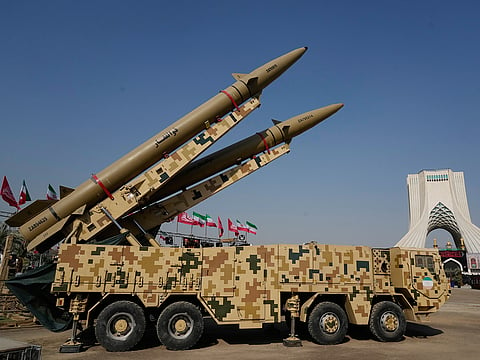
Dubai: Iran has used a secret network of more than 5,000 military-linked agencies to import billions of dollars worth of equipment, explosives and missile components despite Western sanctions and a US naval blockade, a Reuters investigation revealed on Thursday, as Tehran claimed its military readiness was stronger than during its previous wars.
One agency alone imported $2.3 billion worth of military-related goods between January 2025 and June 2026, including rocket fuel ingredients, aircraft parts, industrial machinery and hundreds of heavy-duty trucks that could be adapted for military use, according to shipping records examined by Reuters.
The findings emerged as Iranian Vice President Mohammadreza Aref declared that Tehran was managing the strategically vital Strait of Hormuz and had significantly strengthened its defensive capabilities.
“The Strait of Hormuz has become a source of fear for the enemy, and Iran manages it with ease. The Strait of Hormuz belongs to us, and the country’s strategies on this issue will become clearer,” Aref said on Thursday.
“Our defensive readiness today is much greater and stronger than during the two 12-day and 40-day wars,” he added.
His remarks came amid renewed US-Israeli preparations for possible military strikes against Iran and diplomatic efforts to prevent another escalation.
Secret network of 5,000 agencies
The Reuters investigation identified more than 5,000 agencies whose names begin with MOD, referring to Iran’s Ministry of Defence.
The entities share the Tehran address of the Ministry of Defence and Armed Forces Logistics, with some linked to the Islamic Revolutionary Guard Corps (IRGC) and powerful business conglomerates known as bonyads.
Although official records list February 11, 1979, as their founding date, most were established in 2013, when Iran was already facing severe international sanctions.
Working with Israeli-American risk consultancy 240 Analytics, Reuters examined Iranian banking records, corporate filings and approximately 19,000 import records to trace the network.
The investigation found that the agencies operated through overseas intermediaries and companies, using proceeds from oil sales that bypassed sanctions to purchase equipment for Iran’s military establishment.
Iran sanctions — when they began and what they target
1979 — US sanctions begin: Washington imposed its first sanctions following the Iranian Revolution and US embassy hostage crisis. Restrictions later expanded to banking, trade, investment and oil.
2006 — UN nuclear sanctions: The UN Security Council imposed restrictions on nuclear-related materials and technology, including equipment that could support nuclear weapons delivery systems.
2007–2010 — Arms restrictions tighten: The UN banned Iranian arms exports and subsequently restricted sales of major weapons, missiles, launchers and related equipment to Iran.
2015–2016 — Nuclear deal brings relief: Iran agreed to limits on its nuclear programme in exchange for the lifting of many international sanctions. Relief began in January 2016.
2018 — US restores sanctions: President Donald Trump withdrew Washington from the nuclear agreement and reimposed sweeping restrictions, including measures targeting Iran’s oil and financial sectors.
2025 — UN sanctions return: Britain, France and Germany triggered the snapback mechanism, restoring earlier UN restrictions on Iran’s nuclear and missile activities and arms trade in September.
2026 — War and naval blockade: The US-Israeli conflict brought additional military and maritime pressure. A US naval blockade restricted Iranian shipping, although some sanctions relief was introduced under an interim agreement.
Why it matters: Reuters found that Iran’s military-linked procurement network continued importing equipment despite years of restrictions, raising questions about how effectively sanctions can disrupt its supply chains.
In 97 per cent of the shipments reviewed, transactions were recorded as settled without currency transfers, allowing payments to be made using funds held outside Iran.
Reuters found no evidence that the numbered agencies identified in the documents had themselves been individually sanctioned by Western governments.
Missile materials and hundreds of trucks
One agency, identified as MOD 346428, imported $2.3 billion in goods during the 18 months ending June 2026, including materials potentially useful for producing missiles and drones.
The shipments included detonators, explosives, aircraft engine components, precision machinery and rocket fuel ingredients.
In February, shortly before the war began, Iran imported 93 metric tonnes of titanium from China and hundreds of tonnes of chemicals that could be used in rocket propellants and explosives, customs records showed.
The same agency imported 435 Iveco trucks between January 2025 and June 2026.
Some resembled vehicles used as disguised mobile missile launchers, Reuters reported.
Thousands of Toyota Hilux and Land Cruiser vehicles, along with Toyota Tundra trucks, were also recorded among the purchases.
Toyota said it did not conduct business in Iran and had no knowledge of the transactions described in the investigation.
Iveco said it maintained safeguards against sales to prohibited users but could not control vehicles subsequently resold by third parties.
Reuters cautioned that many imported materials and machines had both civilian and military applications, making it impossible to establish whether every shipment was intended for weapons production.
How supplies bypassed restrictions
The investigation revealed that Iran continued receiving military-related materials after the US-Israeli war began on February 28, despite attacks on its weapons production facilities.
Supplies entered the country through several routes, including cargo vessels crossing the Caspian Sea from Russia, trucks travelling through Central Asia and freight aircraft arriving from China.
Imports by the identified military agency fell by 47 per cent to $54 million in March, shortly after the conflict began, but recovered to $77 million by May.
Reuters also identified five shipments of Russian detonators worth $7.6 million since January 2025, including a $1.9 million delivery in June 2026.
The investigation found that some goods were recorded as originating in European countries, while other shipments were routed through regional trading networks.
However, Reuters said some customs records identified goods only through product codes and declared countries of origin, which could not always be independently verified.
Questions over sanctions effectiveness
The findings offer a glimpse into how Iran has maintained access to materials relevant to missile and drone production despite military strikes, economic sanctions and maritime restrictions.
The investigation does not establish the current strength of Iran’s armed forces or verify Aref’s assertion that Tehran’s defensive readiness has improved.
It does, however, document the scale of a procurement network that continued functioning during the conflict.
The revelations come as Washington considers further military action against Iran, while regional countries pursue diplomatic efforts to avert another round of strikes.
Iran’s claims about the Strait of Hormuz also underscore the importance of the waterway in the confrontation. The strait connects the Arabian Gulf to the Gulf of Oman and is a major passage for global energy shipments.
With military tensions continuing, the Reuters investigation raises fresh questions about whether sanctions and naval restrictions alone can prevent Iran from replenishing critical military supplies.


