Iran’s oil lifeline is choking — while Gulf neighbours restore flow: Kpler data
Blockade forces Iran into economic and production crisis
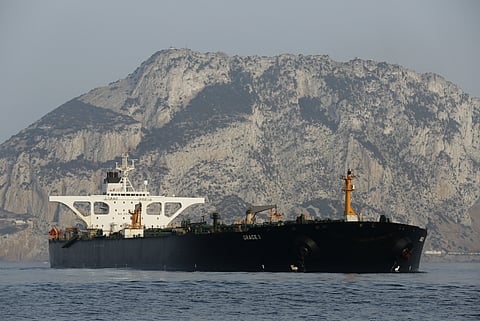
New tanker data points to a striking reversal: Iran’s exports are collapsing under the blockade even as Saudi Arabia, the UAE and other Gulf producers rebuild routes to global markets.
Iran’s oil lifeline appears to be running out of room.
New tanker-tracking data indicates that fresh Iranian crude exports have effectively ground to a halt, while oil shipments from Saudi Arabia, the UAE and other Arab producers have recovered sharply — in some recent weekly measurements exceeding pre-war levels.
The reversal is becoming one of the clearest economic consequences of the US-Iran confrontation: Tehran is losing access to the export revenue it depends on, while its Gulf rivals are adapting around the Strait of Hormuz.
Kpler data shows regional crude exports averaged about 16.5 million barrels per day in September, before jumping to roughly 19.5 million bpd in the final week — above the approximately 17 million bpd pre-war level, CNBC reported.
Get it: Fast, verified news for FREE ... download the Gulf News app — simply click here
September Average: Regional crude oil exports (primarily from Arab producers, excluding Iran) stabilised at an average of 16.5 million barrels per day (bpd) over the month. In the final week of September, the seven-day average surged to 19.5 million bpd as exporters rapidly utilised alternative pipelines, ship-to-ship transfers, and naval escorts. [Source: Kpler]
The broader September picture is more complicated.
Reuters, citing Kpler data published Sept. 28, put exports from key Middle Eastern producers at 16.328 million bpd for the month, about 3.2 million bpd below the February pre-war level of 19.513 million bpd.
The difference, however, is largely a matter of measurement period: the 19.5 million bpd figure is a seven-day average for the final week, not September's monthly average.
Pre-war benchmark: The late-September spike pushed volumes above the baseline pre-war crude export level, which sat at approximately 17 million bpd.
Iran's oil problem is becoming structural
The more consequential figure is Iran's own export collapse.
According to Kpler analyst Homayoun Falakshahi, Iranian crude loadings have effectively hit "zero", or "stopped".
Iran had accumulated roughly 67 million barrels on tankers in southern waters by mid-August, but declining access to empty vessels eventually made new loadings increasingly difficult.
Kpler had already documented the deterioration in August: Iranian crude loadings fell from 893,000 bpd in July to just 156,000 bpd through Aug. 17.
Iran International now reports that "no new Iranian crude cargo has crossed the US blockade line" toward Asian markets since mid-July.
On the other hand, TankerTrackers data indicates Iranian terminals were effectively "inactive" for crude loadings throughout September.
Iran's oil production problem
Falakshahi told the publication that the resulting production level could be around 1.8 million bpd, roughly enough to meet domestic consumption and about half Iran's pre-war output.
That is more than an export problem — it is a production problem.
When producers cannot reliably move crude into international markets, storage fills, tankers become floating warehouses and eventually wells have to be throttled back.
Kpler warned as early as August that the blockade was forcing Iran into a three-way choice: endure the economic pressure, escalate or negotiate. Its analysis said the pressure was extending beyond lost oil revenue to production shut-ins, imports, gasoline balances and government subsidies.
China cannot solve the problem by itself
Iran's traditional safety valve is China.
Asian buyers have taken roughly 1.5 million bpd of Iranian crude over the past year, according to the Iran International report. But China cannot simply absorb oil that cannot physically leave Iranian waters.
Around 15 million barrels of Iranian crude reportedly remained on the water — in Asian waters — last week, with much of that cargo already sold.
Iran may still have oil underground. It may still have buyers. But oil that cannot be loaded, transported and delivered is not generating cash flow.
And the problem extends beyond crude.
Iran had also exported roughly 500,000 bpd of petroleum products and LPG, including to the UAE, China and other Asian markets.
Those flows have reportedly been severely disrupted by the blockade.
The Gulf has learnt to live around Hormuz
This is where the strategic picture gets more damaging for Tehran.
Saudi Arabia and the UAE have spent years creating alternative ways of getting oil to market.
Saudi Arabia can use the East-West pipeline to Yanbu on the Red Sea, while the UAE can move crude through its network to Fujairah on the Gulf of Oman, bypassing Hormuz.
The result is striking: CSIS says Saudi Arabia and the UAE have been able to maintain exports during the crisis by using terminals on the Red Sea and Arabian Sea, reducing their dependence on the Strait.
Recent tanker data suggests the adaptation is working.
The Guardian, citing Kpler, reported that about 40% of regional crude is now bypassing the Strait, compared with only about 17% before the war.
It's a key development of the entire energy crisis. Hormuz is still enormously important — but its ability to stop Gulf oil from reaching world markets is no longer what it was before the war.
Reuters reported Oct. 1 that the UAE exported about 1.4 million tonnes of fuel oil in September, mainly to Southeast Asia, while imports into Fujairah recovered sharply from the second quarter.
Yet inventories and supplies remained below pre-war norms, illustrating that recovery is real but incomplete.
Saudi Arabia has also increased exports substantially. Reuters reported that Saudi crude shipments rose to about 5.4 million bpd in September, up from roughly 2.45 million bpd in August.
ISW: Iran is losing control of the leverage it wanted
The Institute for the Study of War (ISW) has identified the underlying strategic problem.
ISW assessed that Iran has sought to use control over Hormuz and disruption of global oil flows to drive up energy prices and pressure Washington into accepting Iranian demands, including recognition of Iranian control over the strait.
But ISW also noted evidence that Iran has faced difficulties consolidating control over Hormuz.
In its Sept. 23 assessment, ISW said Iran's deteriorating economy and apparent difficulty exercising control over the strait may have contributed to Tehran's renewed willingness to engage Washington. The group also said Iran's diplomatic opening did not necessarily mean Tehran was prepared to make meaningful concessions.
For Iran, that creates a dangerous paradox: The more successful the Gulf states become at moving oil without relying entirely on Hormuz, the less powerful Iran's threat to disrupt the strait becomes.
CSIS: the market has adapted — security has not
The Center for Strategic and International Studies (CSIS) reaches a similar but more nuanced conclusion.
CSIS estimates that Hormuz normally carries roughly 25% of global seaborne crude oil and about 20% of global LNG.
Yet it argues that the energy shock has been moderated by several factors: strategic-stock releases, additional US production, lower Chinese and Japanese imports, and the ability of Gulf producers to reroute some exports.
CSIS has also warned that market resilience should not be confused with restored security.
Its Sept. 18 analysis said fresh attacks on Saudi infrastructure and continued threats around the region were eroding energy security.
So while the world has learned to move more oil around the problem, though it has not solved the problem.
The hidden weakness: refined fuels
There is another warning buried beneath the impressive crude-export numbers.
Refined-product exports remain dramatically weaker.
Iran International's Kpler-based figures put regional oil-product exports at about 3 million bpd in the final week of September, less than half the pre-war level.
The Guardian, also citing Kpler, reported that only about 677,000 bpd of refined products were moving through Hormuz, compared with roughly 3.6 million bpd before the war.
That explains why crude exports can approach normal levels while diesel, jet fuel and other refined products remain under pressure.
What it shows: The market can reroute crude more easily than it can rebuild the entire refining and distribution system.
The result is a peculiar energy landscape. Crude supply is recovering. Fuel security is not.
China's latest decision underscores the problem. Reuters reported Oct. 1 that Chinese refiners were suspending most October fuel exports to protect domestic inventories, which remain below pre-war levels.
Iran faces an increasingly uncomfortable choice
The numbers point to an asymmetry. Iran entered the war with roughly 2 million bpd of crude and oil-product exports, as per Kpler. Those exports have now virtually disappeared from the international market.
Saudi Arabia, the UAE and other producers, meanwhile, are finding ways to replace much of the lost regional volume. This does not mean Iran has been economically defeated, nor does it mean Hormuz has become irrelevant.
Iran still possesses enormous geographic leverage. It can threaten shipping, attack infrastructure and raise the perceived risk of transit.
ISW has noted that Iranian claims of attacks against vessels may themselves be intended to increase shipping companies' risk perceptions, even where independent maritime reporting does not confirm the claimed attacks.
But there is a fundamental difference between being able to disrupt oil markets and being able to control them. That may be key strategic lesson of the seven-month conflict.
Bargaining power shifts
CSIS has described the conflict as a contest of political endurance and bargaining leverage, with Iran attempting to disrupt global energy flows while the United States seeks to prevent Iran from using Hormuz as an economic weapon.
The latest oil data suggests that contest is entering a new phase: Iran's leverage depends heavily on its ability to make the outside world pay a sufficiently high price for isolating it.
But Gulf producers are increasingly demonstrating that they can reroute, substitute and adapt.
And every additional month of adaptation potentially reduces the value of Hormuz as Iran's strongest economic weapon.
That creates the real pressure point for Tehran: If Iran cannot export its oil, while Saudi Arabia and the Arab Gulf countries can increasingly export theirs, then the Strait of Hormuz stops functioning as a uniquely Iranian bargaining chip.
It starts becoming a shared regional vulnerability. CSIS has argued that the Hormuz issue ultimately needs a regional security arrangement rather than an arrangement dominated by any single power.
For now, however, the oil flows tell a dire story. Iran is increasingly trapped behind the chokepoint it sought to control — while its neighbours are learning how to go around it.


