Iran’s quiet power shift: Is the security establishment tightening its grip as US pressure mounts?
Security council reshuffle raises questions over the balance of power in wartime Tehran
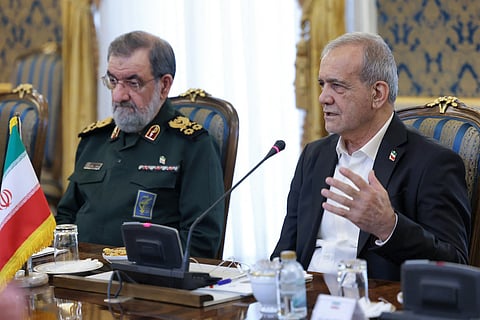
Dubai: As Iran struggles under the weight of a US naval blockade, tightening sanctions and the threat of renewed military confrontation, a series of appointments is raising questions about the balance of power within its leadership.
A sweeping reshuffle of Iran’s Supreme National Security Council (SNSC) secretariat has brought several conservative politicians and former government officials into key positions, highlighting the expanding role of the security establishment in areas traditionally managed by the civilian administration.
The appointments by Mohsen Rezaei, a former commander of the Islamic Revolutionary Guard Corps (IRGC) and secretary of the council, extend well beyond conventional defence and security matters.
They encompass economic resilience, energy, infrastructure, food security and social affairs — areas central to Iran’s ability to withstand mounting American pressure.
Is Tehran simply reorganising its administration to cope with wartime challenges, or is the balance of power within the Islamic Republic beginning to shift?
Return of the conservatives
Iranian news website Didban Iran reported that several officials from the administration of late President Ebrahim Raisi had been brought into the security council’s secretariat.
Former parliamentarian Mohsen Dehnavi has been appointed deputy for the resistance economy, a policy framework intended to reduce Iran’s vulnerability to external economic pressure.
Former energy minister Ali-Akbar Mehrabian will advise Rezaei on energy affairs, while Mehdi Dousti, a former governor of Hormozgan province, takes responsibility for infrastructure.
Alireza Peyman-Pak, who previously held senior government trade positions, has been appointed to oversee food security.
Persian-language broadcaster Radio Zamaneh reported that the appointees included figures with extensive connections to Iran’s conservative political establishment.
However, not all are outsiders to the current administration. Dousti also served in Pezeshkian’s Interior Ministry, suggesting that the reshuffle could also be aimed at strengthening coordination between civilian and security institutions.
Why the economy is now a security concern
The appointments come as Iran’s economic difficulties increasingly threaten its ability to sustain a prolonged confrontation with Washington.
The naval blockade has severely restricted oil exports, depriving Tehran of a vital source of revenue, while damage to energy infrastructure has compounded domestic shortages.
Iran began imposing rolling power cuts last Sunday as authorities struggled to meet electricity demand ahead of winter.
Pezeshkian himself has appealed to Iranians to conserve energy, appearing in a dimly lit presidential office during a televised interview, Al Jazeera reported.
Against this backdrop, maintaining essential supplies, protecting infrastructure and keeping trade routes open have become strategic priorities rather than purely economic concerns.
The rise of Rezaei
Rezaei’s growing prominence is among the political developments that have emerged since the war began in February.
A veteran of the Iran-Iraq war, he commanded the Revolutionary Guards from 1981 to 1997 and subsequently held several senior political positions, including serving as economic vice-president under Raisi.
On August 9, Supreme Leader Mojtaba Khamenei appointed Rezaei as his representative on the SNSC. Pezeshkian subsequently named him secretary of the council, according to Tasnim news agency.
The dual appointment places Rezaei at the intersection of Iran’s military, political and economic decision-making structures.
His appointment decree, published by Tasnim, emphasised coordination between state institutions and addressing emerging national security challenges.
Is Pezeshkian being sidelined?
Although the president chairs the security council, its decisions require the supreme leader’s approval.
The latest reshuffle does not formally diminish Pezeshkian’s constitutional authority. Nor is there public evidence that the president opposed the appointments.
However, the addition of experienced economic and administrative officials to Rezaei’s team raises questions about where key policy decisions will increasingly be made.
Unlike cabinet ministers, who require parliamentary approval, officials appointed to the security council’s secretariat do not undergo the same confirmation process, even when their portfolios overlap with ministerial responsibilities.
The growing prominence of Rezaei and the security establishment has also attracted attention outside Iran, including in an analysis by Iran specialist Raz Zimmt published by Israel’s Institute for National Security Studies (INSS).
Signs of political friction
Pezeshkian’s energy-saving gesture has itself become a political flashpoint, drawing criticism from conservatives who argue that it projects weakness at a time of national crisis.
Tabnak, a news website associated with Rezaei, questioned whether images of the president working in darkness sent the right message to Iranians and the outside world. It argued that a country resisting foreign pressure should demonstrate effective governance and strength.
Government spokeswoman Fatemeh Mohajerani defended Pezeshkian’s actions as a demonstration of courage and honesty, saying they underscored the need for energy conservation during difficult times.
US Treasury Secretary Scott Bessent also seized on the controversy, posting a mocking message on X: “Good job, guys. Have a wonderful winter.”
While the episode does not establish a direct rift between Rezaei and Pezeshkian, it highlights contrasting approaches within Iran’s political establishment to managing the crisis and projecting national strength.
What could this mean for Washington?
Rezaei’s growing influence could also have implications for efforts to end the confrontation with the United States.
His military background, access to the supreme leader and connections across Iran’s political institutions could make him an important figure in building an internal consensus over any potential settlement.
For Washington, understanding where effective decision-making authority lies in Tehran could become increasingly important as economic pressure intensifies.
For now, the reshuffle may reflect the immediate demands of a country under sustained economic and military pressure.
But the bigger question is whether the expanding role of Iran’s security establishment will remain a wartime necessity or become a lasting feature of the Islamic Republic’s political order.


