Iran ex-presidents call for ‘dignified end to war' as fatigue grows: What happened next
Their remarks trigger sharp backlash, condemnation from hardliners and loyalist rallies
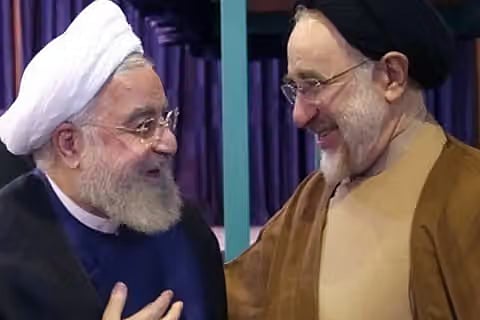
Former Iranian presidents Mohammad Khatami and Hassan Rouhani have broken with the government’s hardline wartime rhetoric, calling for an end to the conflict with the United States through what they describe as an “honourable” or dignified peace.
More significantly, Rouhani has argued that Iranian public opinion should be taken into account in deciding whether the country should continue fighting, putting the question of the war’s future into an unusually sensitive political debate.
At a recent meeting with former officials, Rouhani questioned whether Iran should continue confronting major powers "indefinitely" if the public does not support that course.
Get it: Fast, verified news for FREE ... download the Gulf News app — simply click here
Khatami, Rouhani push diplomacy over 'endless war'
Khatami, 82, warned that Iran cannot be governed indefinitely on “raw emotion” or under wartime conditions.
Iran International, based in London, has cited Khatami as arguing that national policy must serve long-term interests rather than react purely out of vengeance for commanders killed in the conflict.
Khatami, who served as president of Iran (1997–2005) and emboldened reformists who sought to moderate the country's policies on social issues and foreign affairs, has argued for compromise and negotiation to protect Iran’s interests and future, describing an “honourable peace” as an alternative to either surrender or continued war.
Alongside Rouhani, he has urged “measured diplomacy” with Washington and Israel, framing a negotiated settlement as essential to rebuilding the country and restoring hope for the future.
Rouhani: People should be consulted about the war
Rouhani has gone further, suggesting that the question of continuing the war should be put to the people.
“If the people say they accept this, very well, let us continue. But if the people do not accept it and show us another way, do we not want to accept it?” he said at a recent gathering of former officials, according to reports.
Calls for ‘dignified end’
The language used by both men — a “dignified” or “honourable” end to hostilities — has been interpreted by hardliners as a challenge to Tehran’s wartime position.
Hardliner outlets denounced them as tantamount to surrender.
The remarks have triggered a sharp backlash from conservative media and loyalist rallies, where chants such as “Broken be the tongue that speaks of compromise” targeted Rouhani.
The editor of the hardline daily Kayhan called for judicial and security investigations into both former presidents.
Economic squeeze and Hormuz brinkmanship
Reports of an internal debate within Iran unfolds as US efforts to choke off Iranian oil exports cut state revenues.
Petrol prices inside Iran doubled for drivers buying fuel outside their monthly subsidised quota in early September.
Regional sources cited by Reuters say it remains unclear whether this pressure will force concessions, noting that Tehran’s attempts to disrupt shipping in the Strait of Hormuz, and Bab al Mandab have not produced the global shock it hoped would compel Washington to compromise.
Hardened posture
At the same time, Iranian officials have hardened their public posture. In August, a senior Iranian official told Reuters that Tehran would shift to a “fully offensive” military posture if diplomacy with the US failed, warning of escalation in the Strait of Hormuz and beyond if an interim deal was not honored within weeks.
Other reporting described the conflict as drifting onto “autopilot,” with both sides sending mixed signals and the window for peace talks expiring without a breakthrough.
Escalation risk vs concession
Analysts flag that the combination of tightening economic pressure and increasingly offensive rhetoric raises the risk of escalation rather than negotiated reopening.
A September BBC round-table of experts noted there is not yet a sense on the Iranian side that the economic squeeze will alter calculations soon, implying pressure could entrench resistance.
CNN reported in late August that while Iran is losing leverage in Hormuz as flows recover, rising economic pressure could still trigger escalation attempts.
Specialised scenario modeling on US–Iran brinkmanship has revised probabilities toward an escalation-dominant outcome — where negotiations collapse, mining or attacks resume, transits crash and oil prices spike — citing Iran’s stated offensive posture alongside a tightening blockade as conditions for faster escalation.
Drive for de-escalation
On Sept. 9, 2026, Saudi Arabia’s Foreign Ministry said that Foreign Minister Prince Faisal bin Farhan received a phone call from Iranian Foreign Minister Abbas Araghchi to discuss regional developments and efforts to promote regional stability.
The report stated that the two ministers discussed escalating tensions and insecurity and the need for diplomatic cooperation to prevent further regional escalation.
The Saudi FM reaffirmed Riyadh’s commitment to promoting regional security and stability, while the Iranian account described continued diplomatic engagement to prevent tensions from spreading.
Renewed Saudi-Iranian diplomatic contact offers a significant sign of de-escalation efforts, though it doesn’t mean hardliners within Iran agree with it.
Riyadh has repeatedly sought to maintain dialogue with Iran and prevent regional conflicts from spilling into the kingdom.
Riyadh and Tehran restored diplomatic relations in 2023 after years of rivalry.
Signals to watch: diplomacy vs military action?
Khatami and Rouhani’s calls for public consultation and an “honorable peace” represent one branch of a broader two-track dynamic.
On one hand, there's softer language, back-channel diplomacy via intermediaries, and elite concern over revenue shortfalls could signal that the squeeze is approaching a tipping point toward concessions.
On the other hand, public threats uttered to go “fully offensive,” new restrictions or mining around Hormuz, and expanded regional pressure despite deteriorating economics point to a more dangerous scenario of “resistance”, an overarching language of the Tehran regime, and escalation.
For now, the public record shows both trends in play: former presidents urging diplomacy and public input, even as active officials warn of offensive action if Washington does not meet Tehran’s demands, leaving the trajectory of the conflict uncertain.