Iran protests: Who are Revolutionary Guards behind the repression?
Elite force accused of directing crackdown as Iran faces its most serious unrest in years
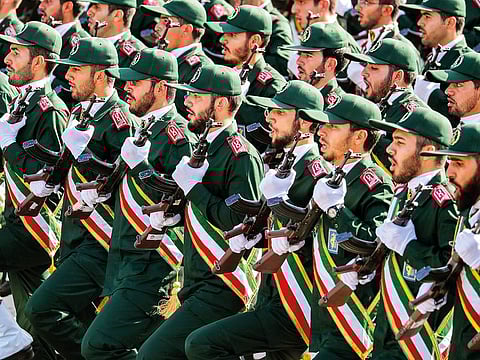
Dubai: With protesters — many of them young — reportedly being shot at close range and the death toll continuing to rise, attention is focusing on the force accused of steering Iran’s repression even as US President Donald Trump threatens action against Tehran.
That force is Iran’s Islamic Revolutionary Guard Corps (IRGC), the powerful military and ideological backbone of the Islamic Republic, which Western governments and rights groups say is orchestrating the crackdown on the country’s most serious unrest in years.
The US-based Human Rights Activists News Agency said the number of dead climbed to at least 2,571 early Wednesday. The figure dwarfs the death toll from any other round of protest or unrest in Iran in decades and recalls the chaos surrounding the country's 1979 Islamic Revolution.
What is the IRGC?
The IRGC, known in Persian as the Pasdaran, was founded in 1979 following Iran’s Islamic Revolution. It was created by revolutionary leader Ayatollah Ruhollah Khomeini to protect the ideals of the new Islamic system and safeguard the regime from internal and external threats.
5 THINGS TO KNOW
Who they are: Iran’s Islamic Revolutionary Guard Corps (IRGC) was formed in 1979 to protect the Islamic Revolution and answers directly to supreme leader Ayatollah Ali Khamenei.
Why they matter now: The Guards are accused by rights groups and Western governments of steering the crackdown on Iran’s most serious protests in years.
More powerful than the army: The IRGC is better funded, trained and equipped than Iran’s regular military and operates land, naval and aerospace forces.
An economic empire: The Guards control or influence vast swathes of Iran’s economy, including energy, infrastructure, telecoms and finance, giving them enormous political leverage.
Global pressure growing: The US and Canada designated the IRGC a terrorist organisation in 2019 and 2024, respectively, , Australia followed in 2025, and European states are under pressure to take similar action.
Unlike Iran’s regular army, the Guards answer directly to the supreme leader — currently Ayatollah Ali Khamenei — and are designed as an ideological force as much as a military one.
Analysts estimate the IRGC’s strength at 150,000 to 200,000 personnel, operating as an elite force with land, naval and aerospace capabilities.
“They are an army in the service of an ideology,” one researcher told AFP.
More powerful than the regular military
Western diplomats and analysts say the IRGC is better trained, better equipped and better paid than Iran’s conventional armed forces. It also serves as Tehran’s main link to allied armed groups across the region, including Hezbollah in Lebanon and pro-Iran militias in Iraq and Syria.
Last year, Khamenei appointed Mohammad Pakpour, a veteran of the Iran–Iraq war, as head of the Guards, replacing Hossein Salami, who was killed on the first day of Iran’s recent war with Israel.
An economic empire
Beyond its military role, the IRGC wields vast economic power. Analysts describe it as an “empire within an empire”, controlling or owning companies across key sectors of the Iranian economy.
These include energy, infrastructure, telecommunications, technology and finance, giving the Guards enormous leverage over both state resources and private enterprise. Their annual budget is estimated at $6–9 billion, roughly 40 per cent of Iran’s official military spending, according to figures cited by AFP.
Critics say this economic reach has entrenched the Guards as a dominant political force with a direct stake in preserving the status quo.
How the Guards enforce control
The IRGC operates a sprawling intelligence network that analysts describe as the most effective within Iran’s security apparatus. In past uprisings, it has demonstrated the ability to rapidly dismantle protest networks, identify organisers and disrupt coordination.
On the streets, enforcement often relies on the Basij, a paramilitary force recruited largely from young Iranians and embedded across institutions, universities and neighbourhoods. Estimates put Basij membership at 600,000 to 900,000, according to data from multiple Western think tanks cited by AFP.
Role in the current crackdown
Experts say the Guards are playing a central role in repressing the current protests, which began as demonstrations over economic hardship and have evolved into a broader anti-government movement.
While local police and Basij units initially handled crowd control, analysts believe the IRGC has been directing the response from the outset and has since deployed ground forces and special units as unrest spread.
Some Guards members are reportedly operating in civilian clothing, a tactic observers say is intended to obscure responsibility for alleged human rights abuses.
Terrorist designation
The United States designated the IRGC a terrorist organisation in 2019, and Canada in 2024, citing its role in regional militancy and internal repression. Australia followed in November, accusing the Guards of links to arson attacks on Jewish targets in 2024.
In Europe, calls are growing to formally blacklist the IRGC. A diplomatic source told AFP that Germany in particular supports designating the Guards’ overseas Quds Force, which Berlin has linked to a 2021 attack on a synagogue.
Why it matters
As protests defy repression and international pressure mounts, analysts say the Guards have become the regime’s last line of defence. Their response — uncompromising and force-driven — underscores how central they are to the Islamic Republic’s survival.
For many Iranians, the question is no longer whether the Guards are behind the crackdown — but how far they are prepared to go to stop the protests.


