Iran intensifies ‘reprehensible aggression’, hits Gulf energy sites; Riyadh warns Tehran will be biggest loser
Qatar calls attacks a 'sense of betrayal' as Gulf states stress they are not part of war
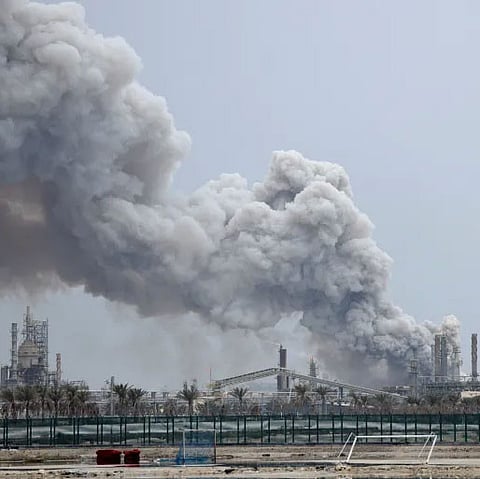
Dubai: Iranian missiles and drones continued to target Gulf countries on Monday, hitting energy facilities and prompting Bahrain’s state oil company to declare force majeure after a strike on its refinery complex.
Bahrain’s state-owned energy firm Bapco said its operations had been affected by the ongoing regional conflict following an Iranian attack on its refinery, forcing the company to activate the legal clause used when events beyond a company’s control disrupt production or exports.
“Bapco hereby serves notice of force majeure on its group operations which have been affected by the ongoing regional conflict in the Middle East and the recent attack on its refinery complex,” the company said in a statement.
Meanwhile, Saudi Arabia has condemned what it describes as Iran’s sustained campaign of aggression against the Kingdom, fellow GCC and other nations, cautioning that continued escalation would ultimately devastate Iran itself.
Saudi Arabia’s Ministry of Foreign Affairs said that if Iran presses ahead with its attacks, it would bear the heaviest diplomatic, economic and strategic consequences, and be “the biggest loser.”
What is force majeure?
Force majeure is a legal clause used when extraordinary events beyond a company’s control disrupt operations.
It allows companies to suspend contractual obligations, such as delivering oil or gas.
Events triggering force majeure can include war, natural disasters, attacks or government actions.
In this case, Bahrain’s Bapco declared force majeure after Iranian strikes hit its refinery.
The move signals that energy exports or shipments may be delayed due to the conflict.
The strikes come as Iran intensifies its retaliation against Gulf countries hosting United States military assets following US and Israeli attacks on Iranian targets since February 28.
Authorities across the Gulf have scrambled to intercept waves of missiles and drones targeting energy installations, military facilities and residential areas.
In Bahrain, at least 32 people were injured, including children, after an Iranian drone attack struck the island of Sitra, south of the capital Manama, according to the health ministry.
Stay updated: Get the latest faster by downloading the Gulf News app - it's completely free. Click here for Apple or here for Android. You can also find it on the Huawei AppGallery.
Iran’s strikes across the Gulf
Bahrain: Drone strike hits Al Ma’ameer refinery, forcing Bapco to declare force majeure.
Saudi Arabia: Air defences intercept two waves of drones heading for Shaybah oilfield.
Qatar: Missile attack intercepted; explosions heard in Doha overnight.
Kuwait: Authorities report fresh missile and drone attacks targeting the country.
Casualties: At least 21 people killed in Gulf states since Iran began its retaliation campaign.
Officials said the strike caused injuries ranging from minor wounds to serious cases, including a 17-year-old girl with severe head and eye injuries and a two-month-old baby.
Bahraini authorities also confirmed that Iran struck the Al Ma’ameer oil facility, causing a fire at the complex. The blaze was later brought under control.
Elsewhere in the region, Saudi Arabia said its air defences intercepted two waves of drones heading towards the Shaybah oilfield in the kingdom’s southeast.
In Qatar, authorities reported intercepting a missile attack as explosions were heard in the capital Doha early Monday.
Al Jazeera correspondent Mohammed Jamjoom, reporting from Doha, said alerts sounded shortly after 3:15am local time, followed by multiple explosions from interceptor missiles.
“A few minutes after that we started hearing the sound of explosions due to interceptor missiles countering those coming in from Iran,” he said, adding that about 12 to 13 explosions were heard.
Kuwait also reported new missile and drone attacks on Monday after earlier strikes over the weekend.
The defence ministry said air defences were working to intercept the incoming threats.
The attacks have disrupted energy markets and transport across the region.
Several Gulf countries have shut their airspace while oil production and supply chains have come under pressure as energy infrastructure becomes a target.
Financial market reaction
Energy producers in Qatar and Kuwait have also declared force majeure in recent days, warning that the conflict could affect export commitments.
Financial markets reacted sharply to the escalating tensions, with oil prices surging to their highest levels since the Russian invasion of Ukraine in 2022, while Asian stock markets fell amid fears of wider disruption to global energy supplies.
The conflict has already taken a deadly toll across the Gulf.
At least 21 people have been killed since Iran began its attacks, including 10 civilians and seven US service members, according to regional officials.
Saudi Arabia condemned the strikes, calling them “reprehensible Iranian aggressions” against the kingdom and other Gulf states.
In a statement, the Saudi foreign ministry said the attacks on the kingdom, Gulf Cooperation Council countries and other regional partners “cannot be accepted or justified under any circumstances”.
The ministry stated that the attacks were “unacceptable under any circumstances,” and reaffirmed the Kingdom’s right to take measures to protect its people, territory, and sovereignty.
Riyadh condemned Iran’s attacks on civilian airports and oil infrastructure, calling them a violation of international law and a deliberate attempt to destabilize the region.
'Flimsy pretexts'
“The targeting of civilian airports and oil facilities is nothing but a demonstration of determination to threaten security and stability and a flagrant violation of international covenants and international law,” the statement said.
The ministry also pushed back against recent remarks by Iran’s President Masoud Pezeshkian, who had publicly stated that Tehran had no intention of attacking neighbouring countries.
The ministry rejected that assurance as hollow, arguing that Iran’s strikes had continued unabated both during and after the speech, driven by what Riyadh called “flimsy pretexts.”
Saudi Arabia rejected Iran’s allegation that the Kingdom had allowed fighter jets and refueling aircraft to launch from Saudi territory to participate in hostilities against Iran.
“The reality is that those aircraft are conducting air patrols to monitor and protect the airspace of the Kingdom and the GCC states from Iranian missiles and drones,” the ministry stated.
Meanwhile, Qatar’s Prime Minister Sheikh Mohammed bin Abdulrahman bin Jassim Al Thani urged all sides to seek de-escalation.
“We will continue talking to the Iranians, we will continue trying to seek de-escalation,” he said in an interview with Sky News.
He described the attacks on Qatar as a “big sense of betrayal”, noting that Gulf states had repeatedly said they did not intend to take part in the war.
The Gulf has borne much of Tehran’s retaliation after the United States and Israel launched a major aerial campaign against Iran in late February, dramatically widening the regional conflict.


