Inside Iran’s missile playbook: Arsenal, range and strategy
A breakdown of Iran’s ballistic, cruise and drone capabilities amid escalating strikes
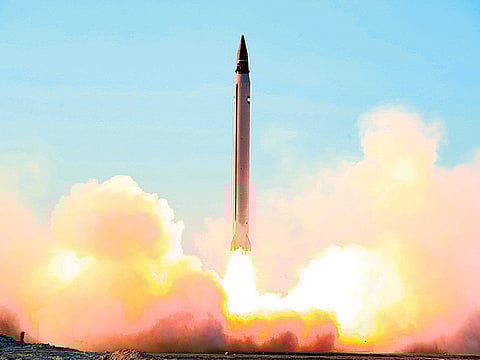
Dubai: As US and Israeli strikes intensify, Iran’s missile force — widely assessed as the Middle East’s largest ballistic missile inventory — has moved to the centre of the conflict, shaping both retaliation and escalation risks.
Defence analysts describe it as one of the region’s most varied arsenals, spanning ballistic and cruise missiles as well as drones, and forming the backbone of Tehran’s deterrence strategy.Here is a comprehensive look at Iran’s capabilities.
Stay updated: Get the latest faster by downloading the Gulf News app - it's completely free. Click here for Apple or here for Android. You can also find it on the Huawei AppGallery.
What are ballistic missiles?
A ballistic missile is a rocket-propelled weapon that is guided during its initial ascent but then follows a free-fall trajectory for most of its flight. It can carry conventional explosives and, potentially, biological, chemical or nuclear warheads. Western governments view Iran’s arsenal both as a conventional military threat and as a possible future nuclear delivery mechanism — an allegation Tehran denies.
How far can Iran’s missiles reach?
Iran has imposed a declared range limit of 2,000km (1,240 miles), which officials say is sufficient for deterrence because it places Israel and US-linked bases across the Gulf within reach. Some systems are assessed to approach 2,500km.
Crucially, despite claims from some US political figures, these missiles cannot reach the continental United States.
According to the US Office of the Director of National Intelligence and independent think tanks, Iran possesses:
Short-Range Ballistic Missiles (SRBM)
Shahab-1
Estimated range: 300km
Based on Scud-B design
Shahab-2
Estimated range: 500km
Based on Scud-C design
Zolfaghar
Estimated range: 700km
Solid fuel
Improved accuracy over earlier Shahab systems
Qiam-1
Estimated range: 700–800km
Liquid fuel
Finless design for better manoeuvrability
Medium-Range Ballistic Missiles (MRBM)
Shahab-3
Estimated range: 800–1,300km
Later variants stretch toward upper end
Emad
Estimated range: 1,700km
Improved guidance over Shahab-3
Ghadr-1
Estimated range: 1,600–2,000km
Extended-range Shahab derivative
Khorramshahr
Estimated range: 2,000km
Larger payload capacity
Some variants reportedly tested beyond that
Sejjil
Estimated range: 2,000–2,500km
Solid fuel
Faster launch prep than liquid systems
Kheibar Shekan
Estimated range: 1,450km
Solid fuel
Unveiled 2022
Haj Qassem
Estimated range: 1,400km
Solid fuel
Named after Qassem Soleimani
Cruise Missiles
Soumar
Estimated range: 2,000–2,500km
Believed derived from Kh-55 technology
Ya-Ali
Estimated range: 700km
Quds variants
Estimated range: 700–1,000km (varies by model)
Hoveyzeh
Estimated range: 1,350km
Paveh
Estimated range: 1,650km
Ra’ad
Estimated range: 350km (anti-ship variant shorter)
Kh-55 (Russian origin design)
Range: Up to 3,000km
Air-launched cruise missile
Nuclear-capable design origin; Iran is believed to have reverse-engineered elements of the system.
Editorial note: Ranges are estimated from open-source defence assessments and may differ by variant, source or testing status.
Cruise missiles
Cruise missiles fly low and can hug terrain, making detection more difficult — especially when launched alongside drones.
Iran also relies heavily on one-way attack drones. Slower but cheaper, they can be deployed in waves to saturate air defences and keep airports, ports and energy infrastructure under prolonged pressure.
Drones: The saturation layer
Iran has developed a large fleet of unmanned aerial vehicles (UAVs), commonly known as drones, including one-way attack drones such as the Shahed series, designed to loiter before striking targets. Slower and cheaper than ballistic missiles, drones can be launched in waves to overwhelm air defences or accompany missile salvos.
Drones are now being used extensively in the current conflict, often alongside ballistic and cruise missiles, as part of coordinated barrages aimed at stretching regional air-defence systems. Analysts say this layered approach — combining ballistic missiles, cruise missiles and drones — complicates interception efforts by forcing air defences to track threats at multiple speeds and altitudes simultaneously.
Underground 'missile cities'
Iran has invested heavily in survivability.
There are at least five known underground “missile cities” in provinces including Kermanshah and Semnan, as well as near the Gulf region. These facilities include storage depots, concealed launch systems and transport tunnels.
Iran first announced in 2020 that it had launched a ballistic missile from underground — demonstrating an ability to fire even after absorbing initial strikes.
For military planners, this hardened infrastructure means degrading Iran’s missile capability could require sustained operations rather than a single decisive blow.
Hypersonic claims
In 2023, Iran unveiled what it described as its first domestically produced hypersonic ballistic missile, the Fattah series. Hypersonic systems travel at least five times the speed of sound and can manoeuvre unpredictably.
However, independent verification of full operational capability remains limited.
When has Iran used its missiles?
Recent use underscores that the arsenal is not theoretical:
2026 escalation: As US and Israeli strikes intensify, Iran has launched ballistic missiles and drones across Israel and at US-linked facilities in the region, widening the conflict and testing regional air defences.
June 2025 (12-day war with Israel): Iran fired ballistic missiles into Israel, killing dozens and damaging buildings. Analysts at the Institute for the Study of War said Israel likely destroyed roughly one-third, though Tehran says it recovered.
Strike on Al Udeid air base (Qatar): In response to US participation in Israeli operations, Iran fired missiles at the base after advance warning; no casualties were reported.
January 2024: Missile strikes targeting alleged Israeli intelligence facilities in Iraq’s Kurdistan region and Daesh (Islamic State militants) in Syria.
2019 Saudi oil facility attack: The US and Saudi Arabia blamed Iran for drone and missile strikes; Tehran denied involvement.
2020 Iraq strike: Missiles fired at US-led forces after Soleimani’s killing.
Strait of Hormuz: Strategic leverage
Iran’s missile doctrine extends to maritime disruption.
Through anti-ship missiles, drones, naval mines and fast-attack craft, Tehran can threaten shipping in the Strait of Hormuz — a chokepoint for global oil and gas trade. Even without a formal blockade, warnings to tankers and war-risk insurance spikes can rattle global markets.
Strategic logic: Deterrence and escalation
Iran argues its missile force compensates for an ageing air force and provides deterrence against the US and Israel. Western analysts say the programme fuels instability and increases escalation risks.
The key strategic questions are:
How many launchers survive sustained strikes?
How effectively can Iran combine ballistic, cruise and drone waves?
How long can exchanges be sustained?
The current conflict, which has spread beyond Iran’s borders into the Gulf and parts of the Levant, underscores how Tehran’s missile capabilities have shifted from deterrence to active battlefield use — shaping both military dynamics and regional security.


