How kamikaze boats broke the back of Iran's 'swarm' tactics in Hormuz: What happens next
Unmanned sea drones surge into fight — turning the tide against Iran’s fast-attack swarms
For decades, the Iranian regime built a strategy around one narrow stretch of water — the Strait of Hormuz, just 33km (21 miles) wide at its narrowest point, yet carrying nearly a fifth of the world’s oil every day.
It was designed as a trap, a way to inflict pain, extort or destabilise the world.
Mines seeded beneath the surface. Swarms of fast-attack boats ready to harass and overwhelm. Missile systems hidden deep within mountain bunkers, aimed at anything that moved.
An "asymmetric" war doctrine refined over 40 years — built on the assumption that no adversary could fully neutralise it.


'Leveraging' the Hormuz Strait
The Islamic Revolutionary Guard Corps (IRGC) believed they had sealed Hormuz — not permanently, but decisively enough to make any attempt to reopen it too costly, too chaotic, too slow.
What followed wasn’t a blunt show of force, but a calculated unraveling — targeting not just the weapons, but the system holding them together.
In a matter of days, the very architecture meant to choke global shipping began to crumble. And at the centre of it was a capability few outside military circles had paid much attention to.
Here's how the US kamikaze boats rewrote the rules of one of the most strategically vital waterways on Earth:
What did the US actually do to “unlock” Hormuz?
The United States didn’t just clear mines or sink boats — it dismantled Iran’s layered “chokehold” strategy on the Strait through a coordinated mix of autonomous drones, precision bunker‑buster bombs, and low‑altitude airpower.
By March 2026, the IRGC had effectively shut the strait using three main tools:
Limpet mines on the seafloor (Maham‑3 and Maham‑7 variants).
Swarms of fast‑attack boats encircling tankers.
Deep‑buried anti‑ship missile sites (Noor, Qader, and Abu Mahdi) hidden in mountains along the northern coast.
Merchant ships continue to trickle through the strait as the IRGC, the sectarian branch of Iran’s military, sets up a "tolled" passageway in another attempt to control the vital waterway.
Washington’s response was a "layered" counter‑strike. This firepower is set to go alongside a multinational force to restore shipping confidence.
How did the GARC drones break Iran’s trap?
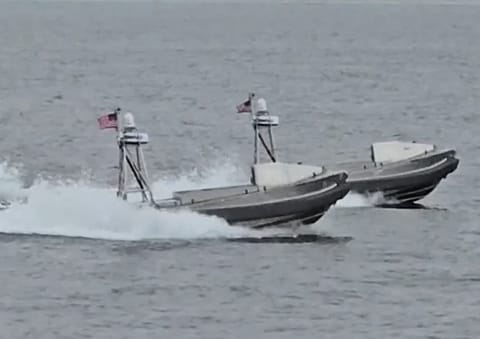
The GARC (Global Autonomous Reconnaissance Craft) is a 5‑metre, fully autonomous speedboat built by Black Sea Technologies (Maryland, USA).
It carries no crew, no remote pilot, and can patrol for hundreds of hours—reportedly over 450 hours and more than 2,200 nautical miles in the Hormuz zone alone.
GARC’s role was three‑fold:
Surveillance and early warning: Detecting IRGC boats, drones, and suspicious activity far ahead of commercial ships.
Force multiplier: Acting as a cheap, replaceable “swarm” to monitor multiple lanes simultaneously.
Potential kamikaze strike platform: When needed, the US can program GARCs to ram or detonate near Iranian vessels, turning surveillance into offense without risking pilots or sailors.
For years, Iran expected a human‑crewed naval showdown. Instead, it was confronted by a fleet of low‑cost robotic “ghost boats” that stayed on station almost continuously.
Why were the GBU‑72 “bunker‑buster” bombs so decisive?
Iran’s underground missile sites near Hormuz were built to withstand conventional airstrikes, with decades‑old tunnels and hardened concrete silos.
The GBU‑72 Advanced 5K Penetrator — a 5,000‑pound bomb — changed the calculus. This is a GPS‑ and inertial‑guided "bunker‑buster" with strike accuracy within metres, even through bad weather or smoke.
It has a thick steel casing that penetrates over 60 meters of soil or 20 meters of concrete before detonating inside, collapsing the structure from within.
The first real‑world combat use was over Iranian coastal missile sites on March 17, 2026.
US Central Command (CentCom) later claimed that these strikes reduced Iran’s missile stockpile along the Hormuz corridor by about 90%, effectively destroying the long‑range “insurance” Iran had built into its choke‑point strategy.
How did the A‑10s and Apaches dismantle the swarm‑boat threat?
With missile caves crippled, the US turned to the skies to dismantle the IRGC’s fast‑attack‑boat swarms:
A‑10 Thunderbolt II (“Warthog”): Equipped with the 30mm GAU‑8 Avenger cannon, it can fire 3,900 rounds per minute, enough to shred small boats in seconds. Flying low and slow, A‑10s kept Iranian skiffs in constant visual tracking, denying them hiding spots behind waves or islands.
AH‑64E Apache helicopters: Operating with Hellfire missiles and onboard cannons, they hunted mobile coastal batteries and small boats that tried to slip in behind the main swarm.
US CentCom reported that airstrikes have already destroyed over 140 Iranian naval vessels, including IRGC fast‑attack craft and larger ships such as the IRIS Dena.
This left Iran with a hugely degraded naval assets to actually carry out its “swarm” doctrine.
How did Iran try to weaponise the strait economically?
Even as military defeats mounted, the IRGC used the strait as a de facto toll booth:
Some tankers were allegedly charged up to $2 million to pass, while others — especially those linked to the US or Israel — were blocked outright.
The IRGC publicly declared the strait “closed,” threatening any vessel that tried to transit, which caused insurers and shipping firms to reroute or simply stop moving cargoes.
Commercial traffic through Hormuz, which ran around 138 ships per day before the crisis, fell to just a handful per day by mid‑March, sending shockwaves through global energy markets.
What did the US and allies actually commit to?
On March 19, 2026, key allies — Britain, France, Germany, Italy, the Netherlands, Japan, and Canada — issued a joint statement pledging to reopen the Strait of Hormuz for commercial shipping. A broader coalition of 22 nations signalled support, though not all committed immediate forces.
The United Kingdom emerged as the most concrete partner:
The Royal Navy is fitting support vessels such as RFA Lyme Bay with autonomous mine‑hunting drones and unmanned surface vehicles to locate and trigger mines at a safe distance.
The UK also plans to deploy the Type 45 destroyer HMS Dragon and provide air‑base support for continued US operations.
Energy Secretary Ed Miliband confirmed that next‑generation autonomous mine‑hunting systems are under active consideration for Hormuz, signaling a shift toward “drone‑led” clearance instead of risking sailors.
How has Trump’s messaging on Hormuz been mixed?
President Donald Trump has sent conflicting signals:
On one hand, he has repeatedly insisted that the US will only consider a ceasefire if the Strait of Hormuz is fully open to shipping, treating the strait’s reopening as a non‑negotiable condition.
On the other, he has simultaneously floated vague “progress” in talks and hinted at possible deals with Iran, even as Washington continues to deploy more troops and advanced weapons to the region.
Iran’s parliament speaker has accused the US of sending “messages about possible negotiations” while planning a larger military escalation, adding to the perception that Trump’s posture is both ultimatum‑driven and opportunistic.
What happens next in the Strait of Hormuz?
Three overlapping phases are likely:
#1. Military stabilisation
The US and its allies will keep pressing the GARC swarm, A‑10s, and precision bombs to degrade remaining IRGC assets and prevent new missile‑site reconstitution.
Continued pressure on Iranian fast‑attack boats reduces the ability to launch mass‑swarm attacks.
#2. Mine‑clearing and autonomy push
The UK and other partners are expected to gradually deploy autonomous mine‑hunting drones and “mothership” vessels to clear the strait without risking divers.
Progress will be slow: mine‑clearing is dangerous and methodical, and experts warn that even a single undetected limpet mine could reignite panic markets‑wide.
#3. Economic and political normalisation
As mines are cleared and escort convoys become routine, shippers will likely return — but confidence will lag behind actual security.
Trump’s demand that the strait be “open” before any ceasefire will continue to shape the timeline, even as allies push for a diplomatic off‑ramp to avoid a prolonged, high‑risk naval campaign.
Taming the swarms
Tehran’s decades‑old trap has been structurally broken by robotic drones and bunker‑buster bombs, but the Strait of Hormuz will only truly reopen when the mines are gone, the swarms are tamed, and the world’s tankers believe it’s safe again.


