Fire-hit USS Ford heads for repairs amid Iran war pressure
World’s largest aircraft carrier to leave frontline after blaze, US prepares replacement
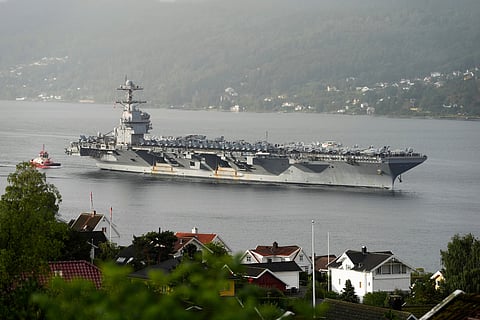
The USS Gerald R. Ford, the world’s largest aircraft carrier and a central pillar of US naval operations in the war against Iran, is expected to head for repairs after a major fire onboard.
The nuclear-powered carrier, deployed for nearly nine months and involved in more than two weeks of strikes linked to the US-Israeli campaign against Iran, suffered a blaze in its laundry facilities last week that took more than 30 hours to extinguish. Two sailors were injured, while hundreds of crew members were displaced after significant damage to sleeping quarters, according to AFP and The New York Times.
US officials say the ship is likely to sail to Crete for repairs, even as Washington prepares to deploy another carrier, the USS George H.W. Bush, to fill the operational gap. The development comes as the war in Iran enters its third week, intensifying pressure on US military assets already stretched across multiple theatres.
Here’s what we know about USS Ford and the impact on the Iran war.
What happened on the USS Gerald R. Ford?
A fire broke out in the carrier’s main laundry area last week, reportedly starting in a dryer vent and spreading rapidly.
It took sailors more than 30 hours to bring the blaze under control. Two sailors sustained “non-life-threatening injuries,” while many others reportedly suffered smoke inhalation.
The fire caused significant damage onboard. “There were about 100 beds that were significantly damaged,” a US defence official said.
Separately, officials said more than 600 sailors lost their beds and have been sleeping in temporary arrangements.
What role has the USS Ford been playing in the Iran war?
The Ford has been a key component of US naval power in the Middle East.
The carrier, along with its embarked air wing, has taken part in operations linked to the US-Israeli war against Iran, conducting sustained air operations as part of the broader military campaign.
USS Ford by the numbers
$13 billion — cost of the carrier
1,100+ feet — length of the ship
100,000 tons — displacement when fully loaded
4,000–4,500 crew — sailors and air wing onboard
650 toilets — system plagued by clogging issues
$400,000 — cost of a single acid flush for plumbing
30+ hours — time taken to extinguish the fire
600+ sailors — displaced from sleeping quarters
10 months — current deployment length
294 days — record for longest modern US carrier deployment
Why is the carrier going for repairs now?
The fire is the immediate trigger, but the deployment has already stretched the ship and its crew.
The Ford is entering its 10th month at sea and could break the post-Vietnam War record for the longest carrier deployment if it remains deployed into mid-April.
Extended deployments are known to strain both equipment and personnel. “Ships get tired too, and they get beat up over the course of long deployments,” said Rear Adm. John F. Kirby.
A planned maintenance and refit earlier this year had already been delayed.
What problems has the ship faced during deployment?
The Ford has experienced multiple operational issues:
Fire damage affecting accommodation areas
Long-standing problems with its toilet system, including frequent clogging
Reports of maintenance strain linked to prolonged deployment
A 2020 US Government Accountability Office report said the ship’s toilet system required frequent acid flushes costing $400,000 each time.
Will the US feel the pinch if the carrier is withdrawn?
In the short term, the withdrawal would create a capability gap, particularly in air operations.
Aircraft carriers are central to US power projection, carrying dozens of warplanes capable of conducting sustained strikes.
However, US officials have indicated that the USS George H.W. Bush is preparing to deploy and will likely replace the Ford.
This rotation is designed to maintain continuous carrier presence, limiting any long-term operational impact.
How important is an aircraft carrier in modern warfare?
Aircraft carriers serve as mobile airbases, allowing countries to project power without relying on host nation bases.
They are especially critical in regions like the Middle East, where rapid response and sustained air operations are required.
The Ford has been conducting flight operations around the clock, underscoring its role in active combat operations.
Where has the USS Ford been deployed?
The carrier’s extended deployment has spanned multiple regions:
Mediterranean
Caribbean (operations linked to Venezuela)
Middle East (Iran war operations)
The ship was redirected from the Caribbean to the Middle East as the conflict with Iran escalated.
How long are carrier deployments typically?
Standard US Navy carrier deployments are around six months.
However, the Ford’s deployment is approaching a year, significantly longer than usual.
The longest post-Vietnam War deployment record stands at 294 days, set by the USS Abraham Lincoln in 2020.
What does this mean for the wider war effort?
The US appears to be managing strain on its naval assets while ensuring continuity of operations.
The likely replacement of the Ford with another carrier suggests that Washington is keen to avoid any perception of reduced military presence during the conflict with Iran.
At the same time, the incident highlights the logistical and operational pressures of sustained high-intensity.
- With inputs from AFP and The New York Times


