Egypt, Pakistan, Saudi Arabia, Türkiye affirm US-Iran agreement should ensure security and stability of Gulf region
Joint statement backs Islamabad MoU as step toward de-escalation and lasting peace
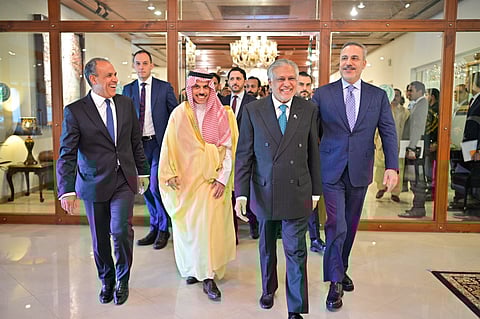
CAIRO: Egypt, Saudi Arabia, Türkiye and Pakistan, emphasised that the US-Iran agreement should take into account the csecurity and stability of countries across the region.
In a joint statement after a consultative meeting held here, Minister of Foreign Affairs, International Cooperation and Egyptian Expatriates Badr Abdelatty, Pakistani Foreign Minister Mohammad Ishaq Dar, Saudi Foreign Minister Faisal bin Farhan Al Saud and Turkish Foreign Minister Hakan Fidan, welcomed the signing of the Islamabad Memorandum of Understanding (MoU) between the US and Iran on June 18, describing it as "a constructive step towards de-escalation and towards ending a conflict which posed significant risks to regional security and stability, as well as to energy markets, international maritime routes, global supply chains, and international trade."
Building on the memorandum of understanding, the ministers emphasised the need for a swift conclusion to the next phase of negotiations to reach "a lasting, verifiable, and mutually acceptable solution" to the remaining issues.
They said the process should take into account the concerns of countries across the region, particularly regarding the security and stability of the Gulf Arab states and the Levant, with the aim of strengthening collective security and promoting long-term regional stability.
The ministers also reaffirmed that the Palestinian cause remains central to achieving lasting peace and stability in the Middle East. Discussions focused on the humanitarian and political situation in the Gaza Strip, the occupied West Bank, and East Jerusalem.
Reiterating their support for the legitimate rights of the Palestinian people, the ministers backed their right to self-determination and the establishment of an independent Palestinian state based on the June 4, 1967, borders, with East Jerusalem as its capital, in line with relevant UN Security Council resolutions.


