Pakistan doubles down on talks, says diplomacy only way to end war
Saudi Arabia, Türkiye and Egypt support Islamabad’s push for dialogue amid rising tensions
Dubai: Pakistan has reaffirmed its commitment to sustained diplomacy and dialogue as the only workable solution to the ongoing Middle East conflict, positioning itself at the centre of renewed international efforts to end the war through negotiations.
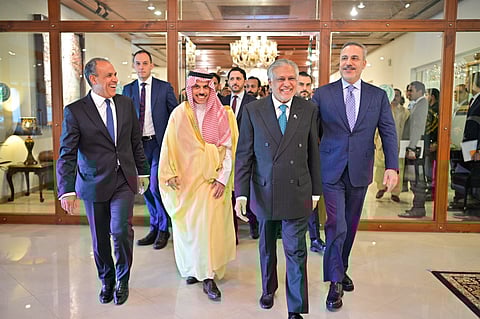
The pledge came after a high-level quadrilateral meeting on Sunday in Islamabad, where the foreign ministers of Pakistan, Saudi Arabia, Türkiye and Egypt collectively called for an immediate and permanent cessation of hostilities, warning that continued fighting would only deepen regional instability and human suffering.
In his address on the national television after the meeting, Pakistan’s Deputy Prime Minister and Foreign Minister Ishaq Dar said the participating countries were unanimous in their view that “dialogue and diplomacy remain the only viable pathway” to resolving the crisis, which has entered a dangerous phase involving the United States, Israel and Iran.
Meaningful negotiations
Dar stressed that Pakistan would continue engaging all relevant stakeholders with “sincerity and commitment” to facilitate meaningful negotiations. “War serves no one’s interest,” he said, adding that the conflict was inflicting devastating consequences on lives and livelihoods across the region.
The meeting, attended by Saudi Foreign Minister Prince Faisal bin Farhan, Turkish Foreign Minister Hakan Fidan and Egyptian Foreign Minister Badr Abdelatty, focused on de-escalation strategies and the creation of conditions necessary for structured peace talks. The ministers agreed to work collectively to reduce the risk of further military escalation and to promote regional stability.
Talks between US and Iran
A key outcome of the discussions was broad support for Pakistan’s initiative to host potential talks between the United States and Iran. Dar revealed that both Washington and Tehran had expressed confidence in Islamabad’s role as a facilitator, with Pakistan offering to provide a platform for negotiations aimed at achieving a comprehensive and lasting settlement.
Pakistan’s diplomatic outreach has intensified in recent days, with Dar confirming contacts with major global players, including China and the United Nations.
Dar said Chinese Foreign Minister Wang Yi and UN Secretary-General António Guterres had both extended full support to Pakistan’s peace efforts, reflecting growing international backing for dialogue-driven solutions.
The quadrilateral meeting also underscored the importance of adhering to the principles of the United Nations Charter, particularly respect for sovereignty and territorial integrity, as tensions continue to escalate across the Middle East.
Peace efforts
Pakistan Prime Minister Shehbaz Sharif, who met the Saudi foreign minister following the talks, reiterated Pakistan’s resolve to play a constructive role in de-escalation. He highlighted Islamabad’s ongoing diplomatic engagement with regional and global partners, including direct outreach to Iran and the United States, to bring both sides to the negotiating table.
Sharif emphasised the need for unity within the Muslim world at a time of crisis, while also appreciating Saudi Arabia’s restraint and leadership. He assured Riyadh of Pakistan’s continued solidarity, describing bilateral ties as strong and unwavering.
The Islamabad meeting comes against the backdrop of a prolonged and intensifying conflict that began on February 28 and has since drawn in multiple actors, raising fears of a wider regional war. Pakistan has emerged as a critical intermediary, relaying messages between Washington and Tehran and working alongside countries like Türkiye and Egypt to keep diplomatic channels open.
Central role
Despite setbacks including Iran’s reported rejection of a recent US proposal, Islamabad remains optimistic that sustained engagement can eventually lead to a breakthrough. Officials say indirect communication between the two sides is ongoing, with Pakistan playing a central role in keeping negotiations alive.
Reaffirming this stance, Dar said Pakistan would continue its efforts with sincerity and commitment and called on the international community to support initiatives aimed at achieving lasting peace. “We will be honoured to facilitate meaningful talks,” he said, expressing hope that dialogue would ultimately prevail over conflict.