8,500-year-old settlement discovered in Egypt’s Western Desert
Egyptian-Italian mission uncovers one of the largest prehistoric settlements in the region
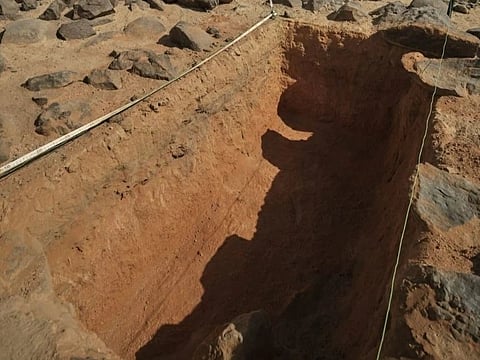
Dubai: An Egyptian-Italian archaeological mission has uncovered an 8,500-year-old human settlement in Egypt’s Western Desert, revealing new evidence of prehistoric communities that lived in the region when the Sahara was considerably wetter than it is today.
The discovery, made on the Rajih Plateau in the Farafra Oasis, is among the largest prehistoric residential settlements identified in Egypt’s Western Desert, according to the Ministry of Tourism and Antiquities.
Get updated faster and for FREE: Download the Gulf News app now - simply click here.
The site, known as Site No. 1, contains approximately 200 archaeological features, including stone structures, hearths and extensive concentrations of stone tools.
Preliminary studies suggest the settlement dates to the middle Holocene period, approximately 8,500 years ago, and was home to a relatively stable, organised community rather than serving merely as a temporary campsite.
Archaeologists said the arrangement of stone structures, hearths and surrounding artefacts indicates that the inhabitants engaged in regular domestic activities, while the settlement’s size and spatial organisation suggest repeated and sustained human occupation.
Evidence of a greener Sahara
Located on the eastern edge of the Farafra Depression, the settlement provides valuable insights into how prehistoric communities adapted to environmental conditions dramatically different from those prevailing in the desert today.
Geological and geoarchaeological investigations indicate that the area once experienced significantly wetter conditions, with shallow depressions, ancient lake deposits and locally available stone resources used for constructing shelters and manufacturing tools.
The findings shed light on the climatic transformations that reshaped the Sahara during the Holocene, when vast areas of the desert were more hospitable to human habitation.
As environmental conditions changed and aridity gradually increased, prehistoric communities were forced to adapt their settlement patterns, mobility and use of natural resources.
New insights into prehistoric life
Sherif Fathy, Egyptian Minister of Tourism and Antiquities, said the discovery deepens understanding of prehistoric human settlement in Egypt and demonstrates how ancient communities adapted to climate change and made use of available natural resources.
He reaffirmed the ministry’s commitment to supporting archaeological research, excavations and cooperation with Egyptian and international scientific institutions.
Hisham El-Leithy, Secretary-General of the Supreme Council of Antiquities, said the discovery offers fresh evidence of evolving settlement patterns in the Western Desert, particularly the transition towards more stable forms of habitation.
He added that the findings would help researchers understand how prehistoric populations responded to environmental challenges and managed the resources available to them.
Archaeological investigations since 2023
The Egyptian-Italian mission began fieldwork on the Rajih Plateau in 2023, exploring an area that had not previously undergone archaeological investigation.
Researchers identified several concentrations of prehistoric stone structures, prompting more extensive investigations during the 2025 excavation season.
The latest work included archaeological surveys, topographical and photographic documentation, excavations, artefact analysis and geological and geoarchaeological studies.
Giulio Lucarini, head of the mission and director of the Farafra Oasis Prehistory Project (FOPP), said comparisons with archaeological discoveries in Wadi El Obeiyid in Farafra and the Dakhla and Kharga oases helped establish the settlement’s preliminary dating.
He explained that the findings build on earlier research conducted in the Rajih plains and Bir Mur, near the foot of the limestone plateau.
According to Lucarini, the research is helping archaeologists develop a more comprehensive understanding of human settlement, livelihoods and mobility in Farafra during the Holocene, particularly as the Sahara experienced increasing aridity.
Barbara Barich, also of the Farafra Oasis Prehistory Project, highlighted the mission’s decades-long research into prehistoric settlement patterns and environmental changes in the oasis.
She said the investigations would continue in cooperation with Egypt’s Ministry of Tourism and Antiquities, the Supreme Council of Antiquities and the Dakhla Oasis Antiquities Inspectorate.


