$10-million bounty on Trump: Iran-aligned Iraqi militia calls for assassination after Soleimani remarks
Islamic Resistance in Iraq offers bounty after Trump boasts of Soleimani strike
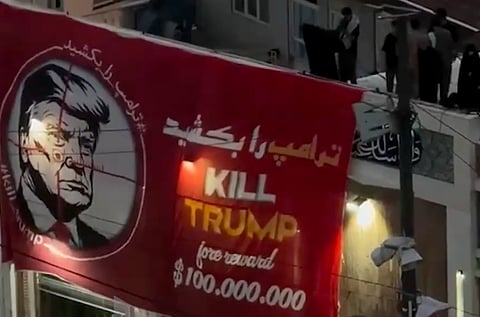
An umbrella coalition of Iran-aligned Iraqi militias has announced a $10-million reward for the killing of US President Donald Trump, dramatically escalating already fraught tensions between Washington and Tehran's regional proxy network.
Get — updated faster and for FREE: Download the Gulf News app now - simply click here
The announcement, made by the Islamic Resistance in Iraq (IRI), came after Trump publicly referenced his role in the 2020 killing of Iran's top military commander, Maj. Gen. Qassem Soleimani, and Iraqi militia leader Abu Mahdi al-Muhandis during a White House meeting with Iraqi Prime Minister Ali Al-Zaidi.
The group said the bounty would go to "anyone who kills Donald Trump" or to anyone who finances or facilitates such an operation.
It claimed the $10 million had been raised through donations from its members and supporters, although no evidence was provided to substantiate the claim.
Who is the Islamic Resistance in Iraq?
The Islamic Resistance in Iraq is not a single organisation but an umbrella coalition of predominantly Shiite armed factions backed by Iran.
Many of its constituent groups are members of Iraq's Popular Mobilisation Forces (PMF) and include organisations such as:
Kataib Hezbollah
Harakat Hezbollah al-Nujaba
Kataib Sayyid al-Shuhada
Asa'ib Ahl al-Haq
The United States has accused these groups of carrying out hundreds of drone, rocket and missile attacks against American troops, diplomatic facilities and allies throughout Iraq, Syria and elsewhere in the Gulf.
Since the outbreak of the current US-Iran conflict, these militias have become one of Tehran's principal instruments for projecting military pressure beyond Iran's borders.
Deep ties to Iran
Although Iraqi militia leaders often portray themselves as independent "resistance" movements, Washington and many Western governments say the groups receive extensive support from Iran's Islamic Revolutionary Guard Corps-Quds Force (IRGC-QF).
According to the U.S. State Department and Treasury Department, several militia leaders have longstanding operational relationships with Iranian commanders and have received Iranian financing, military training, weapons and logistical assistance.
Harakat al-Nujaba, for example, has openly pledged allegiance to Iran's Supreme Leader Ayatollah Ali Khamenei and maintained close ties with the late Qassem Soleimani.
Where does the money come from?
The group claimed the $10 million reward was "collected through donations" from supporters and members.
However, analysts note that many Iran-aligned Iraqi militias have multiple revenue streams, including:
Financial assistance from Iran.
Businesses and commercial enterprises under militia control.
Smuggling networks.
Control of border crossings.
Government salaries received through the Popular Mobilisation Forces.
Alleged diversion of oil revenues and other state resources, according to US sanctions announcements.
US officials have repeatedly accused some militia commanders of siphoning Iraqi public funds and exploiting the country's oil sector to finance armed operations.
Why now?
The bounty was announced after Trump, during talks with Iraqi Prime Minister Ali Al-Zaidi, again referred to the January 2020 US drone strike near Baghdad International Airport that killed:
Iranian Revolutionary Guard commander Qassem Soleimani, and
Iraqi Popular Mobilisation Forces (PMF) deputy chief Abu Mahdi al-Muhandis.
For many Iran-backed militias, both men are revered as martyrs whose deaths remain a rallying point for anti-American mobilisation.
The militias said Trump's recent remarks amounted to boasting about the killings and justified their call for retaliation.
Previous assassination attempts on Trump
The latest threat comes after Trump survived multiple assassination attempts during the 2024 US presidential campaign.
Among the most serious was the 13 July 2024 shooting at a campaign rally in Butler, Pennsylvania, where a gunman opened fire, grazing Trump's ear, killing one spectator and critically injuring two others before being fatally shot by the Secret Service.
A second alleged plot emerged weeks later near Trump's golf course in Florida, where authorities arrested a suspect after Secret Service agents intervened before any shots were fired.
US prosecutors have also, in separate cases, alleged that individuals linked to Iran sought to recruit people to assassinate Trump in retaliation for Soleimani's killing. Iran has denied involvement in such plots.
Growing regional confrontation
The bounty announcement comes amid the most serious confrontation between Washington and Tehran in years.
The US has resumed military strikes against Iranian targets, imposed a naval blockade on Iranian ports, and tightened sanctions against Iran and its allied militias. In response, Tehran's network of proxy groups across Iraq, Syria, Lebanon and Yemen has intensified attacks against US interests throughout the region.
There's no indication the Iraqi militia possesses the capability to carry out an attack inside the US, but the declaration underscores the increasingly personal nature of the conflict between Trump and the Iran-backed groups that have long blamed him for authorising Soleimani's killing.


