Wildfire kills 12 in southern Spain expat community, 23 missing
Foreign residents among dead as Almeria blaze becomes one of Spain’s worst
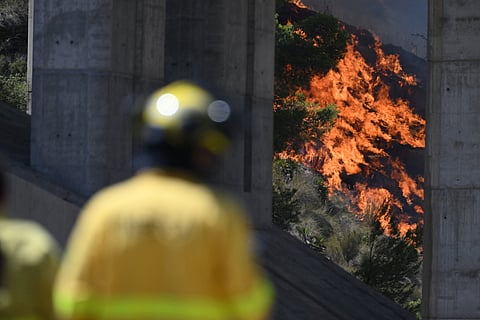
At least 12 people have died and 23 others remain missing after a wildfire swept through an expat community in southern Spain, forcing residents to flee the flames by car and on foot, authorities said.
The blaze broke out late Thursday in a remote, semi-arid area near the Sierra de Los Filabres mountains in Almeria province, as Spain continues to battle extreme heat.
Andalusia regional leader Juan Manuel Moreno said eight people were injured in the fire, which has become one of Spain’s deadliest wildfires in recent years.
Get updated faster and for FREE: Download the Gulf News app now - simply click here.
Emergency services chief Antonio Sanz said many victims died after leaving their homes despite instructions to shelter in place.
Some residents attempted to escape through a dry riverbed, which Sanz described as a “death trap”.
Foreign nationals among victims
Authorities said most of those killed were believed to be foreign nationals living in the area.
Four victims were believed to be British nationals after officials identified a burned-out vehicle with a right-hand steering wheel, a feature common in British cars.
Sanz said seven people died after abandoning their vehicles and attempting to flee on foot.
Dean Taylor, a resident who divides his time between Spain and the UK, said he narrowly escaped the area using back roads.
“It was quite terrifying. It’s a very sad day, isn’t it? It’s devastating, really,” Taylor told The Associated Press.
Firefighters battle difficult conditions
The wildfire was still burning on Friday afternoon, with around 150 firefighters and 220 soldiers from Spain’s military emergency unit working to contain it.
The fire has destroyed more than 3,200 hectares (7,900 acres) of forest and farmland.
Moreno said the steep and dry landscape made firefighting operations difficult.
The region’s dry vegetation, including scrubland and esparto grass, combined with high temperatures and strong winds, created dangerous conditions for the spread of the flames.
Spain faces another heatwave challenge
Spain has experienced increasingly frequent and severe heatwaves, with temperatures often rising above 40°C (104°F).
High temperatures, strong winds and low rainfall have increased the risk of wildfires spreading rapidly.
In June, Spain recorded several days of extreme heat, with more than 1,000 excess deaths linked to high temperatures.
According to the European Union’s Copernicus Climate Change Service, Europe is the world’s fastest-warming continent, with temperatures rising at twice the global average rate since the 1980s.
France also faces high wildfire risk
Neighbouring France is also dealing with extreme heat, with temperatures reaching 40°C (104°F) in western and central regions and around 37°C (98°F) in Paris.
Authorities have issued high wildfire risk warnings after major fires in southern France burned thousands of hectares and disrupted the Tour de France cycling race.
The largest blaze, in the eastern Pyrenees near the Spanish border, had reduced in intensity by Friday but had already burned around 5,000 hectares (12,000 acres) and forced more than 10,000 people to temporarily evacuate nearby villages.
Spain and Portugal have history of deadly wildfires
Spain has suffered several major wildfires in recent years. Last year, fires burned more than 393,000 hectares of land, according to the European Forest Fire Information System, killing four people.
The country’s deadliest wildfire occurred in 1979, when 21 people died in Lloret de Mar, north of Barcelona.
In neighbouring Portugal, a 2017 wildfire in Pedrogao Grande killed 66 people, including 47 who died while trying to escape by car on a road.
Scientists say climate change, driven partly by fossil fuel emissions, is increasing the frequency and intensity of extreme heat and dry conditions, leaving more regions vulnerable to wildfires.


