Philippines back-to-back eruptions: Mayon unleashes fast-moving avalanche of hot rocks; Kanlaon shoots ash plumes
Mayon's lava collapse sparks warnings, tourists undeterred; Kanlaon remains restive
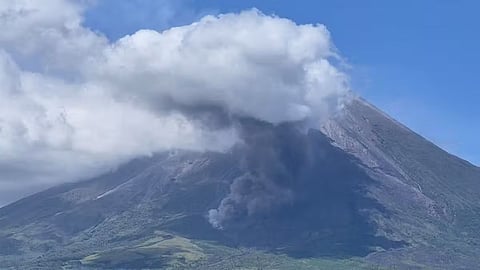
Manila: Two volcanoes are making back-to-back eruptions in Philippines in the last two days.
The restive Mayon Volcano in eastern Philippines sent a fast-moving avalanche of hot gas, ash, and fragmented volcanic rock cascading down its slopes on Friday, according to the Philippine Institute of Volcanology and Seismology (Phivolcs).
The agency said the event was a lava-collapse pyroclastic density current (PDC) — one of the most dangerous volcanic hazards during eruptions.


Lava collapse
As of Friday afternoon, the lava-collapse PDC was still ongoing, Phivolcs said in its latest bulletin, warning communities that similar events may continue as unstable lava piles up and collapses along the volcano’s upper slopes.
Mayon is one of the most closely watched volcanoes in the Philippines, with authorities warning that further hazardous activity, including explosive bursts and additional PDCs, is possible in the coming days or weeks.
Kanlaon eruption
Meanwhile, Kanlaon Volcano on Negros Island has been actively erupting and emitting ash, and Phivolcs continues to monitor it under Alert Level 2 — indicating increased unrest.
On Feb. 26, 2026, Kanlaon produced a moderately explosive eruption, sending an ash plume up to about 2,500 meters above the crater and generating pyroclastic density flows down its slopes.
As of Friday, Kanlaon’s ash emissions remain ongoing, with grayish plumes rising around 1,000 metres above the summit and drifting with prevailing winds.
The volcano’s edifice remains inflated and there are recorded volcanic earthquakes and continued gas emissions — all signs Phivolcs is watching closely for any escalation.
“PDCs are mixtures of fragmented volcanic particles (pyroclastics), hot gases, and ash that rush down the volcano’s slopes or rapidly outward from a vent at high speeds,” Phivolcs explained on its website. These superheated flows can incinerate and bury everything in their path.
Mayon: Alert Level 3 remains
Phivolcs maintained Alert Level 3 over Mayon, indicating a relatively high level of volcanic unrest. Under this status, magma is at the crater and hazardous eruptions remain possible.
The agency reiterated that the 6-kilometer Permanent Danger Zone (PDZ) must remain strictly off-limits due to the continuing threat of PDCs, rockfalls, lava flows, and sudden explosive activity. Residents within the extended danger zones are also advised to remain vigilant, especially in valleys and areas prone to channeling volcanic flows.
Tourist draw despite danger
Despite the ongoing unrest, Mayon’s near-perfect cone and glowing lava at night have continued to draw tourists to vantage points outside the danger zone in Albay province. Local authorities, however, warned visitors to observe safety restrictions and heed evacuation orders if conditions worsen.
Latest situation
In its most recent update, Phivolcs reported persistent degassing, elevated seismic activity, and continued lava effusion from the summit crater. The agency emphasized that further lava collapses could generate additional PDCs without warning. Communities near the volcano were advised to prepare for possible ashfall and to monitor official bulletins for real-time updates.


