Manila Subway: Right-of-way snags fall like dominoes under new law, called ARROW Act
Country's first-ever underground or "tube" system takes form amid new right-of-way law
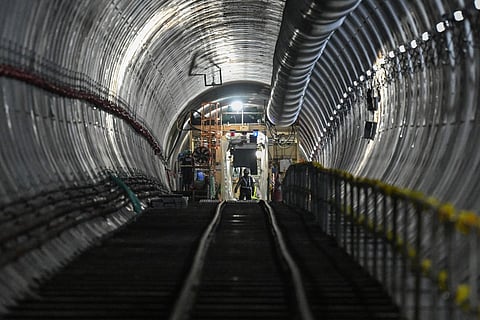
Manila: Right-of-way (ROW) barriers once stalled major infrastructure projects in the Philippines.
Not anymore. They are now falling like dominoes.
A key test case: the Metro Manila Subway Project (MMSP), the country’s first-ever underground rail system.


Construction is currently accelerating, providing a glimpse into the future of state-sanctioned infrastructure projects.
June 2026 target to resolve 100% of ROW issues
At the groundbreaking of the Shaw Boulevard Station in Pasig City, government officials announced that ROW acquisition for the MMSP has reached 90.92%, with full completion (100%) targeted by June 2026.
Pre-construction activities for the Shaw Boulevard Station are nearly complete.
This signal that long-delayed land issues, which used to get stuck for years in local courts, are no longer holding back progress.
Acting Transportation Secretary Giovanni Lopez said construction momentum is now unmistakable.
“Tuloy-tuloy na ang konstruksyon ng mga istasyon ng subway sa Pasig. Malaking tulong ito sa mga komyuter lalo na sa mga nagtatrabaho sa Ortigas business district. Mas mapapadali at mabilis na ang kanilang biyahe (Construction of the subway stations in Pasig are going on unhampered. This would greatly help commuters, especially those who work in the Ortigas district. Their commute will be a breeze)”, Lopez told local media.
If things go as planned, the project could dramatically cutting travel time across the capital region.
A long-awaited underground system
The Manila Subway, scheduled for completion by 2032, is designed to transform urban mobility across Metro Manila.
Once operational, it will link the following cities in the metropolis:
Quezon City
Pasig City
Taguig City
Parañaque City, and
Pasay City.
The Pasig segment under Contract Package 104 covers 3.397 kilometers of tunnels and underground stations — specifically Ortigas Avenue and Shaw Boulevard.
The contract was awarded to the Tokyu-Tobishima-Megawide Joint Venture (TTMJV), a partnership combining Japanese engineering expertise with local construction capacity.
Long-term traffic solution
The Ortigas Avenue Station will rise along Meralco Avenue at the corner of Ortigas and Julia Vargas, while the Shaw Boulevard Station will be located beside Estancia Mall along Meralco Avenue corner Shaw Boulevard — positioning the subway directly within one of Metro Manila’s busiest commercial corridors.
President Ferdinand R. Marcos Jr. described the subway as a “sustainable and long-term” solution to the capital’s chronic traffic congestion. He added that the project is moving “even more quickly” than originally scheduled.
The ROW problem: A century-old bottleneck
For decades, infrastructure projects in the Philippines have faced a recurring obstacle: right-of-way acquisition.
Land needed for railways, highways, airports, and utilities often became entangled in legal disputes. Local courts could issue temporary restraining orders (TROs) that delayed nationally significant projects for years. What was meant to be “temporary” frequently became indefinite.
The consequences were predictable:
Ballooning construction costs
Investor frustration/withdrawal (moving to other countries)
Delayed job creation
Losses/uncertain ROI timelines
Slower connectivity and economic growth
Entire rail lines, expressways, telecommunications expansions, and water projects were postponed because land acquisition disputes lingered in court.
As lawyers thrived on litigation, and engineering problems are "solved" (or never) by lawyers, commuters remained stuck in traffic.
Enter the came-changer: The ARROW Act
In September, President Marcos signed Republic Act No. 12289, better known as the Accelerated and Reformed Right-of-Way (ARROW) Act — a law designed to overhaul the country’s outdated ROW framework.
Building on the earlier Right-of-Way Act (RA 10752) of 2016, the ARROW Act modernizes procedures to match the scale and urgency of 21st-century infrastructure needs.
It is widely regarded as one of the most consequential development laws in recent years.
What the ARROW Act does
#1. Speeds Up Infrastructure Nationwide
The law streamlines legal processes for acquiring land for national infrastructure projects — from rail systems like the MMSP to highways, bridges, broadband networks, water systems, airports, and seaports.
Procedural delays that once trapped projects in litigation are significantly reduced.
#2. Standardises, modernises compensation
Property owners are guaranteed:
Offers based on updated market values using national valuation schedules
Compensation for structures, improvements, crops, and trees
Clearer, standardized payment rules
This reduces disputes over pricing and provides transparency to landowners.
#3. Expands coverage to public service providers
Infrastructure is no longer built solely by government agencies. The ARROW Act now covers private entities delivering public services — including electricity, water, telecommunications, airports, irrigation systems, and seaports — provided they have legal authority to operate.
#4. Strengthens legal certainty and oversight
The law expands the role of government agencies in oversight and imposes civil and criminal penalties for violations of ROW rules. Accountability mechanisms are clearer, reducing abuse and uncertainty.
#5. Provides Special Rules for Foreign-Assisted Projects
For projects funded by international development partners, foreign funding rules may take precedence if they conflict with domestic procedures — ensuring smoother collaboration and protecting global financing arrangements.
Why ROW law matters for the Manila Subway — and beyond
The Manila Subway's accelerating ROW completion rate demonstrates how legal reform can unlock physical progress.
A prominent example of the new environment was the landmark right-of-way settlement involving Corinthian Gardens residents in Pasig, where negotiations avoided prolonged litigation and moved the subway project forward.
If the ARROW Act performs as intended, Filipinos may feel its impact not just in subway rides, but in:
Faster internet speeds
More reliable water supply
Expanded airport capacity
New highways and logistics corridors
In short, fewer court-issued TROs — and more cranes on the skyline.
A 21st-Century infrastructure era?
For much of the past century, Philippine connectivity projects were slowed not by engineering challenges, but by legal paralysis.
The ARROW Act signals a shift: from courtrooms to construction sites.
As right-of-way obstacles fall and tunneling machines continue boring beneath Metro Manila, the country’s first underground railway is no longer just a blueprint — it is rapidly becoming concrete reality.
And for millions of commuters, the promise is simple: shorter trips, less traffic, and a capital city finally moving forward.


