Solving Manila’s housing challenge: Low-cost vertical development works
'Whole-of-government' drive for vertical affordable housing offers hope for urban renewal
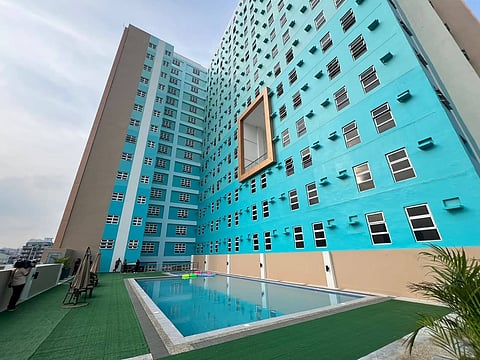
Manila: Metro Manila’s housing shortage is one of the most visible signs of rapid urbanisation.
Informal settlements in this city of 14.8 million people account for roughly 3 million people, or about one in four residents.
They have grown along riverbanks, railways, and unused government land for decades.
Yet the solutions are already emerging.
In-city vertical housing
One promising model is the in-city vertical housing approach pioneered by the City of Manila.
Projects like Tondominium, Binondominium, and San Lazaro Residences demonstrate that city/local governments, backed by state-funding, can build mid-rise or high-rise buildings on existing urban land for low-income and informal settler families without pushing them to distant relocation sites.
The concept is simple, yet powerful.
It's also a game-changer.
Affordable housing within urban core
Instead of relocating families to remote provinces — where jobs, schools, and transport are scarce — the city, backed by state or private funding (or a combination of both), builds affordable housing within the urban core.
The early projects have already housed thousands of families.
With units typically around 40 sqm are built in a mid- or high-rise dwelling, with community facilities such as daycare centres, health services, retail outloets and shared spaces.
This approach works. And works brilliantly.
Because it preserves livelihoods. Because this army of informal settlers see their social mobility improve greatly. They get to live close to markets, ports, schools, commercial areas.
Just like any other major city in the world.
When they are relocated far away, they often return to the city to work, recreating, or reinforcing informal settlements, and urban blight.
Breaking the cycle
Keeping housing near jobs breaks that cycle.
Other cities are also experimenting with similar ideas.
San Juan City’s mid-rise socialised housing projects and joint programmes with the Department of Human Settlements and Urban Development (DHSUD) show how local governments can partner with national agencies and universities to create affordable housing prototypes.
Meanwhile, projects such as the Port Town Housing Project aim to deliver thousands of affordable units within existing urban communities.
These projects show the power of a well-coordinated urban planning, and whole-of-government solution approach.
However, these initiatives remain too small compared to the scale of the problem. Metro Manila alone has up to 3 million people under the "informal settlers" community, as UN Habitat.
And we we need more of them.
The state has no shortage of public lands. To scale up solutions, government must fully utilise idle or underused public land — old government lots, port areas, railway corridors, and obsolete facilities.
Public schools, for example, may be turned into high-rise communities.
Many of these sites sit in strategic locations close to economic centres.
Converting them into vertical housing projects would maximise land value while providing homes for low-income families.
Mass transport
Equally important: integrating housing with mass transit development.
The Philippines is currently building several major railway projects, including the Metro Manila Subway, the $15.4 billion North-South Commuter Railway, MRT-7, and the LRT-1 Cavite Extension, all designed to move hundreds of thousands of commuters daily.
So one can envision housing built near these rail corridors, thus helping transform commuting patterns.
And then imagine these mass transport networks powered by renewable energy (from hydro, geothermal or solar, wind + batteries), it makes the city's mass transport system more resilient to energy market shocks.
Transit-oriented housing — mid-rise buildings near stations — would reduce travel time, cut congestion, and expand economic opportunities for residents.
Incentives for investors
The biggest incentive now is policy reforms, specifically the ARROW Act (RA 12289, the Accelerated Reformed Right-of-Way Act), which speeds up the process of acquiring right-of-way without fear of getting stuck in courts blithely handing out temporary-restraining orders (TROs) to important projects.
In the past, this resulted in the Philippines' brightest lawyers having to solve basic engineering problems, like housing and infrastructure.
Good laws hope -- and lead to better lives. They lead to breakthroughs.
This is where the public-private partnership (PPP) model becomes crucial. Government alone cannot finance the millions of housing units needed nationwide.
But with the right incentives — such as land grants, tax breaks, and long-term leasing arrangements—private developers could participate in large-scale socialized housing programs.
For example, the government could provide land near rail stations while private developers build mixed-income communities: a portion allocated to subsidized housing, and the rest sold commercially to finance the project. This cross-subsidy model is widely used in cities like Singapore and Hong Kong.
Planning to succeed
Over time, these policies could reshape Metro Manila’s urban landscape.
Instead of endless sprawl and informal settlements, the capital could develop dense, well-planned communities connected by rail and public transport.
The transformation will not happen overnight. Even aggressive housing programs will take years to reduce the backlog. But the early projects in Manila — Binondominium, Tondominium, and others — show that a viable model already exists.
If expanded across the metropolis, this strategy could spark urban regeneration: redeveloping blighted areas, improving infrastructure, and gradually “gentrifying” neighbourhoods while ensuring the urban poor remain part of the city’s future.
Manila’s housing crisis may be decades in the making — but with political will, smart urban planning, and strong public-private collaboration, the city can finally begin building a more inclusive and livable capital.


