Flying taxis are almost here: Final hurdles for Joby, Archer, Beta amid eVTOL certification drive
Air taxis: Advanced air mobility industry moves toward commercial launch
Electric air taxi pioneers Joby Aviation, Archer Aviation and Beta Technologies are accelerating efforts to secure regulatory greenlight as the advanced air mobility sector moves closer to launching passenger flights.
Under President Donald Trump's "Future of Flight" initiative, the three US-based electric vertical takeoff and landing (eVTOL) makers were picked for multi-state test deployments, in a move that seeks to accelerate the launch of air taxis withouth sacrificing safety.
The programme, known as the "Advanced Air Mobility and Electric Vertical Takeoff and Landing (eVTOL) Integration Pilot Program (eIPP)" and is run by the US Department of Transportation and Federal Aviation Administration (FAA).
Stage 5 is the final phase of the aircraft Type Certification process.
It follows a long evaluation and testing process through which FAA officials have assessed each of the aircraft’s systems separately.
Regulators are developing new standards specifically for eVTOL aircraft.
There are criticisms that this is slowing approvals across the industry.
Airlines and logistics companies need trained operators and confidence that electric aircraft can match the safety record of traditional aviation.
Milestone
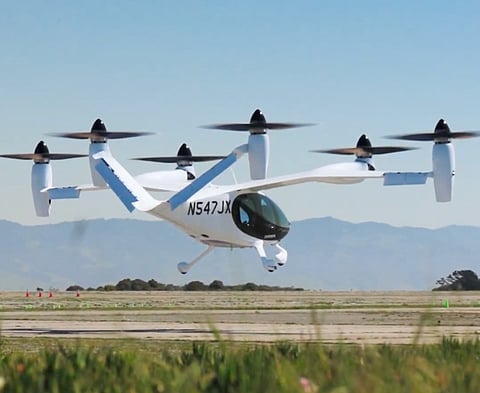
Joby, for its part, recently began flight testing its first production-conforming aircraft, with tail number N547JX at its facility in Marina, California, the company reported.
This marks a key milestone in its certification journey with the US Federal Aviation Administration (FAA).
The production aircraft — powered by six electric rotors and able to carry a pilot and four passengers — is a key step toward formal regulatory evaluation.
Before end-2026, Joby aims to test its aircraft across several states — Arizona, Florida, Idaho, New Jersey, New York, North Carolina, Oklahoma, Oregon, Texas and Utah.


The company says development prototypes have already logged more than 50,000 miles of test flights.
Why is certification taking much time?
Because new certification rules, divided into several "phases", are being crafted at the same time that the new aircraft type is being developed.
Now, the eVTOL makers are preparing to transition from testing to operating.
Unlike earlier prototypes, the Joby aircraft used in these tests (registration: N547JX) is already the final design built for the "Type Inspection Authorisation" (TIA).
That means: it has been built to FAA Designated Engineering Representative-approved designs and signed off by FAA-designated airworthiness reps.
The flight test also marks the start of Joby's Stage 5 certification campaign in the FAA’s aircraft-level evaluation.
Joby, founded on September 11, 2009 (called Joby Aero), recently recorded an 18-point increase in FAA progress on Stage 4 of an extensive 5-stage certification process, and reported that its first FAA-conforming aircraft for TIA set to fly "shortly".
To support its goal of doubling production in 2027, Joby signed an agreement to acquire an existing 700,000+ sq ft facility in Ohio.
Recently, Joby and Uber also presented their one-tap booking system that will integrate Joby aircraft into a connected ground-to-air travel experience.
Certification: Joby hits Stage 4 out of 5
The FAA certification pathway for eVTOL aircraft is complex as the next-generation eVTOL vehicles combine characteristics of helicopters and airplanes.
Joby is pursuing approval under a customised certification basis that allows regulators to define safety standards for this new “powered-lift” category.
As part of the process, Joby is preparing Type Inspection Authorisation (TIA) flight tests of production models, during which FAA pilots will independently evaluate the aircraft.
Having reached stage 4 of the five-stage FAA certification programme, Joby is one of the most advanced positions among eVTOL developers.
Scaling production
Production is also scaling.
Joby plans to ramp manufacturing at facilities in California and Ohio, targeting about four aircraft per month by 2027.
The company aims to launch initial commercial air-taxi operations in Dubai in 2026, with US services expected after FAA certification.
Archer's progress
Meanwhile, Archer Aviation, founded in 2018 by Adam Goldstein and Brett Adcock, is progressing with its "Midnight" eVTOL aircraft following demo flights in various cities.
In January 2026, its "Means of Compliance" (MOC) — detailing how the aircraft will prove it meets safety standards — was accepted by the Federal Aviation Administration (FAA).
The company is now working through detailed certification and testing campaign.
An MOC is the technical plan explaining how a company will prove its aircraft meets safety rules set by regulators.
In FAA's acceptance of the MOC, it is essentially saying: “We agree that these methods are valid ways to prove the aircraft is safe.”
This means: Archer can now conduct the exact tests and demonstrations the FAA will accept as evidence.
Archer has earlier teamed up with Southwest to develop operational plans for domestic US air taxi networks and recently announced ties with Starlink for secure communications.
Archer has also reported that it is using its VTOL tech and expertise to defence use cases — potentially expanding what electric aviation can do.
Beta
Electric aviation pioneer Beta Technologies is also edging closer to commercial flights with its eVTOL aircraft, the ALIA-250.
A few critical hurdles remain: before passengers and cargo routinely fly on battery-powered air taxis.
While its FAA certificationm is proceeding as planned, this process requires extensive tests. Beta has also signed contracts with the US military.
If these hurdles are cleared, air taxi makers like Joby, Archer and Beta could help usher in the first true era of electric flight.
Realistic timelines
Industry timelines suggest Joby could achieve certification around 2027, while Archer and Beta may not be far behind, depending on testing results and regulatory approvals.
These three eVTOL makers companie are also participating in a US government-backed advanced air mobility pilot programme designed to integrate air taxis into national airspace, providing operational data for future regulations.


