eVTOL aircraft, aka air taxis, face delays in the US: Here's why
New way to fly: Why eVTOLs like Archer, Joby, BETA, and Vertical face certification snags
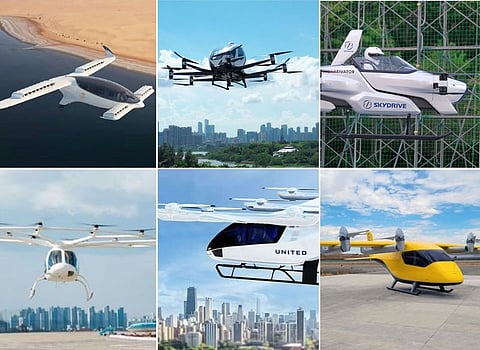
Commercial "air taxi" service has been pushed back. Again.
Reason: It's not because the technology doesn't work or is unproven.
It's because US certification timeline for the next-generation electric vertical-landing-and-takeoff (eVTOL) aircraft — a new mode for human flight — poses complex challenges, and keeps getting pushed back.
Currently, it's stuck in regulatory snags, a hark back to the 1903 moment when the bicycle-maker Wright brothers successfully flew the first powered airplane at Kitty Hawk.


While their feat marked the beginning of modern aviation, there was no Federal Aviation Administration (FAA) to regulate it and ensure safety for everyone.
And there were no airports anywhere then.
For next-gen air taxis, safety rules are evolving, or non-existent, and "vertiports" are nowhere. Air taxis, though, can land/takeoff on existing helipads.
Why the delay?
Key challenge: Regulatory synchronisation
As it stands today, air taxi "operational infrastructure" is non-existent.
An industry report shows that the US certification timeline slip currently reveals: Joby won't certify until mid-2027 at the earliest. Archer follows in 2028.
"The gap isn't technical capability anymore. It's regulatory synchronisation,” stated FAA's Kalea Texeira in a LinkedIn post.
"The aircraft works. The business models hold. The capital's top three players have runway through the end of the decade."
"Vertiports. Energy supply chains. Part 135 integration. Pilot training frameworks that match the aircraft timeline,” explained Texeria, an FAA National Training Program Manager, Aviation Compliance & Data Analytics Expert.
She noted that while Dubai promised a commercial launch (in late 2025), "It didn't happen. Not because the technology failed, but because regulatory approval cycles don't compress on demand.”
FAA role
The FAA is tasked collaborate with federal partners per the Transportation Department’s AAM National Strategy, with the aim to accelerate market entry for US air taxi developers by streamlining regulations and infrastructure support.
But it's not as simple as it seems: there's a complex calculus and moving targets prior to full certification, alongside the development of pilot training, route planning and vertiport standards.
Result: None of the top eVTOL companies based in the US would see certification in 2026, according to an industry report.
Over in China, eVTOL developers and regulators are racing toward passenger certification in 2026, with EHang and AutoFlight.
New US bill: Could it speed up air taxi approval?
What the new bill is about:
A bipartisan bill introduced in the US Senate and House would require the Federal Aviation Administration (FAA) to streamline how it certifies electric vertical takeoff and landing (eVTOL) air taxis and other advanced air mobility (AAM) aircraft.
The goal: get US-built air taxis into service "faster" — but without lowering safety standards.
Backers of the legislation:
The bill — called the Aviation Innovation and Global Competitiveness Act — was introduced by a bipartisan group of lawmakers:
Senate: Ted Budd, Peter Welch, Ben Ray Luján, and John Curtis
House: Troy Nehls, Jimmy Panetta, and Jay Obernolte
Supporters say the measure is essential for keeping the US competitive as other countries race ahead on air taxi deployment.
Why is this bill needed now?
Certifying eVTOL aircraft has proven slow, uncertain, and costly potentially triggering bankruptcies for certain developers.
While the FAA has never compromised on safety, manufacturers argue the process is poorly suited to novel aircraft designs.
Timelines can shift suddenly, requirements can change midstream, and key approval steps — known as "issue papers" — can take years to resolve.
Industry groups say that uncertainty threatens US leadership in a market projected to be worth $115 billion by 2030.
What does the bill actually change?
The legislation would:
Direct the FAA to rely on industry-developed consensus standards— to the maximum extent possible — when approving eVTOL aircraft.
Force greater timeline transparency, requiring the FAA to estimate how long it will take to respond to certification documents such as G-1 and G-2 issue papers.
Limit issue papers to genuinely novel or complex issues, instead of routine technical matters.
Turn recurring certification topics into formal regulations, reducing repetitive paperwork.
Allow more routine certification work to be delegated to FAA-approved organisations, freeing agency staff to focus on safety-critical reviews.
What are G-1 and G-2 issue papers — and why do they matter?
G-1 issue papers define what safety and airworthiness standards an aircraft must meet.
G-2 issue papers explain how a manufacturer will prove compliance with those standards, including flight tests with FAA pilots onboard.
Several leading eVTOL developers have G-1 approvals — but all are still waiting on G-2 approvals, a key bottleneck before final certification.
The new bill could significantly speed up that stage.
Which companies would be affected?
The legislation is backed by major U.S. air taxi developers, including:
Joby Aviation
Archer Aviation
Beta Technologies
Wisk Aero
It is also endorsed by Boeing and major aviation trade groups.
Who supports the bill — and why?
The US National Business Aviation Association (NBAA) says the bill will improve “transparency, predictability, and accountability” in certification.
NBAA president Ed Bolen argues the current system discourages investment and risks pushing innovation overseas.
Other supporters include:
Aerospace Industries Association
General Aviation Manufacturers Association
Association for Uncrewed Vehicle Systems International
Airports Council International–North America
Does this mean companies can certify their own aircraft?
Not exactly — but it’s close.
The bill would allow manufacturers to use standards they helped develop, as long as those standards are formally recognised by the FAA.
Critics warn this could weaken regulatory independence, while supporters argue it reflects how certification already works in other aviation sectors.
The FAA would still retain final approval authority.
How does this connect to recent FAA rulemaking?
In 2024, the FAA issued a special federal aviation regulation (SFAR) covering pilot training and initial eVTOL operations. That rule hinted at using industry consensus standards.
This bill goes further: explicitly telling the FAA to rely on those standards wherever possible.
What about real-world air taxi operations?
The legislation aligns with a broader government push to move eVTOLs from theory to practice.
President Donald Trump recently launched the eVTOL and Advanced Air Mobility Integration Pilot Program (eIPP) — a three-year effort that could allow passenger-carrying and revenue flights at select airports as early as this summer.
Data from those pilots is expected to shape long-term FAA policy.
Can the eVTOL certification process be accelerated?
Even without the bill being passed, the EIPP launching mid-2026 is hoped to accelerate the process, via five "pilot" projects, public-private partnerships and real-world demonstrations generating data to guide the development of standards.
However, even optimistic projections now point to the LA Olympics 2028 as the milestone — and that isn't looking very promising either.
What's 2027 certification probability?
One indusrtry estimate shows a 20–30% chance for one certificate (e.g., Joby mid-2027 per FAA Stage 4 progress); <15% for multiple.
A modal certification may not come until 2028.
What’s the bigger picture?
The new US bill reflects a strategic concern: if the US gets stuck in bureaucratic red tape, and moves too slowly, it could lose leadership in air taxi technology to Europe or Asia.
Supporters argue the choice is not between speed and safety — but between smart regulation and regulatory drift.
Whether Congress agrees could determine how soon Americans see air taxis lifting off from US cities.


