Iran’s president in Pakistan as negotiators tackle sticking points
His visit comes day after breakthrough talks in Switzerland produced roadmap towards peace
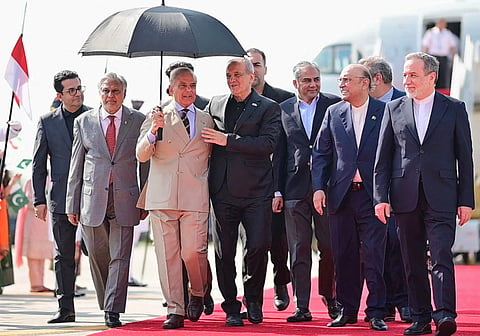
Dubai: Iranian President Masoud Pezeshkian arrived in Pakistan on Tuesday in a high-profile visit that underscored Islamabad’s growing diplomatic role in efforts to secure a permanent agreement between Iran and the United States, even as differences emerged over key elements of the proposed deal.
Pezeshkian was given a red-carpet welcome and guard of honour on arrival in Islamabad, where he was received by Prime Minister Shehbaz Sharif, President Asif Ali Zardari and senior Pakistani officials. Iranian Foreign Minister Abbas Araghchi accompanied the president on the trip.
The visit comes just a day after Pakistan and Qatar announced that the opening round of US-Iran negotiations in Switzerland had produced a 60-day roadmap towards a final agreement aimed at ending the conflict that began with US and Israeli strikes on Iran on February 28.
Iranian officials said one purpose of the visit was to thank Pakistan for its role in facilitating dialogue between Tehran and Washington. Habibollah Abbasi, director of public relations at the Iranian president’s office, said expressing appreciation to Prime Minister Shehbaz Sharif for his mediation efforts was among the objectives of the trip, according to Geo News.
Major unresolved issues
However, signs quickly emerged that several major issues remain unresolved despite what both sides described as encouraging progress.
A key discrepancy surfaced over international inspections of Iranian nuclear facilities. US Vice-President JD Vance had said Iran agreed to allow inspectors from the International Atomic Energy Agency to visit nuclear sites damaged in previous US strikes. But Iranian Foreign Ministry spokesman Esmail Baghaei rejected that claim, saying no such visits were currently scheduled.
Differences also appeared over the use of Iranian funds that could be unfrozen as part of a future agreement.
Islamabad locks down for Pezeshkian visit
All major bus terminals in Islamabad were closed from Monday night until the Iranian president’s departure.
Operations at Faizabad and Chongi No 26 terminals were suspended.
Islamabad’s Red Zone was sealed, with access restricted to authorised officials.
Popular hiking routes, including Trails 2, 3, 4 and 5, were closed until further notice.
The Islamabad High Court cancelled Tuesday’s cause list and directed staff to work from home.
The Federal Constitutional Court also suspended judicial work at its principal seat.
Ministries, divisions and government offices inside the Red Zone were ordered to work remotely.
Autonomous bodies and attached departments in the area were given a one-day holiday.
Essential institutions, including the Prime Minister’s Office, Parliament, key ministries and banks, remained exempt from the restrictions.
Why it matters:
The sweeping measures underline the high level of security surrounding President Masoud Pezeshkian’s visit, his first foreign trip since the outbreak of the Iran war and a visit that comes amid sensitive US-Iran negotiations.
Key sticking points in the talks
Iran disputes US claims on IAEA inspections
Differences over use of unfrozen Iranian assets
Sanctions relief framework still under negotiation
Mechanism being developed for Strait of Hormuz shipping
New “de-confliction cell” proposed for Lebanon
Fresh violence reported in southern Lebanon
Technical talks continuing in Switzerland
Final agreement targeted within 60 days
Vance said any released assets would be directed toward purchases of American agricultural products under a framework overseen by the United States and Qatar. Iranian officials pushed back strongly, insisting Tehran alone would decide how to spend its assets once sanctions are lifted.
Despite the disagreements, negotiators continued technical discussions in Buergenstock, Switzerland, where specialised working groups were established to address sanctions relief, nuclear issues, reconstruction, monitoring mechanisms and implementation of any final agreement.
The talks also focused on two of the most sensitive issues left unresolved by the war — security in the Strait of Hormuz and continuing tensions in Lebanon.
Lebanon violence
According to mediators, the two sides agreed to establish a communications mechanism aimed at ensuring safe commercial shipping through the strategic waterway and a separate “de-confliction cell” designed to reduce the risk of renewed fighting between Israel and Hezbollah.
Yet even as negotiators met in Switzerland, violence flared again in southern Lebanon. Lebanese media reported that Israeli forces opened fire in two separate incidents, killing two people and raising fresh concerns about the durability of the fragile ceasefire.
The renewed violence highlighted the challenge facing diplomats. Iran has repeatedly insisted that stability in Lebanon must form part of any broader regional settlement, while Israeli Prime Minister Benjamin Netanyahu has vowed to retain freedom of military action against Hezbollah.
Before arriving in Islamabad, Pezeshkian cautioned that the success of the negotiations would depend on all parties fully implementing their commitments.
During his visit, the Iranian leader is expected to hold talks with Prime Minister Shehbaz and President Zardari covering bilateral relations, energy cooperation, trade, border security and regional connectivity.
Pakistan’s Foreign Office said the visit would also provide an opportunity to review progress following the Islamabad Memorandum of Understanding and discuss broader regional developments.
While both Washington and Tehran have described the Swiss talks as constructive, Tuesday’s developments showed that significant political and technical hurdles remain before a final peace agreement can be reached.


