Man says 'I love you' after wife wakes him from 7-year vegetative state by biting his toes
Chinese man's first words move millions after years of devoted care and unlikely recovery
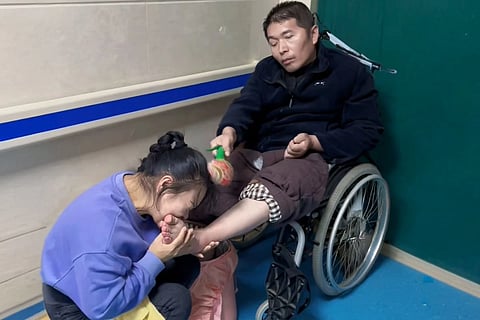
For seven years, every morning, Song Mei did the same thing.
She spoke to her husband as though he could hear every word.
She massaged his arms and legs, played familiar voices and sounds, and gently bit his toes before the day was over.
It wasn't desperation. It had become routine.
Get updated faster and for FREE: Download the Gulf News app now - simply click here.
Doctors had suggested stimulating the nerves in his feet as part of his rehabilitation. There was no promise it would work. Still, Song never stopped trying.
Then, after years of silence, Zhao Jinqian opened his eyes.
His first words were plain.
"I love you."
The story has spread widely across Chinese social media, where many have focused as much on Song's persistence as on Zhao's recovery.
Their lives changed in October 2019.
Zhao, a waterproofing contractor in Henan province, climbed onto the roof of a warehouse after hearing that a three-year-old child was trapped. As he reached the youngster, both fell about six metres.
Witnesses later said Zhao shielded the child with his own body.
The child survived with minor injuries.
Zhao suffered devastating brain trauma and multiple fractures. Doctors told the family he was unlikely to regain consciousness.
For Song, there was no dramatic moment when life changed direction. Instead, it simply narrowed.
She left her job as a kindergarten art teacher and became her husband's full-time caregiver while raising their two children.
Days were organised around rehabilitation.
Exercises. Massage. Conversation. Music. Then more exercises.
Then the same routine began again the next morning.
Family members say there were long stretches when nothing appeared to change. Yet Song treated every day as though her husband might respond.
People in their hometown already knew the couple for helping others.
According to local reports, Song volunteered her time teaching art to children from low-income families. Zhao had quietly paid a student's school expenses from a remote mountain village, despite the family's modest income.
That history helps explain why the story has resonated.
Online comments have described Zhao's rescue of the child and Song's years of care as two acts of the same devotion—one measured in seconds, the other in years.
Doctors caution that recoveries after prolonged disorders of consciousness remain rare.
Patients with severe brain injuries sometimes show improvement through rehabilitation and sensory stimulation, but outcomes vary widely depending on the extent of the damage. Specialists say no single therapy, including nerve stimulation, has been shown to consistently restore consciousness after years in a vegetative state.
Exactly when Zhao became fully aware remains unclear.
What is clear is this: the moment his wife had waited years to hear.
After years spent talking to someone who could not answer, she finally heard his voice.
"I love you."


