US admits firing Hellfire missiles at tanker carrying Indian crew
India calls attacks 'deeply worrisome' and urges an immediate end to such incidents
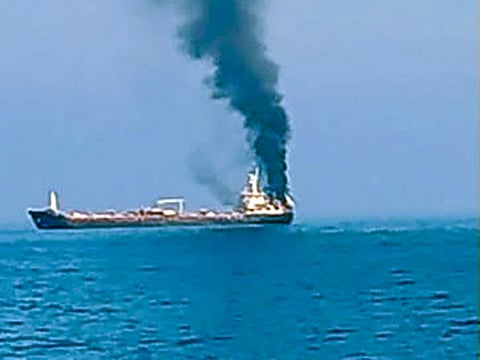
Dubai: The US military has acknowledged firing two Hellfire missiles at a tanker carrying Indian crew members off the coast of Oman, marking the third incident involving Indian-crewed vessels in the region in less than a week and deepening concerns over maritime security in the Gulf.
In a statement posted on X, US Central Command (CENTCOM) said it targeted the Guinea-Bissau-flagged tanker MT Jalveer after accusing it of attempting to transport Iranian oil in violation of Washington's blockade on Tehran.
“US Central Command acted against Guinea-Bissau-flagged M/T Jalveer as it attempted to transport oil from Iran through the Gulf of Oman,” CENTCOM said. “A US aircraft fired two Hellfire missiles into the ship's engine room after the crew repeatedly failed to comply with directions from US forces.”
The US military said it has disabled nine vessels, redirected 135 ships and allowed 42 humanitarian vessels to proceed since launching its maritime blockade on April 13.
According to Iran's Mehr news agency, five of the vessel's 20 crew members were rescued by passing ships and taken to Oman. There was no immediate confirmation from Indian authorities on casualties or injuries aboard the tanker.
What is a Hellfire missile?
The AGM-114 Hellfire is one of the US military's best-known precision-guided missiles, designed to destroy targets with high accuracy while limiting collateral damage.
Key facts
Type: Precision-guided air-to-surface missile
Developer: United States
Primary role: Destroy tanks, vehicles, boats and other targets
Launch platforms: Helicopters, drones and aircraft
Guidance: Laser or radar-guided, depending on the variant
Range: Around 8km, depending on the model
Combat use: Widely used in Iraq, Afghanistan, Syria and other conflict zones
Why is it called Hellfire?
The name comes from its original purpose: Helicopter-Launched, Fire-and-Forget anti-tank weapon. Over time, newer versions have been adapted for a wider range of missions, including strikes against boats, buildings and other targets.
Where has it been used before?
Hellfire missiles have been a key weapon in US military operations for decades and have been used extensively in conflicts in:
Iraq
Afghanistan
Syria
Yemen
They are also commonly carried by attack helicopters such as the Apache and by armed drones.
India condemns attacks
The latest incident comes a day after India formally protested to Washington over another US strike that killed three Indian seafarers aboard the Palau-flagged tanker Settebello off the Omani coast.
India's Ministry of External Affairs on Thursday described the recent attacks on ships carrying Indian crew members as “deeply worrisome” and called for an immediate end to such incidents.
“There have been several incidents involving Indian seafarers in West Asia in the last few days. We attach high importance to the welfare and well-being of our seafarers' community,” External Affairs Ministry spokesperson Randhir Jaiswal said.
“Yesterday, we condemned the attack on a ship off the coast of Oman in which, unfortunately, we lost three Indian nationals. We had summoned the US chargé d'affaires to register a strong protest. We expect the US to take due note of our protest,” he added.
Third incident in days
The attack on MT Jalveer is the third maritime incident involving Indian-crewed vessels near Oman in recent days.
On Wednesday, three Indian seafarers were reported killed after US forces targeted the tanker Settebello, which Washington accused of attempting to breach its blockade on Iranian oil exports.
Earlier, on Monday, a fire broke out aboard MT Marivex south of the Strait of Hormuz. The vessel, carrying 24 Indian seafarers, was damaged in what authorities described as an attack, though all crew members were reported safe.
The back-to-back incidents have heightened concerns in India over the safety of its seafarers operating in one of the world's busiest and most strategically important shipping corridors, as tensions between the United States and Iran continue to spill into Gulf waters.


