Has India’s last school been built?
Fall in fertility rates and shrinking number of children may result in school closures
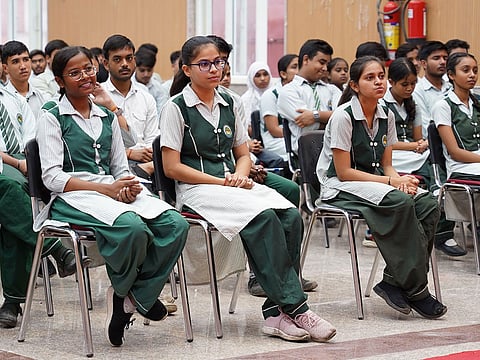
Thiruvananthapuram: For decades, India grappled with a surging population problem, and school textbooks explained the dangers of an exploding population. That trend has distinctly reversed now, with a steadily declining fertility rate, which in turn is manifesting in many ways – like school closures.
The statistics of the shrinking number of children in the 0-14 age group in India is now prompting the question whether India’s last school has already been built.
Statistics given in Parliament point to that: schools are closing not in hundreds, but in thousands, which in turn adds to the chances that India may not have to build any more schools.
India had 1.03 million government schools in 2019-20, but the number fell to 1.01 million in 2024-25, or a reduction of about 20,000 schools in a five-year span. The reasons for the reduced numbers may be outright closures, mergers of schools for want of students, or the repurposing of some schools for other use.
Fall in fertility
The fall in fertility was first experienced by Kerala, and over about a quarter century, all of India is feeling the decline in children’s numbers. Overall school enrolment in India has fallen from 251.8 million in 2022-23 to 248 million in 2023-24, and further to 246.9 million in 2024-25. This comes as little surprise because India’s total fertility rate (TFR) – the total number of children a woman has during her child-bearing years – has fallen to 1.9, below the replacement level of 2.1.
The decline in child numbers is so palpable that Andhra Pradesh chief minister Chandrababu Naidu has advocated a three-child norm to sustain India’s demographic advantage.
The drop in student numbers is most visible in lower classes. In classes 1-5 the total enrolment has fallen from 107.8 million in 2023-24 to 104.4 million in 2024-25, or 3.4 million students less in a single year.
Many schools now barely survive. Government schools with less than 10 students numbered 52,300 in 2022-23, and two years later in 2024-25 there were more than 65,000 of them.
The consequences are multi-fold: the end of the much-valued demographic dividend, a shrinking workforce, economic slowdown, an increased dependency ratio which also implies the need for increased pension and healthcare spending, and changing consumer markets. On the flip side, the government can divert part of education funds to other sectors.
Population projection
Dr S. Irudaya Rajan, Chair at the International Institute of Migration and Development (IIMAD) told Gulf News: “We have recently completed a population projection of India from 2021-2051. It shows in 2021 India had 341 million children between 0-14 years. By 2031, it will decline to 322 million. Meaning, in 10 years from 2021-2031, 19 million children less in the 0-14 age group. Between 2031-41, there will be another 34 million children less and between 2041-51, another 22 million children less. It is part of the fertility crisis we are talking about today.”
Rajan feels this is the right time for India to improve the quality of education. “We should not worry about the decline in enrolment, but about increasing the capability of our young students”, he says.
“In many countries, schools have been converted into day care centres, old age homes and reading places for public”, says Rajan, adding that the time has come for India to think in those lines.
Dr Anil Chandran, Demographer and Assistant Professor at the Department of Demography of Kerala University, told Gulf News: “The sharp fall in number of children, and the large numbers of students going abroad for education, are creating a crisis in the senior care sector. An ageing society, and a drop in the number of children are already creating difficulties for Kerala society”.
Will policies like the one mooted by Chandrababu Naidu yield results? “Unlikely”, says Dr Chandran, pointing out that such measures have been tried in the West and were unable to reverse the fall in fertility.


