Women leaders on navigating crisis and uncertainty
Panelists at UAE forum share how calm, clarity and empathy shape leadership under pressure
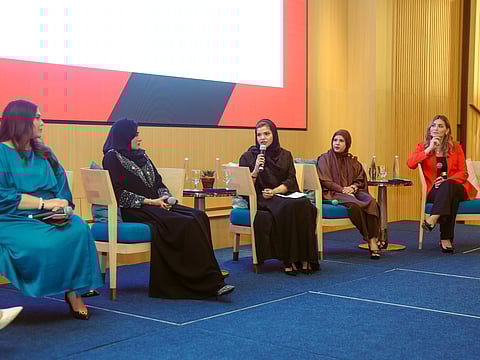
When uncertainty hits, leadership stops being a title and starts showing its true shape.
At the the Tristar presents Limitless: The UAE Power Women’s Forum in association with Gulf News, held at Taj Exotica Resort & Spa, The Palm, five women leaders cut through the noise on what it really takes to steer organisations through volatility. The panel, titled Confronting the Unexpected, brought together voices from education, consulting, real estate, marketing and corporate leadership, each offering a grounded view of how decisions are made when the stakes are high.
For Aditi Jhunjhunwala, Head of Operations, Banke International Properties, it starts at the top. “Leaders have to remain calm and composed,” she says, stressing that tone travels fast across organisations. Clear communication, she believes, is just as critical, because “once there is clarity, people can take better and more informed decisions.” Drawing on the Covid period, she explains how transparency and prioritising employee safety helped her organisation navigate uncertainty, even at the cost of short-term business disruption.
That emphasis on people is echoed by Amal Al Ghammai, Executive Director of Employee Services, American University of Sharjah, who frames leadership as a balancing act between empathy and structure. “Effective leadership requires clarity, calmness and consistency,” she says, adding that transparency remains a core principle, even when answers are not fully formed. In complex environments like higher education, where students, faculty and staff require different messaging, she notes that communication must be tailored, while governance and fairness provide a stable backbone. “Leadership is really about how thoughtfully you navigate the direction for others to follow,” she says.
From a consultancy lens, Alia Noor, Associate Partner, Taxation & Compliance, Ahmad Alagbari Chartered Accountants, offers a sharper, almost philosophical take. “In times of uncertainty, leaders are not prepared, they are revealed,” she says, arguing that volatility does not halt business but reshapes it. Strategy may shift, but direction should not. She points to the UAE’s stability as a key factor in maintaining business continuity, even as global conditions fluctuate. “In times of turbulence, the greatest danger is not the turbulence itself, but acting with the logic you used yesterday,” she adds.
For Yasmin Kayali, Chief Marketing Officer and Societal Impact Leader, Deloitte Middle East, the conversation moves beyond process to mindset. Challenges, she believes, are a matter of choice. “They should not diminish us. Rather, they should help us rise,” she says, linking individual resilience to collective progress. In a supportive environment, she adds, leadership has a multiplier effect. “As you rise, your team rises, your company rises, your community rises, and therefore the country rises.”
That sense of confidence is perhaps most emphatically articulated by Nawal Hussain Al Balooshi, Marketing Specialist, Tristar, who grounds her perspective in the UAE’s leadership model. She points to long-term government investment and preparedness as the reason many residents feel secure even in uncertain times. “If you ask me whether there is any challenge, I would tell you no, because we are ready,” she says, underscoring a belief shaped by both policy and lived experience.
As the discussion shifts from principles to practice, the panel reveals how strategy evolves in real time. Jhunjhunwala explains how changing investor sentiment in real estate has pushed her organisation to pivot away from off-plan sales towards secondary and commercial segments. “We have slightly tweaked our strategy,” she says, noting that hiring decisions have also been recalibrated to prioritise experience and immediate impact.
Al Ghammai brings it back to fundamentals in human resources, where communication remains a constant. “Explaining the why or the rationale really helps a lot,” she says, highlighting the role of clarity in maintaining trust during change. Noor builds on this by emphasising trust as the foundation of high-performing teams. “Preparedness builds confidence, but trust builds strong teams,” she says.
Kayali frames the shift in broader organisational terms, pointing to agility and purpose as anchors in uncertain times. “You are going towards a destination, but you might have to change your route,” she says, adding that protecting people and retaining expertise ensures organisations are ready to move when conditions improve.
The conversation also touches on sector-specific pressures. In higher education, Al Ghammai describes a rapid pivot to hybrid and online systems, supported by continuous communication and flexible policies, including adjusted grading systems. In compliance, Noor stresses that regulatory discipline cannot be an afterthought. “Compliance is not a separate task. It has to be embedded in day-to-day operations,” she says.
In marketing, Kayali highlights the importance of restraint and relevance. During periods of crisis, she notes, credibility matters more than visibility. Campaigns may be paused or redirected, with a greater focus on supporting stakeholders rather than pushing commercial messaging. “Sometimes it is more important to be there for your stakeholders and your clients,” she says.


