Rare Ibn Battuta manuscript fetches nearly Dh1 million at Abu Dhabi book fair
One of only seven known copies records journeys through the Hejaz and Gulf
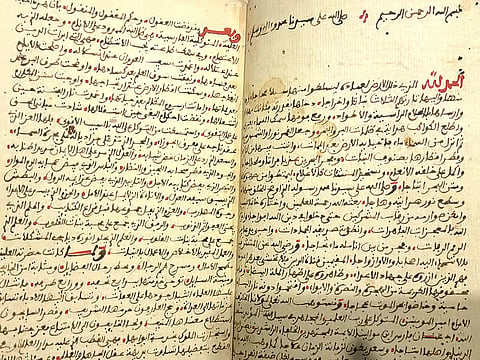
Abu Dhabi: Nearly seven centuries after Ibn Battuta chronicled an epic journey that took him across the Hejaz and the Gulf, a rare manuscript of his famed Rihla has fetched close to Dh1 million at the 35th Abu Dhabi International Book Fair (ADIBF 2026).
Only seven complete or incomplete copies of the Rihla are known to survive worldwide, making the manuscript an exceptionally rare record of one of the medieval world’s greatest journeys.
Get updated faster and for FREE: Download the Gulf News app now - simply click here.
Brought to the fair by London-based rare book dealer Peter Harrington, the manuscript covers the Moroccan medieval explorer’s travels between 1325 and 1333 and contains some of the earliest surviving eyewitness descriptions of places in what are now Oman, the UAE and other parts of the Gulf.
Its nearly Dh1 million price reflects its rarity, age and historical significance. Its value is further enhanced by its preservation of important early accounts of the Hajj and the Gulf, including descriptions of Nizwa, Qalhat, Kalba and Khorfakkan. As a handwritten record of one of history’s most celebrated journeys, it is also of considerable significance to collectors and scholars of Islamic history, travel and exploration.
Born in Tangier in 1304, Ibn Battuta travelled an estimated 120,000 kilometres over about three decades, crossing much of the Islamic world and journeying as far as China and Sumatra. The distance he covered far exceeded the recorded travels of his contemporary Marco Polo.
Also Read: Ibn Battuta: A legendary traveller
The manuscript begins with Ibn Battuta’s departure from Tangier and traces his journey through Cairo, Damascus, Medina and Mecca before continuing to Iraq, Persia, the Red Sea, East Africa, the Gulf, Anatolia and Central Asia. It ends with his account of Neyshabur, now Nishapur in present-day Iran.
Among its most significant passages is Ibn Battuta’s description of the Hajj, considered one of only three major medieval first-hand accounts of the pilgrimage, after those of Nasir Khusraw and Ibn Jubayr.
The manuscript is particularly significant to Gulf history. Ibn Battuta’s account is considered the first description of the southern Gulf following the rise of New Hormuz in 1300. He recorded visits to Qalhat and Nizwa in Oman and Kalba and Khor Fakkan in present-day Sharjah, as well as pearl fishing off the coasts of Bahrain and Qatif.
The quarto manuscript, measuring 250 by 190mm, is written on laid paper in Maghribi script and bound in black-brown calf with a blind-tooled panel design and gilt-stamped fleurons.
The earliest surviving incomplete manuscript of the Rihla, written by Ibn Battuta’s scribe Ibn Juzayy and dated 1356-57, is held by the Bibliothèque Nationale de France. Another surviving copy is held at Cambridge.
Peter Harrington has exhibited at the Abu Dhabi International Book Fair since 2016 and regularly brings rare works to book fairs in the UAE. Previous offerings have included a Shakespeare First Folio valued at Dh20.8 million, the Rothschild collection of explorer Richard Burton’s works valued at Dh9.2 million, and a manuscript of Ibn Sina’s Canon of Medicine priced at Dh464,550.