From migrant farm worker to brain surgeon: How Dr. Alfredo Quiñones-Hinojosa conquered the American Dream
How one of the world’s leading neuroscientist is hunting down the cure of brain cancer
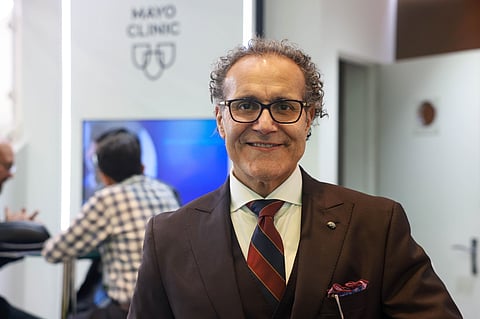
Dubai: Beneath the cold blaze of surgical lights, a patient lies open-eyed and conscious whilst a surgeon navigates the most complex structure known to science - the human brain. Electrodes map neural pathways in real time, a theatre of clinicians works in near-silence and the patient, feels nothing.
One misplaced incision and the consequences are irreversible - a lost word, a stilled limb, a life irrevocably altered. It is less a surgical procedure and more an act of precision under unrelenting pressure, imagine a specialist bomb disposal unit, except the device is the mind itself.
This is the world Dr Alfredo Quiñones-Hinojosa, a leading neurosurgeon at the Mayo Clinic in Jacksonville, Florida, he has spent decades performing what many would consider the most demanding discipline in modern medicine, operating on conscious patients to protect the abilities that define us as human.
"I give you my word, every time I am about to walk into the operating room, my heart is racing at 150 beats per minute. Once I get in there, once I focus my mind, lather my hands and enter that state, my heart rate drops to about 40. I don't know if it's the mind controlling the body or simply the realisation that you have a life in your hands and you have to do everything possible to take care of it,” Dr Quiñones-Hinojosa known widely as Dr Q, told Gulf News at the World Health Expo in Dubai earlier this month.
From migrant farm worker to operating on the human brain
His work in awake brain surgery and the surgical treatment of primary and metastatic brain tumours, with an emphasis on motor and speech mapping, was the subject of an episode of the Netflix docu-series The Surgeon's Cut. But his path to the operating theatre is, perhaps, the more extraordinary story.
In the mid-1980s, at the age of 19, Dr Q crossed the Mexican-American border from Mexicali with no money and no English. He spent his first few years in the US as an undocumented migrant farm worker beneath the unforgiving California sun, picking tomatoes and cotton, welding, laying rail. The same hands that bore the cuts and calluses of that labour, now remove brain tumours.
It was, in part, loss that redirected him. "It had to do with the death of one of my grandparents, my grandmother, who was a midwife and a town healer," he explained. "I looked back and realised I wanted to help people with my knowledge and with my hands. That's when I decided to go into medicine."
He saved what he could, took English classes, and enrolled at a community college in Stockton, the first step in a journey that would take him to UC Berkeley, then Harvard Medical School, graduating from both with distinction. Along the way, he became an American citizen.
The professor who opened the only door
While he was at Berkeley, the assumptions followed him, based on the way he looked, his name and accent.
"Between 1991 and 1994, I had long hair, earrings, a goatee. You look at this kid and may think there's no possible way he would become anything. Most people didn't realise I was getting straight As."
Working 40 hours a week as a physics, calculus and chemistry tutor just to stay afloat, he caught the attention of neuroscientist Dr Joe Martinez, a professor who saw past the surface at a time when few others did, and invited him into his laboratory. It was the door that changed everything.
The first time Dr Q witnessed brain surgery, it stopped him cold. "My knees buckled. I was terrified because I realised how fragile life can be, and how the smallest mistake can take away a patient's ability to see, to hear, to understand, to speak. If I cut just a little bit more, I could take that away in a heartbeat." That terror never fully left him.
Inside ‘awake brain surgery’
Watch the Netflix episode and one detail arrests you immediately, there is a neuropsychologist stationed at the patient's side, mid-surgery, asking them to identify famous faces, stick out their tongue, or smile. The patient complies, brain exposed, whilst Dr Q works millimetres away.
"Because if we compromise that function when I'm taking the tumour out, I know I need to consider stopping right there," he explains. "We're testing functions depending on the anatomy."
The procedure is called an awake craniotomy. The skull is opened but the patient remains conscious because the brain itself feels no pain. Certain regions governing speech, movement, and vision cannot be reliably monitored under general anaesthesia. The only way to know if they are being damaged is to watch the patient perform whilst the surgeon operates. The moment something falters, the surgeon stops.
He touches a site on the brain with a small electrical stimulator whilst the patient is mid-task - speaking, counting, moving a limb and watches. If they pause, freeze or lose the thread, he notes it. Then he waits, releases, and tries again. "It may be that one time was by chance," he said. "So I test every single site two or three times."
Only once a site is confirmed safe, he proceeds and does not simply remove the visible tumour, he takes the margins too. "We know cancer cells are hiding in those margins," he says. It is, in the most literal sense, a search and destroy operation, conducted one careful, reversible test at a time.
Before a single incision is made, months of preparation have already taken place - functional MRI scans and many neuropsychological evaluations.
"I equate a lot of the surgery to a symphony," he said. "To produce that music, to get that rhythm, to test the patient in the most sophisticated ways while they're awake, it's not only about keeping them safe and understanding the anatomy, but about what happens when I'm taking the tumour out. The more of the tumour you can remove, the better those patients will do."
Are we closer to curing brain cancer?
That question sits at the heart of his NIH-funded research (The National Institutes of Health is a part of the US Department of Health and Human Services) into tumour biology, cell migration and how brain cancers spread.
"My peers - other scientists, decide whether my team and I receive tens of millions in funding. It is the highest seal of approval."
His work has contributed to advances now entering clinical trials, including mesenchymal stem cells and CAR T-cell therapy. "Over the last twenty years, we are closer to finding a cure for brain cancer than we were," he said.
Beyond the laboratory, his foundation BRAIN (Bridging Resources and Advancing International Neurosurgery) facilitated surgeries for 53,000 patients across 28 countries last year alone with a team of 2,000 young doctors.
A surgeon who is not afraid of fear
With a job like this, fear and burnout are inevitable, what matters, Dr Q says, is not whether those emotions surface but how you choose to face them.
"I don't think I can ever overcome that of knowing that I have a life in my hands," he says. "If you ever go into the operating room with a brain surgeon who is not afraid, run. Being afraid is part of the respect and awe I have for life and the responsibility I feel as a doctor."
For a man who crossed a border at 19 with nothing, who picked crops beneath the California sun before he ever held a scalpel, fear was never the obstacle, it was always the compass. It pointed him towards a purpose.
"It's not fear that matters," he says. "It's how we respond to it."


