Lana Nusseibeh calls for radical change at UN
UAE candidate for next Secretary-General outlines vision for stronger global leadership
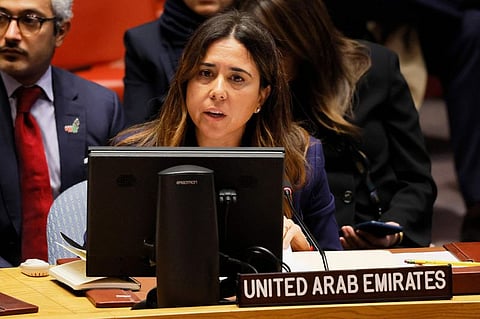
Lana Nusseibeh, the UAE’s candidate for United Nations Secretary-General, has called for fundamental changes to the organisation’s culture, approach and accountability, arguing that the world body needs a more assertive leadership capable of responding effectively to global crises.
In an interview with The Wall Street Journal (WSJ), Nusseibeh outlined her vision for transforming the UN at a time when conflicts, geopolitical divisions and growing questions about the effectiveness of multilateral institutions have placed the organisation under mounting pressure.
“What we require is a radical change in culture, in mindset, in approach, and in how we measure delivery,” Nusseibeh told the newspaper.
The UAE Minister of State, who previously served as the country’s Permanent Representative to the UN, said the contest to succeed António Guterres had attracted considerable international attention because it represented a turning point for the global system.
A more engaged UN leadership
Nusseibeh told the WSJ that she sees herself as a transformational leader who would become a “geopolitical secretary-general”, signalling her ambition to give the UN a more prominent role in addressing international challenges.
Her approach comes amid concerns that the organisation has struggled to influence some of the world’s most serious conflicts, particularly when major powers are directly involved.
According to the WSJ, candidates seeking to succeed Guterres have pledged to assert the UN’s role more forcefully in major international disputes, even as the organisation faces financial constraints and diminishing support from powerful member states.
Sudan a defining test
Nusseibeh identified the conflict in Sudan as a critical measure of the next Secretary-General’s effectiveness, saying that dealing with the crisis would be the litmus test for whoever assumes the leadership of the UN.
Her remarks come as the devastating civil war continues to pose major humanitarian and diplomatic challenges to the international community.
Asked about Sudan, Nusseibeh said she would serve as an independent Secretary-General, with her allegiance firmly anchored in the United Nations, its Charter and international law.
Her response underscored the importance she places on the independence of the office and the responsibility of its holder to act in accordance with the principles governing the international organisation.
Experience in Security Council diplomacy
Nusseibeh’s candidacy draws on extensive diplomatic experience, including her role in securing a UN Security Council resolution on humanitarian assistance to Gaza in December 2023.
As the UAE’s representative to the UN, she helped steer the resolution through the Security Council, facilitating the delivery of humanitarian aid during the war between Israel and Hamas.
The resolution was one of her notable diplomatic achievements, alongside the work of Costa Rica’s Rebeca Grynspan in helping secure an arrangement to protect Black Sea grain shipments during the Russia-Ukraine war.
Nusseibeh’s experience in navigating Security Council negotiations provides a practical backdrop to her proposals for more effective UN leadership, particularly at a time when disagreements among major powers have frequently obstructed collective action.
Raised in the UAE, Nusseibeh comes from a prominent Palestinian family in Jerusalem. Her father, Zaki Nusseibeh, moved to Abu Dhabi after the 1967 war and later became a close adviser to the UAE’s founding father, Sheikh Zayed bin Sultan Al Nahyan.
She told the newspaper that this background had shaped her appreciation of the international system and her determination to help renew it so that it could remain credible and deliver meaningful results.
Race to succeed Guterres
Nusseibeh, 48, is among eight candidates seeking to succeed Guterres, whose second five-year term ends on December 31.
If selected, she would become the first woman, the first Muslim and the first person of Palestinian descent to lead the United Nations.
Among Nusseibeh’s principal rivals is Costa Rica’s Rebeca Grynspan, who has led most of the informal Security Council ballots since July, according to The Wall Street Journal. Grynspan, 70, who heads UN Trade and Development, has advocated reforming the organisation from within and restoring its role in resolving conflicts. However, her candidacy has faced opposition from permanent Security Council members, believed to include the United States. Another contender, Argentina’s Rafael Grossi, who heads the International Atomic Energy Agency, has ranked second in the voting but is believed to face opposition from Russia and Britain. With no candidate securing the necessary consensus, the contest remains open ahead of Guterres’ departure on December 31.
The Security Council is expected to hold another round of voting on Thursday as its members seek agreement on a candidate to recommend to the General Assembly.
The selection process remains complicated by divisions among the five permanent members of the Security Council, whose agreement is essential before a candidate can be recommended for appointment.
A Reuters report on Thursday said the council had yet to reach consensus after eight rounds of informal voting.


