Inside a UAE classroom on the first morning back: How UAE teachers handle school nerves
From a 5am wake-up to a hands-up anxiety check, how one UAE school handles day one
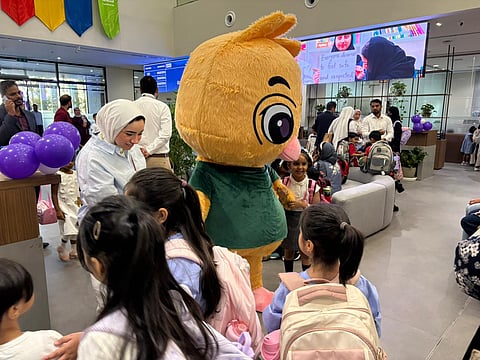
Somewhere in the UAE this morning, a child woke at 5am because they were too excited to sleep. Another walked into a classroom and cried. A third put a hand up when a teacher asked who was feeling anxious.
The first day back is a small emotional event for thousands of families across the Emirates, and it lands differently on every child. Gulf News spent the morning at North Gate British School in Ajman, where the timetable has been built around settling children rather than teaching them, and where one member of staff works full time on a job most schools fold into detention slips.
The 5am start
For Balaji Anbanathan, the day began before dawn. His son Tuhinbala, starting Year 3, barely slept. The excitement kept the boy up through the night, his father said, and the family was awake by 5am. Anbanathan took the morning off work to walk him to the gates.
Year 1 teacher Juhi Varma was meeting a room of children she had never taught.
"I have different kind of children with different nationalities in my classroom," Varma said. Some walked in settled and went straight for the activity stations. Others arrived in tears.
Her handling of it is deliberately unhurried. "So now they are entering as it's their first day and I am their teacher. They don't know me. It's a totally new day," she said. "I'll be just supporting all of them to just engage them in the activities, to know about them. They should know about me."
I had asked her what she does about separation anxiety, Varma pointed to one girl in particular.
"I have one girl, so I need to sit with her. I have to make her happy," she said.
The plan is not to distract the child immediately. It is to sit down, ask what is upsetting her, then move her gently towards something absorbing until the homesickness loosens.
'Raise your hand if you're feeling anxious'
Further along the corridor, Year 6 form teacher Cynthia Nakayenga opened the year with something other than a lesson, running a mental check-in and asking students to raise their hands if they felt anxious.
It puts the feeling in the open, as a normal thing to admit rather than something to carry until home time.
That approach is timetabled, not improvised. Vice Principal Kamran Ajmal said morning form periods exist for it.
"The form tutors will be there to support them," Ajmal said, describing the session as a wellbeing check where students can reflect, ask where they are meant to be, and raise anything worrying them before academic work begins.
The other point comes at 2pm, when tired children have to find the right bus. "We're going to organise the students into the correct buses at the end of the day. We're going to walk them down and make sure they're getting on the correct bus," he said.
The first day of school ever
Some children have nothing to compare it to. Four-year-old Zad Hassan started FS2 today, his first day of school in his life.
His father, Hassan Mohyeldin, had been counting down with him. "We were counting down the days till the first day of school," Mohyeldin said.
The nerves seemed to dissolve on arrival. "He's playing, as you can see. He's accommodating himself as well," his father said, watching him head for the play area. "It's really nice, as I said before, it's a good feeling, as a parent."
The teacher whose job is asking why
The same logic runs through a role the school has created that few others have. Mahmood Fida is a restorative behaviour teacher, working mainly with secondary boys, and his brief is not punishment. It is diagnosis.
When a teacher flags a student, Fida starts with a conversation about what has changed. He gave the example of a Year 10 boy acting up in class: rather than reaching for a consequence, he asks whether the boy was like this before, and what has happened since.
"Most time we see that he's misbehaving. But we need to find the reason why is he? Because he's just a child. He doesn't know so many things," Fida said. "Maybe he's confused. He wants to explore himself."
The questions stay consistent. How it started, why it occurred, and how the school can help.
He is clear the role covers the positive side too. There are two kinds of behaviour, he says, and both get attention, so the good is noticed as deliberately as the difficult. I asked him to name a favourite student, he refused.
"If you go by the list, there are thousands. They're so lovely, they're so sweet," said Fida. "This is the age to explore themselves."
He would like to see the job exist elsewhere, arguing that behaviour is a precondition for learning rather than a distraction from it.
"I'll motivate every school to have it. It's really good, because it really helps the student," he said.
What older students share works
Children who have done this several times give sharper advice than most adults. Year 9 student Yunus Majid, back from a summer in Scotland, went straight to friendship.
"If you're alone, you're not gonna feel like motivated to do a lot of stuff unless that's your personality. I think having friends is a key for motivation," he said. His second tip is a mindset shift: treat it as your school, not somewhere your parents dropped you off, and be friendly with teachers rather than wary of them.
Classmate Hayyam Abid, back from Pakistan, keeps some learning ticking over outside school hours so the return is less of a jolt, doing extra maths with his mother and his older brother.