Dubai Future Week opens with five hard questions for AI
Speakers at Dubai Future Week question AI on trust, agents and time in an AI city.
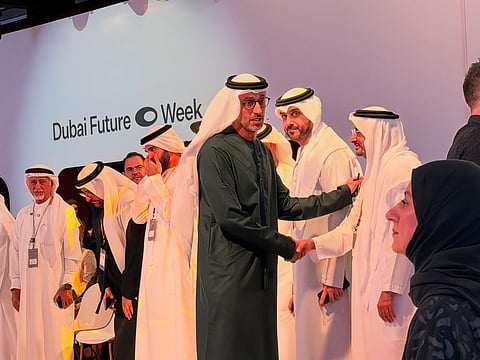
The Dubai Future week kicked-off with officials ready to take on what happens next, in the future quite literally. At the AI retreat a closed door session which brought together government and industry leaders in one room to pick their heads about moving from AI experimentation to everyday operations.
Khalfan Belhoul, CEO of Dubai Future Foundation, set the stage by asking the room full of delegates, “What happens the day after AI becomes the norm?”. He spoke of how we are already in the execution phase, with the infrastructure to support AI ready, models up to speed with reality. “Where then is the advantage?” he asked.
He emphasized on where value goes once infrastructure and models reach saturation. Telling officials that they must now prepare for the next chapter. Speaking of agentic AI, he said, “Once agents speak to agents and transactions are purely agentic, who is the customer?” he asked.
He then turned towards trust. “Who can we trust once anything can be generated?” He also cautioned that AI will start building and improving itself. Conversations can no longer revolve around simply asking models to do mundane tasks, we have to get AI agents to efficiently work while also keeping an agile environment.
Dubai accepts that mistakes will happen, he said. Regulatory sandboxes let officials test fast while protecting people. “Let’s focus on this conversation to be the first in what happens after that,” he told delegates.

Younus Al Nasser, CEO of Dubai Data and Statistics Establishment at Digital Dubai spoke on how Dubai can become an intelligent city for a simpler life. “No one can predict the future,” he said. The skill that counts now, is asking the right question.
He described three shifts with fitting examples that summarize the direction Dubai is taking to be a city of the future. The first starts with a woman who has just moved to Dubai. She needs a visa, a bank account, a car and a phone line. Today she deals with each provider separately. Tomorrow she asks once and the city responds. “We are moving from services into fulfilling needs.”
The second concerns business, he said. There will come a time when a customer’s agent will negotiate prices and terms with other agents. “These AI agents don’t have preferences,” Al Nasser said. He asked why then would an AI agent pick Dubai over any other city. He urged government delegates to ponder on the fact that businesses have moved from going out there to look for customers to be found online and by AI. “Tomorrows companies will have to trust AI to make them seen.”
The third came from his own home. Work alerts and payment reminders pull him away from his children. He called AI a time-shortening machine, “I have dedicated my tasks to the AI agent, provided I can spend more time with my kids.” Al Nasser admitted he lacks answers to some of his own questions. But that was the point.
Delegates left the AI Retreat with a homework list. Government officials now carry the questions back to their teams, with the aim of returning to the next Dubai Future Week with answers ready.


