Born in Kazakhstan, raised in UAE: How teen turned curiosity into gold at International Economics Olympiad
A medal is a victory for sure. And, it all began with, curiosity.
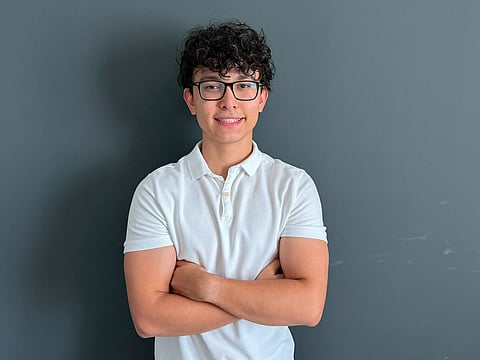
He is bright and beaming, as one should be after winning a gold medal.
Ali-Mansur Valiyev relates his journey to the International Economic Olympiad, with a cheery ease, not downplaying the triumph but neither painting it too colourfully. He describes the process in matter-of fact tones, stating that it involved reading the news, dissecting economic concepts, attending training camps.
That journey eventually took him to Shenzhen, China. When he learned he had won gold at one of the world's leading competitions for high school students in economics, finance and business, there was one person beside him to celebrate: His mother.
Recalling the feeling, he says, “It was quite a surreal experience. I think, going into this a few years back, I didn't really expect to win gold or even take part in the Olympiad. But yeah, I think the moment when I won gold, I was with my mum as well and it was quite exciting.”
The 2026 IEO brought together national teams from across six continents, with Valiyev among five students selected to represent the UAE after a rigorous selection process involving students from 56 countries.
A medal is a victory for sure. And, it all began with, curiosity.
From Kazakhstan to the UAE
Valiyev’s story in the UAE began long before economics entered the picture. Born in Kazakhstan, he spent the first four years of his life there. He explains what brought him to the UAE: “When I was young, I had Laryngitis and the conditions there in my hometown in Kazakhstan weren't really too good for me, because I was getting sick really often because of all the dust and everything.”
And so, he moved to the UAE to be close to the beach and that’s where he has been for the past 13 years. It's home, now.
It was at Dubai College that economics entered his life. He first encountered the subject in Year 10, an introduction that would eventually shape his future. “I began learning economics formally when I was in Year 10, and I think that the teachers that I had there were incredible, incredible at guiding me.”
The classroom gave him the foundations. Curiosity did the rest.
When economics stopped being just a school subject
The IEO tests far more than a student's ability to memorise economic theories. For Valiyev, economics had become a way of making sense of the world around him.
Before long, he found himself venturing beyond the classroom, exploring ideas that went far beyond the curriculum simply because they fascinated him.
“I really enjoyed taking that and then going out on my own outside of the school lessons and the school curriculum and really delving more into what I thought was interesting. I think I was really curious about this subject.”
This feeling of pulsing curiosity fired his preparation for the Olympiad. After signing up for the UAE qualifiers, Valiyev spent nearly two years working through training camps and selection rounds before earning a place as one of five students chosen to represent the UAE.
Preparation, however, wasn't about memorising formulas or spending endless hours buried in textbooks. It meant learning independently, following global news and applying economic thinking to real-world events. While the UAE training camps lasted around two hours, students were expected to continue building their knowledge well beyond those sessions.
“I would wake up in the morning, do a bit of studying and, rather than just studying for the IEO, look into economics as a whole—reading about different concepts, following the news and developing my understanding of the world through economics.”
Two years of preparation and a few missed social events
There was, inevitably, a balancing act. Valiyev was also a student, working on other projects and research, while pursuing interests outside academics.
And yet, he managed, and kept up with physical activity too, including going to the gym and swimming. “Obviously a few social events had to go, because of the training, but I mean it is what it is.”
The closer the Olympiad came, the harder it was, to balance.
But years of balancing school, research and other projects had already taught him a skill that would prove invaluable: how to prioritise.
“I think that over the course of these past few years, being at a school like DC, taking on different projects and doing research taught me not only time management, but also how to prioritise and balance my time efficiently.”
And, importantly, he did not see the preparation as something he had to endure just to win.
The secret weapon: Actually liking what he was doing
So, what kept him going through two years of preparation?
Passion. Passion for what he was doing. “I think that's, for me... I'm just really happy I'm doing a subject that I'm actually passionate about, and that's probably the greatest thing for me,” he says.
For Valiyev, economics isn't confined to graphs or the intricacies of national income accounting. It is a way of making sense of the world.
“When I read world news, for example, I can apply economic thinking to almost any topic. It allows me to understand not only what is happening within a particular industry, but also how it connects to the wider world, different countries and broader global trends.”
That ability to connect seemingly unrelated events is what keeps the subject engaging.“I think that economics is a really crucial subject because it helps me understand how the world operates, from the global economy to individual companies.”
And the medal wasn't a carrot dangling in front of him. "It was really curiosity that I had for the subject, and it kind of allowed me to keep on going.”
Then came the moment: 'I could actually win this'
The IEO was divided into three rounds, each designed to test a different kind of economic ability. The first tested foundational economic knowledge. The second involved essay-style problems requiring students to apply economic reasoning to subjects including AI, data centres and current events. The final round was a business case challenge in which participants effectively took on the role of consultants and presented a solution to a business problem.
With competitors arriving after making it through their own national selection processes, Valiyev had no shortage of reasons to feel daunted.“I didn't really have any exact expectations going in,” he says.
His strategy: Focus on his own preparation rather than getting distracted by the competition. “The main thing for me that really helped me through, was that this entire process was just focusing on my own path and my own journey." He didn't focus too much on the competitors and the people he was up against. He focused on himself, and his own knowledge.
Then came the first round, the moment when his preparation began to translate into confidence. “In the first round, I think for the economic knowledge, I felt really good because I think my knowledge was able to be showcased in that round.”
For the first time, a medal felt within reach. “I think as soon as I finished that first round, I understood that, okay, I do have a solid chance of doing well in this competition.”
Learning to think, not just remember
Perhaps the most challenging part of the Olympiad was also what made it the most rewarding: there was no way to predict exactly what questions would appear.
“They can apply to any scenario, or they are new. You won't see them in previous Olympiads or past questions. They are always quite new and apply to different scenarios.”
This meant preparation had to go beyond memorising theories and formulas. Valiyev needed to understand economic principles deeply enough to apply them when faced with unfamiliar problems.
“I think that's essentially the main thing for me — having that good base of understanding so I could apply in different scenarios and really reason and think about how economics really applied in the real world as well.”
The Olympiad was not just a test of what he knew, but how he could think.
The people behind the medal
While Valiyev’s independent curiosity played a major role, he is quick to credit the people who helped him along the way.
His teachers at Dubai College, he says, provided the initial exposure that allowed him to develop his interests further. Mentors also became sounding boards, particularly when it came to discussing economic developments and events in the news. That environment gave him the freedom to move from just learning economics to questioning it, applying it and discussing it.
What comes after gold?
For now, the gold medal remains a major milestone. But Valiyev says the focus should not be on chasing achievements alone, it should be on following genuine interests and being open to opportunities.
“Just do what you're passionate about.”
His other advice is simple: try things, even if they do not immediately lead anywhere.
“Ensure that you sort of take up every opportunity that you can if it's something that interests you, even if you think it might not lead to anything.”
Not every project or idea he explored before the Olympiad became a major achievement, but he says those experiences still shaped him.
“Before the Olympiad and before all of these projects and research came to fruition, I was trying out and doing a lot of things that maybe didn't lead to anything but really gave me some great experiences and great things that I really value now.”
For someone who entered a global competition without expecting to win, the gold medal was the result of years spent exploring what interested him.


