Is Dubai emerging as value medical tourism hub for rare-disease care, gene therapy?
Patients are travelling to Dubai for gene therapies unavailable in home markets
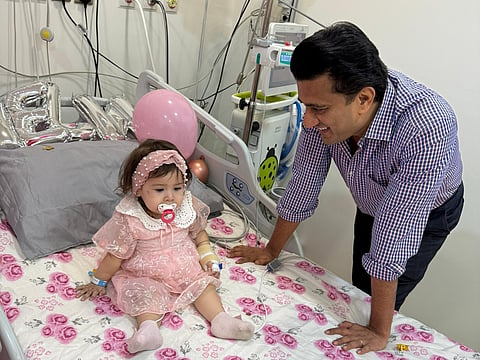
Dubai: Dubai is emerging as a medical value tourism destination for patients with rare and complex diseases, with international families travelling to the emirate not simply for healthcare, but because specialised expertise, advanced technology and specific gene therapies, the head of a top hospital group has said.
The shift is taking medical tourism beyond the traditional model of travelling for treatment in a particular destination. For rare-disease patients, the destination can be determined by whether a particular therapy, clinical team or treatment pathway is accessible.
Take for example, Medcare Hospitals Group.
The healthcare group says it has treated 280 international patients with two rare genetic disorders — 225 with Spinal Muscular Atrophy (SMA) and 55 with Duchenne Muscular Dystrophy (DMD). The patients have come from more than 30 countries across the Middle East, Europe, Central Asia and Southeast Asia.
Dr Shanila Laiju, Group CEO of Medcare Hospitals, said the international patient base is becoming more geographically diverse. “Patients are travelling to our Dubai facilities for complex treatments spanning oncology, cardiac sciences, neurosurgery, gene therapy and rare disorders, and orthopaedic and spine care.”
Rare care
The growth is particularly visible in rare genetic conditions, where access to a specific treatment can determine where a patient travels.
Medcare says it has recently became the first hospital outside the US to administer a newly licensed intrathecal gene therapy to an adult patient with SMA, Dr Laiju. The patient, a 22-year-old Egyptian man, travelled to Dubai for the one-time treatment after spending much of his life dependent on a wheelchair.
Another case involved six-year-old Turkish patient Cinar Atar, who travelled with his family to Dubai for DMD gene therapy because the treatment was not available in Turkey.
For patients and families dealing with rare diseases, therefore, medical tourism can be less about finding a cheaper procedure and more about finding treatment that may not be accessible at home.
Laiju said the international patients treated by Medcare have mainly come from the Middle East, European countries, Central Asia and Southeast Asia, with Turkey among the key markets. She said some patients previously faced the prospect of travelling as far as the US for treatment. “Dubai has an advantage of having, you know, that connectivity here,” she told Gulf News.
Beyond tourism
Laiju said the distinction between conventional medical tourism and what she described as medical value tourism is important. For rare diseases, she said, patients are not necessarily travelling because Dubai itself is an attractive destination. They are travelling because a particular combination of expertise, technology and clinical capability is available.
“The healthcare journey is not only about the treatment,” she said, pointing to the UAE's connectivity, visa processes and wider tourism ecosystem.
She said Dubai's medical tourism proposition is increasingly about creating an integrated journey around specialised care.
“What Dubai is trying to do is why not have every expertise here, bringing the advanced technologies, the innovative treatments that can be there,” she said “For these rare diseases, like these genetic diseases, you need to have that clinical expertise team that is available, which I think is definitely an advantage here as well.”
Global access
The UAE's regulatory environment is another part of that proposition, according to Laiju. “One of the key factors positioning the UAE as a destination for cutting-edge healthcare is the proactive approach of the authorities in approving breakthrough gene therapies,” she said.
“This gives patients access to some of the world’s most advanced therapies at an early stage and is helping establish the UAE as one of the primary destinations for patients seeking innovative gene treatments.”
She also pointed to the country's international medical workforce and adoption of advanced technologies. “The UAE brings together medical expertise from across the world, with clinicians, nurses, paramedics and allied healthcare professionals contributing to a highly diverse pool of medical talent,” she said.
“At the same time, hospitals in the country have been early adopters of advanced technologies for managing complex cases.”
Together, she said, these capabilities are strengthening the UAE's position in specialised medical care.
A longer stay
Rare-disease treatment also differs from the more familiar medical-tourism model of a short hospital visit followed by a return flight. Laiju said patients can spend one to two months in the UAE, although the duration varies depending on the case and treatment pathway.
Before travelling, patients undergo a teleconsultation so doctors can establish whether they are eligible for the treatment. Once the clinical assessment is complete, a dedicated team helps manage the process. “For international patients, the healthcare journey can begin well before they arrive in Dubai,” Laiju said.
Medcare's international-patient service includes medical second opinions, virtual consultations and treatment plans, as well as assistance with visas, travel and accommodation, multilingual support and a dedicated point of contact. The treatment itself can also involve multiple medical specialties.
“It’s always a multidisciplinary team of doctors,” Laiju said. “A lot of specialties [are] involved in this.”
The cost factor
Gene therapy is expensive, but Laiju cautioned against making simple price comparisons between Dubai and other international destinations. “It is very expensive. Especially the drug that's used is very expensive,” she said. But she said patients with complex diseases typically consider more than the treatment bill itself.
“They consider the overall healthcare journey, the accessibility, the expertise and continuity,” she said.
The cost can also vary substantially depending on the therapy, disease and eligibility of each patient, making a generalised Dubai-versus-another-country comparison difficult. The financial burden means some international patients rely on crowdfunding and charitable organisations to fund treatment, Laiju said.
Dubai's next step
For Dubai to expand its rare-disease medical tourism proposition, Laiju said the next opportunity is to make the entire journey easier and more affordable for international patients.
“Dubai has built a strong ecosystem around tourism, connectivity and healthcare,” she said. “The next opportunity is to create more incentives for international patients to choose the UAE for specialised healthcare, particularly for complex and rare diseases.”
Among the measures she suggested were support with airfares and travel, further streamlining of medical visa processes and arrangements with hotels to offer reduced rates to patients who may need to remain in Dubai for weeks or months.
She also said greater international awareness of the UAE's specialised medical centres is needed. “There is a lot of awareness that is required because many people may not know it,” Laiju said. “We need to shout out a little bit more probably.”
That could become increasingly important as Dubai tries to build a medical value tourism proposition around expertise rather than simply destination appeal.
According to market research from Custom Marketing Insights, the UAE medical tourism market is projected to grow at a compound annual growth rate of 8.7 per cent between 2024 and 2033, from a projected $1.09 billion in 2024 to $2.3 billion by 2033.
For Gulf patients, the development also points to a broader shift: specialised care that once meant travelling to the US, UK or Germany is increasingly becoming available closer to home, while Dubai's air connectivity and tourism infrastructure can make it easier for international families to combine complex medical care with a longer stay in the UAE.
Medcare is not alone in seeking to build the UAE’s reputation for advanced treatment of rare and complex diseases. Fakeeh University Hospital in Dubai has positioned its gene-therapy capabilities as part of the emirate’s emerging role in advanced genomic medicine, while Aster Hospitals offers international-patient services covering rare genetic conditions, including gene therapies for spinal muscular atrophy (SMA) and Duchenne muscular dystrophy (DMD).
Dubai Health’s Al Jalila Children’s Hospital has also operated an SMA gene-therapy programme since 2020, helping bring treatments to patients in the UAE rather than requiring families to travel overseas.
The push extends beyond Dubai. In Abu Dhabi, M42 and PureHealth have been involved in developing gene-therapy research and manufacturing capabilities for rare diseases, while Cleveland Clinic Abu Dhabi has been involved in a UAE-first gene-therapy clinical trial for a rare inherited eye disease.
Together, these developments point to a broader UAE push to build capabilities in rare-disease treatment, genomic medicine and gene therapy, rather than relying solely on conventional medical tourism.


