London’s talent pool at risk if tax bands stay frozen, Cameron says
Former PM says frozen tax bands could erode London’s talent base
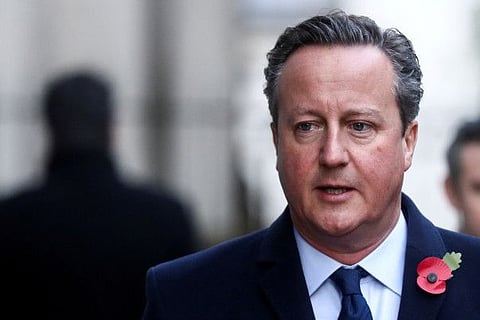
Dubai: Former UK Prime Minister David Cameron voiced concern that London risks losing its appeal as a global business hub if tax thresholds remain frozen and economic competitiveness weakens.
“I am worried about it. I want talented people to think I’m welcome to stay in London. I want to build a business in London,” said Cameron at the Abu Dhabi Finance Week. “Yes, there are issues about how we tax people, but we’ve also got to make sure all the other things we’ve got going for us, our schools, universities, quality of life, remain strong. So yes, it is a worry.”
Freezing thresholds risks talent drain
Cameron added that the current fiscal stance risks pushing more middle-income earners into higher tax brackets. “If we keep freezing tax thresholds, we’re going to see people at relatively low amounts of earnings paying a 40% rate. They’ve got to think about that,” he said, noting that London’s position as a top-tier financial centre demands urgent policy focus.
“In the rankings you’re doing here [Abu Dhabi], I think we still rank number two overall, but to maintain that place we’ve got to make sure we’re firing on all cylinders. Getting pension funds to invest more is going to be part of that.”
Relocation trend gathers pace
According to the Henley Private Wealth Migration Report 2025, the UK is set to lose a net 16,500 millionaires this year, the highest on record, while nearly 10,000 are expected to arrive in the UAE. The surge follows a pattern of professionals across finance, healthcare, and technology relocating to Dubai and Abu Dhabi, driven by a mix of lifestyle and taxation differentials.
“Making the move from the UK to the UAE used to be an exotic adventure,” said Dr Tracie Scott, Assistant Professor at Heriot-Watt University Dubai. “In 2025, it has now become commonplace. The cost of living in the UK, salaries that are not commensurate with taxation rates, including a 20% VAT, does not leave much for a family to enjoy at the end of the month.”
Economic adjustment in motion
Analysts say the movement points to a deeper reordering of global wealth flows. Dr Jelena Jajusevic, Deputy Global Head of Department (Accountancy, Economics and Finance) at Heriot-Watt University Dubai, observed that the UAE “is benefiting from a global reshuffle of wealth” concentrated in hubs that offer stability and tax efficiency.
“This concentrates mobile wealth in a few hubs that offer safety, low taxes and strong infrastructure, and leaves traditional welfare states with a shrinking pool of high-income taxpayers,” she said. “For the UAE, the opportunity now is to channel incoming wealth into productive areas such as green infrastructure, digital innovation and talent development.”
Cameron’s remarks also reflect a broader anxiety over the UK’s economic direction following Brexit and years of political volatility. “I ran the campaign to keep Britain inside the EU and, ultimately, I lost that campaign, and obviously I regret the fact that I lost,” he said. But he rejected the view that the referendum itself was reckless. “You can’t govern a country and take people with you if you keep promising them a choice and don’t give them a choice.”
As the UAE consolidates its status as a magnet for capital and expertise, the challenge for London, as Cameron implied, is to remain a place where business, investment and ambition still find the same home advantage they once did.