My Business: A five-minute family scare led this UAE founder to build a safety wearable
Tapy’s Aman Watch helps families track people of determination and elderly relatives
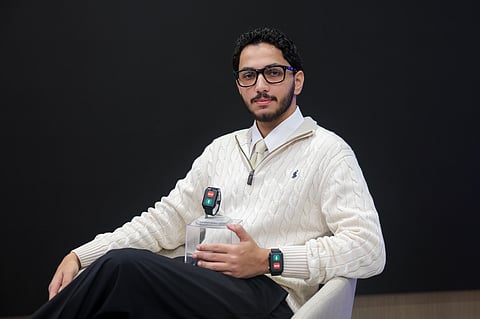
Dubai: Youssef Alhussainy did not set out to build a company. The idea for Tapy began during a house move, when his sister Rawda, who has Angelman syndrome, slipped out of the family home unnoticed.
Rawda is non-verbal and needs constant care. The family found her on the street after a few minutes, but the shock stayed with them. “Those minutes of not knowing where she was changed something in me permanently,” Alhussainy said.
Get updated faster and for FREE: Download the Gulf News app now - simply click here.
The 22-year-old Egyptian founder, who grew up in the UAE and is based between Dubai and Sharjah, began looking for a product that could help his family prevent such a scare from happening again. Trackers, wearables and apps were already available, but none worked for Rawda’s needs.
A family problem becomes a business
General GPS trackers did not solve the problem, Alhussainy said, because they were not designed for someone who could not press a button, describe a situation or keep a device on if it felt uncomfortable.
“My sister Rawda whom has Angelman syndrome. She is non-verbal, and like many people with her condition, she has a tendency to wander,” he said. “I did not set out to start a company. I set out to protect my sister, and then realised that millions of other families needed the same thing.”
That search led to the Tapy Aman Watch, a UAE-made smart wearable for people of determination and the elderly. The first version started as a DIY solution for Rawda, but people began noticing the device and asking about it. Families facing the same fear saw something they recognised immediately.
Tapy was soft-launched in October 2024 and has since reached families across the UAE, Australia, New Zealand, Saudi Arabia, Jordan, Malaysia and Kuwait. Its first batch sold out within months.
Built around care
Alhussainy says the company’s biggest success was the No Families Left Behind initiative, which works with sponsors to provide watches to families that cannot afford them.
“Our biggest success is the No Families Left Behind initiative, a collaborative effort with sponsors who share our belief that safety should not be a privilege, through which we have placed 150 watches with families who are not able to acquire the device on their own,” he said.
That mission is closely tied to the product’s purpose. Tapy is aimed at families caring for children with disabilities, elderly relatives and others who may be at risk of wandering or isolation emergencies. Alhussainy says messages from families who say the watch helped bring someone home safely remain the strongest measure of the company’s work.
The company has also been recognised as Best UAE Homegrown Business at the MBRIF Demo Day and has appeared on EDB Accelerator Live.
Learning to scale
Alhussainy said one of the hardest lessons came from trying to build quickly without having every part of the operating model ready to scale.
“One of the harder realities we faced early on was not having the correct infrastructure to scale,” he said. “A company’s reputation is its most important asset. You can lose money and recover. You cannot easily recover from losing the trust of the people who believed in you early.”
That lesson influenced how Tapy now thinks about operations, customer support and delivery. The company has been largely self-funded, which Alhussainy said forced discipline around spending and priorities. Support from programmes such as MBRIF helped with exposure, credibility and access to mentors and investors.
He also credits the wider UAE ecosystem for making the business possible. The country’s free zones, infrastructure and openness to innovation in health and assistive technology gave Tapy a practical base from which to grow.
“The UAE has been genuinely supportive in ways I did not fully anticipate when we started,” he said. “There is a genuine willingness here to support products that address real social needs.”
A founder shaped by family
Alhussainy comes from a business family and says he was raised to be a builder. From a young age, he attended meetings, helped source materials and watched decisions being made up close. That exposure helped shape his confidence, but Tapy also became deeply personal because two of his closest family members are co-founders.
“There is a layer of trust and shared purpose in working with family that is difficult to replicate, and for us, it has been one of our greatest strengths,” he said.
There were moments when the easier route looked tempting, especially when operational challenges felt larger than the progress being made. A 9-to-5 job was visible, but the problem remained too personal to walk away from.
“Every time I considered stepping back, something would bring me back to why we started: a message from a family, a close call someone shared with us, a reminder that the gap we identified is real and still largely unfilled,” he said.
What comes next
Alhussainy wants Tapy to become a trusted safety layer for families across the GCC, serving homes, schools and care centres. He also wants the No Families Left Behind initiative to become more structured through partnerships with healthcare and social welfare systems.
His advice to new founders is to “Start with a problem you cannot walk away from. Not a trend, not a gap in the market, but something that genuinely keeps you up at night because it matters.”