UAE’s Dh1 billion Fujairah desalination plant: What it means for water supply
Project involves building a major facility that will convert seawater into potable water
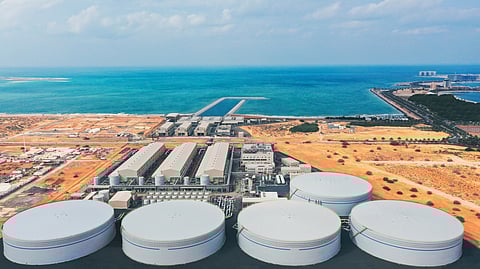
Dubai: Plans for a new large-scale desalination plant at the Port of Fujairah on the Gulf of Oman are set to add significant capacity to the UAE’s water supply network in the coming years, following its announcement on Tuesday.
The project involves building a major facility that will convert seawater into potable water for homes, businesses and industry, using modern desalination technology to support growing demand across the UAE.
Get updated faster and for FREE: Download the Gulf News app now - simply click here.
What is being built?
Key details:
Investment value: Dh1.046 billion
Capacity: 60 million imperial gallons per day
Technology: Seawater reverse osmosis (SWRO)
Storage: Equivalent to 18 hours of production
Timeline: Around 30 months to completion
The plant will draw seawater, remove salt and impurities, and supply potable water for residential, commercial and industrial use.
How the process works
SWRO desalination forces seawater through specialised membranes under high pressure. These membranes separate salt and other impurities, producing clean water suitable for consumption.
Compared with older thermal desalination methods, reverse osmosis typically uses less energy. This makes it a widely adopted approach for new desalination plants across the UAE.
Why this matters
As arid climate conditions, urban development and industrial expansion continue to increase consumption levels, there’s always need for additional capacity to ensure uninterrupted supply. Expanding desalination output is seen as essential to maintaining long-term stability.
Projects such as Fujairah I help ensure supply keeps pace with demand, especially during peak usage periods. The plant’s storage capacity also plays a role. By holding nearly a full day’s production, it helps maintain supply if demand spikes or operations are temporarily disrupted.
How it is structured
The Fujairah I plant is being developed under a public-private partnership (PPP) model. This means:
Private companies handle construction and delivery
The utility secures long-term water supply agreements
This is EtihadWE’s second such project after the Naqa’a IWP, which has a capacity of 150 million imperial gallons per day.
Who is building it
The project will be delivered jointly by NMDC Infra and Lantania Aguas through Lantania NMDC Water.
NMDC Infra brings experience in large-scale infrastructure and marine works
Lantania Aguas specialises in desalination technology and water treatment
Together, they will design, build and commission the plant.
What happens next
Construction will cover civil works, installation of systems and final commissioning over roughly 30 months. The plant will begin operating at partial capacity before reaching full output of 60 MIGD.
Once operational, it will supply desalinated water across Fujairah and EtihadWE’s wider service areas, supporting households, businesses and industrial users.