DTC begins talks to revise Abu Dhabi taxi fares after National Taxi acquisition
DTC confirms Abu Dhabi fare talks and plans to expand autonomous taxis from 2027
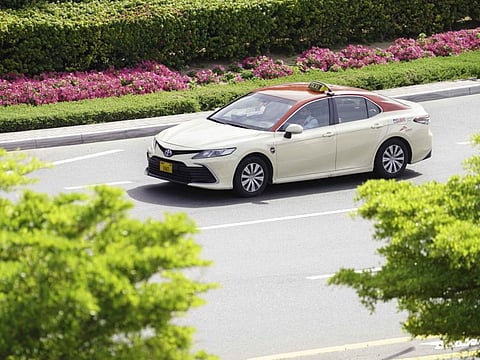
Dubai: Dubai Taxi Company has begun discussions with the Abu Dhabi Government on revising taxi fares following its acquisition of National Taxi, although no changes have been approved and the final decision rests with the authorities.
Mansoor Rahma Alfalasi, Group CEO of Dubai Taxi Company, confirmed the discussions in an interview with Gulf News after saying the company saw scope for a review of Abu Dhabi’s taxi fares, which are lower than those charged in Dubai.
Get updated faster and for FREE: Download the Gulf News app now - simply click here.
Asked whether DTC was speaking with the Abu Dhabi Government about revising fares, Alfalasi said, “Yes, for sure. We just started, and we see how it goes.”
The discussions come after DTC completed its Dh1.45 billion acquisition of National Taxi, giving the company an estimated 12% share of Abu Dhabi’s taxi market and a combined market share of about 59% in Dubai.
Fare decision rests with authorities
Alfalasi said DTC would provide operating data and other evidence to the relevant authorities when making its case for a fare review, while considering the impact of any proposed change on passengers.
The company cannot set uniform taxi prices across Dubai, Abu Dhabi and Al Ain because fares are determined separately by the authorities in each emirate.
Any revision would therefore require government approval, and Alfalasi did not provide a proposed fare level or timeline for a decision.
Dubai already operates a mechanism through which the Roads and Transport Authority reviews the running-kilometre component of taxi fares every two months in response to fuel price movements.
The authority can increase, maintain or reduce the rate depending on changes in fuel costs, meaning some fluctuations are reflected in the amount paid by passengers.
DTC also received Dh25.6 million in taxi vehicle fee reductions from the RTA covering March, April and May, providing partial relief after weaker passenger demand during the second quarter.
National Taxi integration begins
DTC expects the integration of National Taxi to produce early operational savings, while other benefits will be delivered over a period of up to three years.
Initial measures include extending DTC’s discounted fuel agreement with Enoc and combining the procurement of spare parts and other operational requirements.
Alfalasi said some of the benefits would be introduced within the coming months, while more complex integration measures would take longer to complete.
The acquisition gave DTC immediate access to Abu Dhabi and Al Ain, while lifting its combined taxi fleet across the UAE to more than 9,000 vehicles.
DTC is also preparing to operate through Bolt in Ajman and is considering opportunities in Sharjah and other cities across the UAE.
The company remains open to expansion through conventional taxi operations, ride-hailing services and delivery businesses where commercially viable opportunities emerge.
Autonomous taxi expansion starts in 2027
DTC has also started testing 50 autonomous taxis through its partnership with Apollo and plans to increase the fleet to as many as 1,000 vehicles over the next two to three years.
“We start now with 50 cars, and our plans to reach up to 1,000 cars, maybe in the coming two to three years,” Alfalasi said.
The initial trial will test passenger safety, technical performance and the vehicles’ ability to operate under road conditions specific to Dubai.
Roundabouts are among the features that autonomous vehicles must learn to navigate before the service can be introduced across a wider area, according to Alfalasi.
The vehicles use machine learning systems that continue gathering information from the conditions encountered during daily testing.
DTC expects the expansion phase to begin in early 2027 once the current trials have been completed, although the company has not disclosed how many autonomous taxis will be added during the first year.
Dubai has set a target for 25% of transport trips to be completed through autonomous vehicles by 2030, covering taxis and other forms of public transport.
Taxi demand expected to improve
DTC expects passenger activity to strengthen during the fourth quarter after taxi and limousine demand recovered progressively between April and June.
Taxi and limousine trips were about 36.7% lower year-on-year in April, before the decline narrowed to 24.4% in May and 11.2% in June.
Trip volumes increased by about 31% between April and June, with the return of residents after the summer and an improvement in tourism expected to support further demand.
“We think that by Q4 a lot of people will start coming back again,” Alfalasi said.
He added that a fuller recovery in passenger demand could begin in early 2027, with airport traffic and international visitor numbers remaining central to the performance of DTC’s taxi and limousine businesses.
The bus and delivery bike divisions were less affected by the decline in tourism because they operate across different customer segments.
Airport demand weighs on Q2 results
Quarterly revenue declined 22.5% year-on-year to Dh484.5 million, while earnings before interest, taxes, depreciation and amortisation fell 57.2% to Dh77.2 million.
Net profit reached Dh10.4 million, compared with Dh105.4 million during the second quarter of 2025, while first-half net profit totalled Dh61.1 million.
Taxi revenue declined to Dh396.8 million and limousine revenue fell to Dh24.5 million following weaker airport and tourism-related activity during April and May.
Delivery bike revenue increased 53.1% to Dh27.9 million, while bus revenue rose 2.3% to Dh32 million, supported by long-term government contracts.
DTC’s total operating fleet reached 11,928 vehicles at the end of June, including 6,522 taxis and 669 fully electric vehicles.