UAE raises clean energy ambition as minister says round-the-clock solar can compete with gas
Suhail Al Mazrouei says cleaner energy, storage, stronger grids are key to Gulf resilience
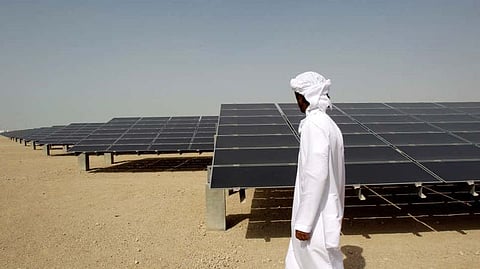
Dubai: The UAE is raising its clean-energy ambitions as the Gulf faces a more uncertain energy landscape, with Minister of Energy and Infrastructure Suhail Al Mazrouei saying the country is targeting around 35 per cent clean energy by 2030-31 and arguing that round-the-clock solar power can be commercially competitive with natural gas.
Speaking at the 50th edition of Middle East Energy in Dubai, Al Mazrouei said the region's recent geopolitical shocks had highlighted the value of diversifying energy sources and building resilience across the electricity system — from generation through to distribution.
"We adjusted and updated our numbers, so our target for clean energy by the year 2030-2031 will be around 35 percent, and we may see high number," he said.
The minister's comments come as the Middle East's energy sector faces a combination of geopolitical uncertainty, rising electricity demand and a rapid expansion of renewable energy, storage and digital infrastructure.
Solar scales
Al Mazrouei said the UAE would continue expanding renewable energy because the economics increasingly support it, rather than because of a preference for one energy source.
"This diversification toward cleaner forms of energy will continue. Not because we are biased, because it makes sense," he said.
He pointed to falling renewable costs and the growing competitiveness of large-scale solar projects, saying cleaner forms of energy are flourishing in the Gulf where they make commercial sense.
"For us here in the UAE, we've been betting on the continuation of enhancing our renewable energy, and we will continue to do so," he said.
A key example is the UAE's planned 5GW solar project backed by 19.5GW of battery storage.
Al Mazrouei described it as one of the world's largest deployments of round-the-clock solar, saying the project is designed to deliver 1GW of uninterrupted solar power around the clock.
"We believe the price is very competitive compared to natural gas," he said.
That combination of solar generation and large-scale storage is particularly significant for Gulf power systems, where electricity demand is high and reliability is critical.
War tests resilience
Al Mazrouei framed the current period not simply as one of crisis, but as a test of how resilient energy systems have become.
"This year could be seen as a year of challenge, but we see it [as] a real year of resilience, a year of resilience for this energy, for the energy industry, and especially for the electricity sector," he said.
He said countries and companies that had invested in diversifying their energy sources were seeing the benefits as geopolitical conditions changed.
"Those who invested in the diversification of energy sources and in their breadth have seen the benefits of such an investment under the geopolitical changes that we're seeing in the region," he said.
The message is particularly relevant for Gulf economies as the war and wider regional tensions put renewed focus on energy security, supply resilience and the ability of electricity systems to withstand disruption.
Al Mazrouei said resilience must extend across the entire electricity chain.
"The importance of this diversification, and the importance of resilience and resiliency in the whole system, from the generation to the distribution, is very important," he said.
More electricity
The UAE minister also warned that the region's energy challenge is no longer simply about replacing existing generation.
"The world needs more energy, and the region will need more electricity," he said.
That demand is being reinforced by industrial expansion, electrification and the rapid growth of digital infrastructure.
At Middle East Energy's 50th edition, speakers highlighted the emergence of artificial intelligence and hyperscale data centres as a major new source of electricity demand.
The event's organisers said the rapid rise of AI and data centres is putting pressure on power grids, backup systems and storage capacity.
Mark Ring, Group Director at Middle East Energy, said the industry was facing a defining moment.
"The rapid rise of AI and hyperscale data centres is fundamentally reshaping energy demand, putting unprecedented pressure on power grids, backup systems and storage capacity," he said.
Fix the grid
For Al Mazrouei, increasing generation alone will not be enough.
He called on the energy industry to focus on reducing transmission losses and improving the efficiency of existing systems.
"We need to increase the efficiency of whatever system we have, because the previous decades efficiencies does not work anymore," he said.
"We are in need for more power, and we need to work on improving those efficiencies."
He urged companies attending the event to use technology and research to capture losses within electricity systems.
"Those companies who are presented here, we need your scientists to work on those improvements because they will create the cheapest form of energy, which is capturing those losses and converting them to the customers," he said.
The emphasis on efficiency reflects a wider challenge for Gulf electricity networks: meeting rapidly increasing demand without relying solely on building more generation capacity.
Gulf links
Al Mazrouei also called for greater interconnection between countries and regions, arguing that stronger electricity links could help balance different patterns of demand.
"We need, as well, to ensure that interconnectivity between countries and continents is a project to be pursued," he said.
"The value is huge between the different seasonalities of demand that we have here, for example, in the Gulf and different countries."
He said greater interconnection could help optimise the wider electricity grid.
The call comes as Gulf countries continue to invest in expanding and modernising power infrastructure while simultaneously increasing renewable generation and storage.
Bahrain's warning
Yaser bin Ebrahim Humaidan, Minister of Electricity and Water Affairs, Bahrain, also highlighted the changing nature of the energy-security challenge, saying geopolitical forces, supply disruptions and trade rerouting are reshaping energy investment and infrastructure decisions.
He said energy security has become one of the defining issues for the global economy, with the Gulf's strategic position carrying greater weight as international markets become more exposed to disruption.
"The Gulf's strategic position has never carried greater weight, as global energy security rises to the top of political agendas," the Bahraini minister said.
"This region's ability to deliver reliable, abundant, and increasingly clean power will shape markets far beyond our borders."
The minister said the region was not merely participating in the energy transition but was positioned to lead it, citing its geography, capital and investment ambitions.
Storage rises
Storage was also placed at the centre of the region's energy transition.
Humaidan said storage was no longer simply a supporting technology but had become "core infrastructure", allowing grids to accommodate higher shares of renewable energy while providing flexibility when generation or transmission is constrained.
That view closely aligns with the UAE's emphasis on pairing large-scale solar generation with battery storage.
The shift is significant because adding renewable generation alone does not solve the challenge of supplying electricity when the sun is not shining. Large-scale storage can help bridge that gap and provide greater flexibility to electricity networks.
Three priorities
The Bahraini minister described decarbonisation, digitalisation and resilience as interconnected challenges rather than separate agendas.
"The electricity sector has been transformed," he said. "What was once a conversation about capacity has become a contest for the future — a contest to build systems that are cleaner, smarter, and stronger at the same time."
He said the region must simultaneously respond to geopolitical volatility, rising electricity demand and decarbonisation pressures.
The challenge is becoming more immediate as AI, hyperscale data centres and the wider digital economy drive electricity requirements that existing grids were not necessarily designed to accommodate.
"The 3x grid challenge is not a distant scenario; it is a present test of whether our systems can scale generation, transmission, and flexibility fast enough while remaining secure and sustainable," he said.
The 50th edition of Middle East Energy, running in Dubai from September 1 to 3, brings together the companies and investors working across power generation, transmission and distribution, renewable energy, storage and energy management.
Organisers said the event has more than 1,500 exhibitors and tens of thousands of registered attendees, with buyers representing more than $98 billion in live projects.


