Oil demand to stay above 100m bpd through 2040, says Dr Al Jaber
UAE says oil stays above 100m bpd as LNG and power demand surge over the next 15 years
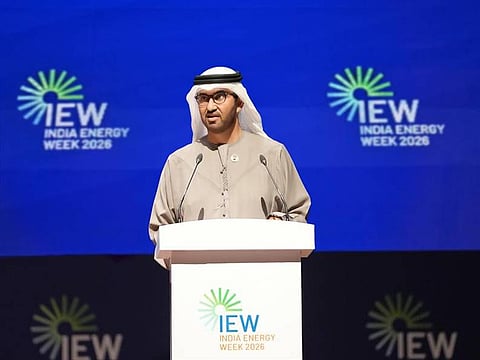
Dubai: Global oil demand will remain above 100 million barrels per day through 2040, with demand for both liquefied natural gas and electricity set to grow by 50% or more, according to Dr Sultan Al Jaber, UAE Minister of Industry and Advanced Technology, and Managing Director and Group CEO of ADNOC, who urged industry leaders to invest across the energy system and look beyond short-term volatility.
Speaking at India Energy Week in Goa, Dr Al Jaber said the defining story of energy today is growth, shaped by the rise of emerging markets, the rapid expansion of artificial intelligence and the transformation of energy systems. Those forces, he said, are converging most clearly in India, now the world’s third-largest energy consumer.
“Transformation rewards those who move boldly, not those who wait for calm seas,” Dr Al Jaber told delegates, adding that demand at this scale requires sustained investment across all forms of energy. “The biggest risk is not oversupply, it is underinvestment.”
Power demand set to surge alongside oil and gas
Electricity demand, Dr Al Jaber said, will be driven by more than data centres and AI workloads. Cooling is emerging as a major structural driver, with the number of air conditioners worldwide projected to more than triple to 5.6 billion by 2050. That pace equates to ten units sold every second for the next three decades.
India’s role in that growth is becoming increasingly decisive. Over the next 15 years, air travel in the country is expected to expand by 150%, its urban population is projected to approach one billion and data centre capacity is set to increase tenfold. Those trends, he said, will shape global demand for oil, gas and power well into the next decade.
Dr Al Jaber framed the UAE-India relationship as a stabilising force in a volatile energy landscape, describing reliable partnerships as the true strategic reserve.
“Progress and growth at this scale and pace requires a special kind of partnership,” he said. “Partnership that is strategic, long-term, agile and flexible. Steadfast, dependable, principled and consistent.”
India is the UAE’s number one LNG market, with ADNOC the country’s largest LPG supplier and a key provider of crude oil, chemicals and industrial feedstocks. ADNOC ranked as India’s fourth-largest crude supplier in 2025, while Indian national oil companies hold equity stakes in major ADNOC upstream concessions, including Lower Zakum.
Bilateral trade between the UAE and India is expected to double to $200 billion by 2032, reinforcing the commercial foundation of the relationship.
Investing across the energy system
Dr Al Jaber said supporting India’s growth will require capital across traditional and clean energy. Through ALTÉRRA, the world’s largest private climate investment vehicle, the UAE is backing 11 GW of wind, solar, and battery storage projects linked to India’s clean energy ambitions.
ADNOC’s international investment arm, XRG, is expanding its global gas portfolio, building a chemicals platform and investing in energy infrastructure to support industrial and digital growth at scale. The strategy, he said, reflects a commitment to remain a reliable and responsible energy supplier as demand evolves.
Technology reshapes operations
Alongside expansion, ADNOC is pushing deeper into advanced technology. The company has deployed more than 200 AI tools and 65 robotics applications across its operations, including what it describes as the world’s first agentic AI for the energy sector. Every well in its portfolio is now monitored in real time.
So far, those systems have helped halve unplanned shutdowns while improving efficiency and resilience, Dr Al Jaber said.
The UAE’s message to investors, he added, is consistency. In the past three years, the country has signed 35 Comprehensive Economic Partnership Agreements, including its first with India, and attracted more than $45 billion in strategic foreign direct investment in 2025.
“If you are an investor seeking predictable returns, look to the UAE,” Dr Al Jaber said. “If good governance and the rule of law are essential, you will find them in the UAE. And if you want a partner whose conviction will not waver, you can count on the UAE.”