Oil rises as Hormuz deal hopes clash with Iran’s demands
Energy markets stay volatile as Iran ties shipping access to US concessions

Oil prices were higher in early Asian trading Monday as uncertainty over a possible agreement to reopen the Strait of Hormuz continued to outweigh hopes for a quick return to normal shipping.
At 8:33 am Tokyo (on Aug. 10, 2026), market data on OilPrice.com showed West Texas Intermediate crude at $78.71 a barrel, up 53 cents, or 0.68%; Brent crude at $84.28, up 73 cents, or 0.87%; and Murban crude at $80.25, up 72 cents, or 0.91%.
Natural gas was also higher at $2.719 per million British thermal units, up 5.7 cents, or 2.14%.
The gains came despite renewed diplomatic efforts to reopen the strategic waterway, reflecting traders' concern that an emerging Iran-Oman arrangement may not immediately restore unrestricted global shipping.
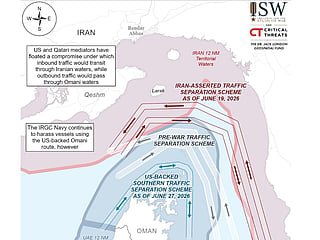
Iran said Monday that it was nearing a final agreement with Oman on new shipping lanes through the Strait, but Tehran has tied a full reopening to additional concessions from Washington.
Get it: Fast, verified news for FREE ... download the Gulf News app — simply click here
Hormuz remains the market's biggest wildcard
The Strait of Hormuz has been largely disrupted since the outbreak of the US-Iran war in late February.
The waterway normally carries a huge share of global oil and LNG shipments, making any prolonged disruption a direct threat to energy supplies and shipping costs.
Oil prices have been extremely sensitive to every signal from the diplomatic track.
Brent settled at $83.55 a barrel Friday, while WTI ended at $78.18, after both benchmarks gained as traders questioned whether a proposed reopening arrangement would actually restore normal commercial traffic.
By Monday, Brent had climbed again toward $85, with Reuters reporting that futures rose $1.20, or 1.44%, to $84.79, while WTI gained $1.12, or 1.08%, to $79.29 in the latest trading session.
The screenshot's prices are therefore consistent with a market that remains firm but highly volatile, rather than one convinced that the crisis is ending.
The emerging deal is not yet a clean reopening
The central problem is that Tehran and Washington appear to have different ideas about what “reopening” means.
Iran has been negotiating with Oman over a mechanism to establish new shipping lanes through the strait.
But Tehran has said the United States must meet additional conditions, including concessions linked to the conflict and sanctions, before unrestricted passage can resume.
Earlier reporting suggested a proposed arrangement could give Iran significant control over inbound traffic — a major concession given Washington's longstanding insistence that Iran should not control the international waterway.
That uncertainty is precisely what oil traders are pricing.
A deal on paper does not necessarily mean:
tankers immediately resume normal passage;
US-linked vessels receive guaranteed access;
insurers immediately restore coverage;
Iranian and US sanctions are lifted;
Gulf producers can immediately restore normal export schedules.
Until those questions are resolved, the market is likely to retain a geopolitical premium.
What it means for oil consumers
For motorists and businesses, the critical issue is not simply whether Brent is above or below $80.
It is how quickly and reliably Gulf oil can reach international markets.
A prolonged disruption raises shipping and insurance costs, lengthens voyages and forces refiners to seek alternative crude supplies. Even if physical oil remains available elsewhere, the re-routing can increase the cost of getting it to consumers.
The U.S. Energy Information Administration has also substantially revised its expectations for oil prices as supply conditions have changed, illustrating how quickly the outlook can shift as the Hormuz situation develops.
Why prices haven't exploded
The market is also being restrained by the possibility of a diplomatic breakthrough.
Oil prices had fallen sharply earlier this month after President Donald Trump announced new talks with Iran, reflecting expectations that a settlement could eventually restore Gulf shipments.
But traders have repeatedly discovered that the distance between an announcement and actual tanker traffic is substantial.
That explains Monday's price action: traders are neither pricing a permanent closure nor assuming an immediate reopening.
They are pricing uncertainty.
What to watch next
The next major market trigger will be whether Iran and Oman can finalise the proposed shipping arrangement — and, crucially, whether Washington accepts its terms.
The US has signaled optimism that a deal could come soon, while Iran has continued to attach conditions to reopening the waterway.
For Asian markets, the implications are particularly significant. Asia is heavily dependent on Gulf crude and LNG, meaning any delay in normal Hormuz traffic can quickly feed into refinery costs, freight rates, fuel prices and inflation.