Egypt to power 7,000 factories with solar in $1-billion energy shift
Egypt leaps with factory-focused solar drive, in bid to cut gas use, boost exports
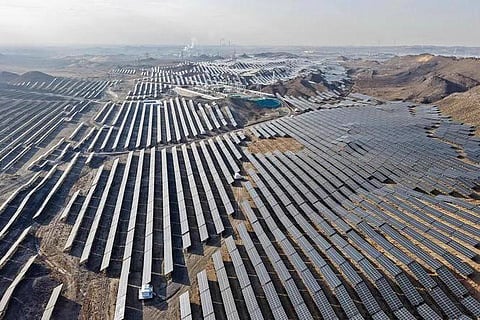
Egypt is accelerating its solar expansion, with a new programme targeting 1,000 megawatts of solar capacity across about 7,000 factories.
The initiative, called "Shams El-Senaa", is part of Cairo’s push to cut natural gas use, lower industrial costs and improve export competitiveness, industry tracking site OilPrice reported.
Prime Minister Mostafa Madbouly reviewed implementation plans with Electricity and Renewable Energy Minister Mahmoud Esmat earlier this month.
He directed that later phases be extended beyond factories to government buildings and other facilities.
Get it: Fast, verified news for FREE ... download the Gulf News app — simply click here
Ecofin (Agence Ecofin), an economic and financial news agency focused on Africa) has also reported that Egypt is projected to expand solar capacity 12-fold by 2035, citing growth from 2.9 GW to 34.3 GW to a GlobalData report published on April 28, 2026.
This is a pivot from fossil fuels.
In 2025, fossil fuels generated 87% of the country's electricity in 2025, hydropower 6%, wind and solar 7%.
Climate Analytics put 2022 gas at 79%, renewables at 12% and oil at 9%. The Atlantic Council put fossil fuels at about 80%.
RENEWABLE ENERGY DRIVE: Egypt currently gets most of its electricity from fossil fuels, mainly natural gas and petroleum, which account for about 87% of generation. Renewables make up around 13%, split between hydropower and wind and solar.
The country aims to source 42% of its electricity from renewables by 2030 and 60 to 65% by 2040 under its Integrated Sustainable Energy Strategy.
Solar capacity is projected to grow from about 2.9 gigawatts to 34.3 gigawatts by 2035. 1019
Scaling up solar reduces domestic gas consumption, freeing up reserves for export and foreign currency generation. It also helps relieve pressure on public finances, with fossil fuel subsidies costing around $7 billion annually.
Cost advantage
Solar power costs roughly $0.02 per kilowatt-hour, compared with more than $0.06 per kilowatt-hour for fossil fuels.
The shift could also improve grid stability by offsetting daytime loads on conventional plants.
The government plans to install solar systems on public and government building rooftops as part of a separate nationwide project.
It is also pursuing private investment, with around 32 power purchase agreements signed by 2025 to produce 1,465 megawatts of renewable energy.
Egypt is also developing large-scale projects including the Benban Solar Park and the Obelisk Solar Power Project, which is backed by $600 million in investment and Chinese technology.
Solar-powered factories
For factories, the programme could mean lower electricity bills and improved competitiveness.
For Egypt, it is a step toward energy security and a more diversified energy mix.
For the region, it signals a growing shift toward renewables as a way to reduce reliance on imported fossil fuels.
Latest updates
The Obelisk solar farm in southern Egypt generates around 1.1 gigawatts and features battery storage and automated cleaning robots.
The Shams El-Senaa initiative targets 1,000 megawatts across factories.
Egypt is also preparing to introduce nuclear energy into its power mix, with the El Dabaa plant expected to contribute around 4.4 gigawatts once operational.


