UAE opens safe air corridors: Airlines to operate 48 flights per hour, says Minister
17,498 passengers have travelled on 60 flights from March 1 to 3: Touq Al Marri
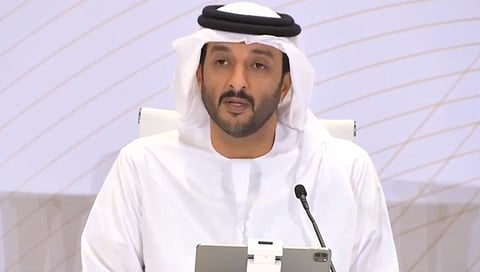
Abu Dhabi: The UAE has opened safe air corridors in coordination with Gulf countries, with a current handling capacity of 48 flights per hour, said Abdulla bin Touq Al Marri, Minister of Economy and Tourism, during a government media briefing on Tuesday.
The Minister said, "The capacity as of today, based on the emergency routes available, is 48 flights per hour with a possibility of increasing this figure at a later stage, according to the latest development and security ratings and measures,” implying, the UAE has created special emergency air corridors that can currently handle up to 48 aircraft movements per hour safely.
According to Al Marri, from March 1 to today (March 3), a total of 17,498 passengers have travelled on 60 flights.
In the next phase, 80 flights are scheduled with national carriers, totalling 27,000 passengers. The Minister said the following phases would be launched based on how the security situation evolves and when conditions are deemed safe.
However, regular commercial operations of Emirates, Etihad, and Air Arabia are yet to resume. flydubai has begun limited operations.
When will airspace open?
The Minister also clarified that the General Civil Aviation Authority is conducting ongoing coordination and monitoring with partners to assess developments and enable a gradual, safe return of air navigation in the country’s airspace.
As part of the response, limited operational flights have begun to facilitate the return of citizens and residents.
“Airspace safety and human safety will always remain our first priority,” Al Marri said.
However, he urged affected passengers not to proceed to airports unless contacted directly by their airlines, in order to avoid congestion and ensure the smooth flow of travellers during this phase.
UAE airports and national carriers Etihad, Emirates, flydubai, and Air Arabia have instructed passengers not to travel to the airport unless they have received a call from the airline asking them to do so.
All airlines have resumed limited operations, with priority being given to stranded passengers. In the meantime, the Minister said the government has agreed to cover expenses for stranded tourists' stay and food.
“The UAE economy has proven its resilience in absorbing pressures generated by geopolitical and regional challenges,” he said, reaffirming that economic stability remains firmly intact.
Safe air corridors
The Minister said air corridors were established in coordination with neighbouring countries and Gulf Cooperation Council states, as well as with the International Civil Aviation Organisation (ICAO), activating approved regional emergency aviation plans.
ICAO is a specialised agency of the United Nations that sets global standards, regulations, and procedures for the safety, security, efficiency, and environmental sustainability of international civil aviation.
The current emergency routing capacity allows for 48 flights per hour, with the possibility of gradually increasing that number in line with developments and safety assessments.
Resilient economy
Al Marri said the UAE economy has demonstrated strong resilience and maintained stability with high efficiency despite geopolitical and regional pressures.
He said that the country adopted proactive and flexible strategies that have strengthened the economy and enhanced its ability to absorb external shocks, including previous crises such as the Covid-19 pandemic and other regional and international challenges.
The Minister's comments come as the US-Israel war on Iran, and the ensuing fallout on Gulf countries, including the UAE, enters its fourth day.
Stay updated: Get the latest faster by downloading the Gulf News app now - it's completely free. Click here for Apple or here for Android. You can also find it on the Huawei AppGallery.
On food security
He stressed that the UAE’s food security system is a “red line”, affirming that the country has sufficient stockpiles of essential goods and that strategic reserves of key commodities are adequate to cover domestic needs for a period of four to six months.
Import activity, he said, is proceeding according to plan without disruption, and there are no disturbances in supply chains related to the import of goods and products. Authorities monitor stock levels daily in coordination with suppliers to ensure continued availability. The UAE, he added, maintains a broad trade network and the ability to identify alternative markets quickly when needed.
On tourism
Turning to tourism, Al Marri said the sector continues to operate with high preparedness and coordination. The UAE’s tourism ecosystem includes more than 1,260 hotels and over 40,000 companies operating in tourism-related activities across the country.
He emphasised that the Ministry of Economy and Tourism, in partnership with local tourism authorities, hotel establishments and tourism companies, is working closely to ensure the safety, security and smooth experience of tourists and hotel guests, while maintaining the highest standards of service quality and professionalism.
He said the government is covering accommodation and hospitality costs for stranded travellers affected by flight delays, ensuring the continued provision of essential services and logistical support for those unable to travel during the limited operational phase.
The aviation sector, he added, is managing the current situation within a clear institutional framework, with high readiness, proactive planning, and full coordination with relevant authorities to ensure business continuity while maintaining strict safety and security standards.
*The story was updated to include a new quote from the UAE Minister of Economy Abdulla bin Touq Al Marri in the second paragraph.

