dnata CEO sees Dubai travel demand fully turning around in Q1 2027 as cargo posts ‘mega growth’
Passenger bookings are rising as dnata sees cargo surge amid Hormuz disruption
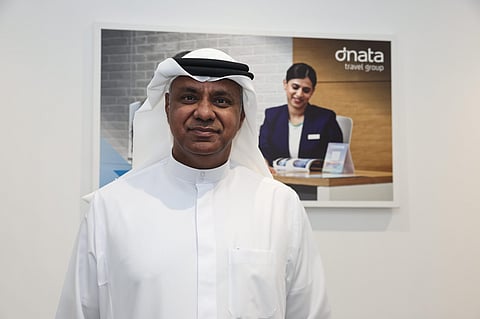
Dubai: dnata expects Dubai's travel market to see a “complete turnaround” in the first quarter of 2027, as the Emirates Group-owned air services company sees early signs of a recovery in bookings and passenger spending following the disruption caused by the regional conflict.
Nabil Sultan Al Murr, who took charge as dnata's CEO three months ago after a decade long career leading Emirates Sky Cargo, said the winter schedule is expected to perform well, with leisure and business travel into Dubai likely to see a “huge pickup” in the first quarter of next year.
“I honestly think that winter schedule will look fairly well,” Al Murr said. “But you know, quarter one of next year we probably should see a complete turnaround and a huge pickup and probably in demand for leisure and business travel into Dubai," he told Gulf News on the sidelines of the Arabian Travel Market.
The comments come as dnata's businesses have experienced very different effects from the conflict. Inbound travel into the UAE was hit, particularly from European and Asian markets, while demand from the Indian subcontinent, Middle East and Africa rebounded quickly.
However, for the fourth quarter, dnata is already seeing some encouraging indicators, with booking demand about 5 per cent higher than last year, while per-passenger spending is up by almost 10 per cent, said Al Murr.
dnata is a global air and travel services provider, operating across airport ground handling, catering, cargo and travel services.
It operates in more than 160 cities across 37 countries, serving airlines, airports, travellers and the wider aviation industry.
Cargo surges
While passenger travel was disrupted, dnata's cargo operation experienced the opposite trend. “Cargo business have been phenomenal,” Al Murr said, describing “mega growth” in tonnage uplift and cargo handling across the UAE and Dubai.
He linked the increase partly to disruption around the Strait of Hormuz, which has pushed demand for air freight higher.
“Under the current circumstances, you know, with the impact on Strait of Hormuz, this has even pushed demand on air freight to even a higher higher extent,” Al Murr said.
He expects cargo demand to continue growing through the year.
The cargo growth comes as dnata continues to invest in its global freight infrastructure. The company recently invested over EUR70 million in a cargo facility in the Netherlands, which Al Murr said is now operational and “doing exceptionally well”.
dnata has also launched a Cargo Integrated Command Centre in Dubai, giving it a centralised view of cargo operations across DXB and DWC.
Inbound recovery
The conflict's impact has been uneven across dnata's travel businesses. Al Murr said inbound UAE travel was affected in the early stages, particularly from European and Asian markets.
Other markets, however, recovered much faster. “Indian subcontinent, Middle East, Africa. You continue to see almost immediate rebound in demand and profit,” he said.
One particularly resilient segment has been visits involving friends and relatives, or VFR traffic.
“Obviously, people when they have families, they're much more relaxed and comfortable about traveling to Dubai, spending time with the family,” Al Murr said.
“That sector has definitely been there and has actually grown.”
dnata said it has also seen strong outbound traffic from the UAE, with Al Murr describing the past summer's outbound and inbound traffic as “phenomenal”.
Airlines return
The recovery in Dubai's passenger market will also depend on international airlines restoring capacity.
Al Murr said most Indian carriers had continued operating normally, while some European and Asian airlines reduced operations during April and May. However, he said many of those carriers have already filed for winter slots for October and November and have opened flights for sale.
“We expect that most of these airlines should start to return probably by November-December,” he said.
“We probably see most of them back again in action.” That would provide additional capacity into Dubai as the winter travel season gets under way.
Staff retained
Dnata's airport operations also faced lower flight volumes during the disruption, but the company chose to retain its workforce.
The group continued to operate flights and cargo while dealing with fewer aircraft movements.
“Our policy was to keep everyone and then focus on this coming area, you know, to train people to you know make sure that they're ready when that next wave comes about,” Al Murr said.
He described that as the right decision for the company at this stage.
dnata's airport operations division employs about 41,000 people and operates at 86 airports across 16 countries, according to the company's FY2025-26 fact sheet.
Catering grows
dnata's catering operation has continued to expand globally despite the disruption. Al Murr said the flight catering business is now spread across about 60 locations, with the company continuing to win new airline customers.
“We continue to win new customers because obviously, you know, we've created such a high standard for the quality of our product that we offer,” he said.
He also pointed to demand for the group's culinary and food products as a sign of continued growth. dnata's wider Catering and Retail business operates across more than 60 locations in 12 countries and handles 115.3 million meals annually, according to a company fact sheet.
The division is also expanding its infrastructure, including a new inflight catering centre at Western Sydney International Airport and an expansion of its Melbourne catering facility.
dnata has also entered Indonesia through a partnership with a local provider at Denpasar International Airport.
New markets
Beyond the immediate recovery, Al Murr sees opportunities in emerging markets across the Middle East, Africa and Central Asia.
“We are going to be focusing a lot to emerging markets,” he said.
He identified markets including Iraq, Libya and parts of the Indian subcontinent as potential opportunities, while stressing the importance of stability.
“The catchment area around us could be of good potential where we see some business coming back, some level of stability coming back that warrants us to seriously start examining those and maybe making a move,” he said.
dnata is already pursuing opportunities in Azerbaijan and is working on an operation there that Al Murr said it hopes to start in 2028.
Investment pipeline
He also signalled that dnata remains open to acquisitions and investments. The company has made multiple investments globally, he said, targeting businesses that can complement its operations.
“There’s always opportunities, investment that constantly we examining and evaluating,” Al Murr said.
“And of course, if the right opportunity presents itself, I'm sure I'm sure we make a move.”
That said, dnata's diversified structure has provided some protection during the conflict, with the company operating across airport services, catering and travel.
And for Al Murr, that diversification is central to how dnata can navigate disruption while continuing to invest for the next cycle of growth.
The immediate focus, however, is on the return of passengers.


