Saudi Arabia says Houthis rejected Oman talks as Yemen presidential palace comes under attack
US has warned banks to watch for Iranian abuse of religious charities, donation networks
Highlights
We are closing this live coverage. For the latest updates, click here.
Oil edges lower in Asian trade, Brent holds above $105
Oil prices fell in early on Friday, with Brent crude remaining above $105 a barrel as markets weighed persistent threats to Middle Eastern supplies against plans to release more emergency oil reserves.
Brent crude was quoted at $105.50 a barrel, down 45 cents, or 0.42%, while US West Texas Intermediate crude fell 53 cents, or 0.54%, to $97.44, according to OilPrice.com data at about 10:40 am Tokyo time (5.40am Gulf, 1.40am GMT) on Oct. 16, 2026.
The declines followed a mixed session Thursday. WTI futures for November delivery rose $2.88, or about 3%, to settle at $97.97 a barrel, while Brent futures for December delivery slipped 14 cents to $105.92, according to CNBC.
Iran’s Basij chief says AI improved military targeting
Iran’s Basij paramilitary chief, Hossein Taeb, said that AI had improved military targeting and intelligence capabilities, Iran International reported. “We saw the benefits of artificial intelligence in the defense field,” Taeb said. “We used AI for intelligence awareness, and our targeting became more precise.”
Taeb urged Iran to prioritize AI and cybersecurity, saying technological capability increasingly determined national power. A cleric and former Revolutionary Guard intelligence chief, Taeb returned to lead the Basij in August, with a mandate to expand its grassroots intelligence network.
Iran army chief vows Hormuz to stay shut until Iran’s ‘rights’ respected; US says shipping continues
Iran’s army chief, Maj. Gen. Amir Hatami, said that the Strait of Hormuz would remain "closed" until what he described as the rights of the Iranian people were respected, Iranian state media reported.
“The Strait of Hormuz was immediately closed, remains closed to this day and will remain closed until the enemy respects the rights of the Iranian people,” Hatami said at an event at Imam Ali Officers’ University in Tehran, according to Iran’s state broadcaster IRIB.
Hatami said the strategic waterway was under the “full surveillance” of Iran’s army and the IRGC. He claimed that “not a single enemy vessel” had been able to enter the maritime space of Oman and the Strait of Hormuz.
He also said Iran’s armed forces were prepared for any further conflict and claimed that many enemy military bases had been "damaged".
The US military disputes Iran’s assertion that it controls or has fully closed the strait. US Central Command said commercial and energy traffic continues to move through Hormuz and rejected Iranian claims of control, saying US forces and regional partners helped ship more than 19 million barrels of crude oil through the waterway in a single day.
Bessent says ‘noose is tightening’ around Iran’s economy
US Treasury Secretary Scott Bessent said Thursday Washington would maintain financial pressure on Tehran until its government could no longer fund its military, following new sanctions targeting Iran-linked financial networks.
“The noose is tightening around Iran’s economy, and not even Iran’s so-called allies can save it,” Bessent said in a post on X.
“The Department of the Treasury will not relent until the Iranian regime’s coffers are empty and every remaining financial lifeline sustaining its war machine has been severed,” he added.
The Treasury said the measures, part of its Operation Economic Outcast campaign, targeted Iran’s efforts to access international financial systems through an Iraqi bank and offshore and shadow-banking networks.
According to the department, these networks moved hundreds of millions of dollars through shell companies and foreign-exchange specialists across the Middle East and Asia.
Washington said the campaign seeks to disrupt financial channels Iran allegedly uses to evade sanctions, generate revenue and fund its military and allied armed groups.
CENTCOM disputes Iran’s Hormuz claims, ship-sinking account
The US military on Thursday rejected claims by Iran’s Islamic Revolutionary Guard Corps (IRGC) that Tehran controls the Strait of Hormuz, that a Singapore-registered container ship sank after "striking a naval mine" and that hundreds of American service members had been killed in Jordan.
US Central Command, which oversees American military operations in the Middle East, said the US and regional partners maintained control of the strategic waterway despite what it described as aggression by Iran’s Revolutionary Guard.
“The United States and regional partners control the strait as commercial vessels continue to transit despite unwarranted IRGC aggression,” CENTCOM said, according to the statement provided.
Iran accuses Britain of 'destructive' role, fueling insecurity in Mid-East
Iran’s Foreign Ministry accused Britain of playing a “destructive role” and fueling insecurity across the Middle East, escalating a diplomatic dispute over British allegations that Tehran was involved in a suspected plot against a British air base.
Foreign Ministry spokesperson Esmaeil Baghaei said the British government could not conceal its role in regional instability by “shifting blame and distorting reality,” according to Iran’s state-run IRNA news agency.
His comments responded to British Foreign Secretary Ed Miliband, who described Iran’s actions as “aggression.” Baghaei said the chaos in the region stemmed from “unlawful interventions,” including those backed or supported by Britain, and accused Miliband of reversing the roles of victim and aggressor.
The remarks came after Britain said a suspected plot near RAF Fairford, an air base used by US bombers, was probably coordinated in Iran. The British government said the incident demonstrated the Revolutionary Guard’s willingness to project hostile activity beyond Iran’s borders through covert networks and proxy actors.
Iran has denied the allegation, called it a “clumsy false flag operation,” and summoned British Ambassador Hugo Shorter to protest. Tehran has demanded that Britain provide evidence and warned it may reconsider diplomatic ties if London does not.
Iran condemns Colombia's reopening of its embassy in Israel
Iran’s Foreign Ministry condemned Colombia’s reopening of its embassy in Israel — specifically its relocation to Jerusalem — in a statement issued Thursday, calling the move a "violation of the UN Charter and international law".
The ministry said Colombia’s action “strongly” violated the UN Charter and fundamental principles of international law. It described Jerusalem as an inseparable part of Palestinian territory and said states must avoid measures that amount to recognizing what it called Israel’s occupation.
Iran also accused Colombia’s government of aligning itself with an “occupying and genocidal regime,” saying the embassy move legitimised the occupation of Palestinian land and contradicted the Palestinian people’s right to self-determination. It warned Bogota that it must accept responsibility for the consequences of what Iran called an “immoral” and unlawful decision.
Colombia opened its embassy in Jerusalem on Wednesday, becoming the 10th country to locate its Israeli embassy there rather than in Tel Aviv. The move came under conservative President Abelardo de la Espriella, who restored diplomatic ties with Israel after his predecessor, Gustavo Petro, severed them in May 2024 over the war in Gaza.
Saudi-led coalition releases footage of cruise missile interception
The Saudi-led coalition has released video footage showing the interception and destruction of a cruise missile, according to its official spokesman.
Saudi-led coalition releases footage of Houthi attacks
The Saudi-led coalition has released video footage showing attacks attributed to the Houthi militia on Abha International Airport, Najran International Airport and King Abdullah International Airport in Jazan.
The footage was presented during Thursday’s press conference by the coalition’s official spokesman.
Saudi-led coalition says Houthi attacks on airports violate international law
The Saudi-led Coalition to Restore Legitimacy in Yemen has condemned Houthi attacks on civilian airports and facilities, including King Khalid International Airport in Riyadh, describing them as violations of international humanitarian law.
Coalition spokesman Major General Turki Al Malki said the attacks threaten civilian safety and travellers. He also warned that the coalition would continue taking measures to dismantle the Houthis’ offensive capabilities, including weapons depots, missile launch platforms and other facilities used to carry out attacks.
Al Malki said coalition forces had dismantled mountain storage facilities in Sanaa, Saada and Amran, and destroyed several missile launch platforms. He also accused the Houthis of using civilian infrastructure and vital resources to support their military operations.
He called for an immediate halt to Houthi attacks on civilians and civilian infrastructure, including airports, ports, oil facilities and other essential sites.
US issues new Iran-related sanctions
The US Treasury’s Financial Crimes Enforcement Network (FinCEN) has issued an alert to help financial institutions identify and report potential Iranian abuse of religious charity networks, including the diversion of religious donations known as tithes or khums.
The alert forms part of Operation Economic Outcast, a US initiative targeting Iran and its financial enablers, including the Islamic Revolutionary Guard Corps (IRGC).
Saudi-led coalition intercepts drone over Khamis Mushait
Saudi-led coalition forces have intercepted and destroyed a hostile drone in Khamis Mushait in southwestern Saudi Arabia, coalition spokesperson Turki Al Maliki said.
Saudi Arabia travel update: IndiGo issues advisory
IndiGo has cancelled flights to and from Riyadh, Jeddah, Dammam and Madinah until October 24, 2026, inclusive, citing the evolving situation in Saudi Arabia.
In a travel advisory posted on X, the airline said affected passengers are being notified using the contact details provided at the time of booking. Customers who booked through travel partners have been advised to contact them directly for assistance.
IndiGo said the safety and well-being of passengers and crew remain its highest priority.
Saudi Arabia warns of legal action over missile, drone footage
Saudi Arabia’s Civil Defence has warned that filming, publishing or sharing information about missile and drone interceptions and their impact sites could expose individuals to legal liability.
In a post on X, the authority urged the public to refrain from sharing such material.
Houthi attack on presidential palace in Yemen's Aden kills 4
At least four people were killed and 10 more wounded in a Houthi missile attack Thursday on the presidential palace in Yemen's Aden, which also serves as the internationally recognised government's headquarters, three government military sources told AFP.
Media affiliated with the Houthis said earlier that the group attacked a "headquarters of military operations" at the Al-Maashiq Palace in Aden, the southern city that is the government's interim capital.
Saudi Civil Defence says danger has passed in Najran
Saudi Arabia’s Civil Defence said the danger had passed in Najran Province, moments after issuing an alert warning residents of potential danger in the area, according to a post on its official X account.
Saudi Arabia says Houthis declined to meet in Oman in recent weeks
A Saudi foreign ministry official on Thursday said the country reached out to Yemen's Houthis in recent weeks as fighting escalates between the two sides, but the group refused to meet in Oman.
"At the beginning of this escalation, we asked them to meet in Muscat, Oman and they refused. This was the last communication which happened a few weeks ago," said Dr. Rayed Krimly, deputy minister for public diplomacy at the foreign ministry, during a virtual briefing with reporters.
Houthis target presidential palace in Yemen's Aden
Yemen's Houthis on Thursday fired missiles at the presidential palace in Aden, which also serves as the headquarters of the internationally recognised government, security sources told AFP, while a journalist saw smoke rising from the site.
"Houthi missiles targeted the Al-Maashiq presidential palace in Aden," the government's interim capital, three local police sources said on condition of anonymity, after residents of the southern city reported hearing explosions.
Iran's military says oil tanker on fire in Gulf of Oman
Iran's military on Thursday said an oil tanker had caught fire in the Gulf of Oman as it was attempting to pass through an area deemed prohibited, according to state television.
"A few hours ago... surveillance teams of the army's navy identified a non-compliant oil tanker that had caught fire," state television cited a military statement as saying.
"The offending tanker had switched off its tracking systems and was attempting to pass through the prohibited zone," it added.
It was not immediately clear what caused the fire or who was responsible.
Saudi Arabia accuses Iran of encouraging Houthis in latest escalation
A Saudi foreign ministry official on Thursday accused Iran of encouraging the Houthis in the latest escalation of their fight with the kingdom, adding that the Islamic republic continues to arm and train the group.
"Iran continues to arm, train and support the Houthi militia in violation of UN security council resolutions," Dr. Rayed Krimly, deputy minister for public diplomacy at the foreign ministry, said during a virtual briefing with reporters.
"We think that the escalation by the Houthis at this latest stage of the conflict is encouraged by Iran," he later said.
The official said the kingdom, however, remained in communication with Iran, even if Tehran appeared unwilling to offer concessions.
Riyadh’s King Khalid International Airport targeted 20 times since October 1
Houthi strikes on Riyadh’s King Khalid International Airport left 17 people dead and 333 wounded between October 7 and 11, Turki Al Maliki, spokesperson for the Saudi-led coalition in Yemen, told a press conference in the Saudi capital on Thursday, adding that the airport had been targeted 20 times since the start of the month and that the October 10 strike involved 10 drones along with missiles and other projectiles.
Hezbollah says explosives seized by authorities belong to group
A Hezbollah MP acknowledged Thursday that a 500-kilogram shipment of explosives seized last week by Lebanese authorities belonged to the group, a rare admission by the Iran-backed militants.
"The vehicle and its cargo belong to the resistance" against Israel, lawmaker Hassan Fadlallah said.
He said Hezbollah also called for the immediate release of those arrested over the seizure.
Fadlallah demanded the return of the shipment, seized on a road linking eastern Lebanon to Beirut, saying it constituted "capabilities" used by Hezbollah against Israel.
Lebanese Prime Minister Nawaf Salam has said the state will no longer tolerate any possession of "illegal weapons".
A judicial source told AFP the explosives were seized from a vehicle that was carrying 250 kilograms of TNT and 250 kilograms of the explosive C-4.
Salam has said authorities will "identify all individuals involved in this criminal operation and those who ordered it".
Iran's president says US blockade aims to spark protests
Iranian President Masoud Pezeshkian said Thursday that the country was facing its most intense blockade since the 1979 Islamic Revolution, accusing the United States of seeking to provoke public protests.
Iran and the United States have been at war since February 28, when US and Israeli strikes killed Iran's supreme leader, Ayatollah Ali Khamenei.
"Over the 48 years since the Revolution, we have never faced such intense blockade, war and difficulties as we are facing now," Pezeshkian said in a speech broadcast by state television.
He accused Washington of seeking to make life difficult for Iranians in order to fuel public anger and trigger unrest.
EU, Gulf nations postpone summit in Saudi Arabia after Houthi attacks
A summit between the European Union and Gulf countries in Riyadh has been postponed, Brussels said on Thursday, as Saudi Arabia faces sustained attacks from Yemen's Houthis.
"The second Summit between the European Union and the Gulf Cooperation Council, originally planned for 24 October 2026 in Riyadh, Saudi Arabia, has been postponed. A new date will be announced in due course," the European Council representing the bloc's member states said.
Houthis deny attacks on Saudi Arabia’s Medina region
Yemen's Houthis said they did not carry out any attack on the Medina region Thursday, shortly after Saudi Arabia said it had intercepted a missile targeting the area of the holy city.
"The Yemeni armed forces confirm that they have not carried out any operation today targeting Saudi territory, and that the Saudi enemy's claims of an attack on Medina are a shameless and brazen lie," Houthi military spokesman Yahya Saree wrote on X.
UAE leaders condole with Saudi King over airport attack
President His Highness Sheikh Mohamed bin Zayed Al Nahyan has sent a message of condolences to the Custodian of the Two Holy Mosques King Salman bin Abdulaziz Al Saud of Saudi Arabia, expressing his sincere condolences and sympathy over the victims of attacks on King Khalid International Airport in Riyadh, which resulted in several deaths and injuries. He also wished the injured a speedy recovery.
FNC Speaker condemns Houthi attacks on Saudi Arabia, affirms UAE's full solidarity
Saqr Ghobash, Speaker of the Federal National Council (FNC), affirmed the UAE's full solidarity with Saudi Arabia and strongly condemned the attacks carried out by the Houthi terrorist group against civilians and civilian and economic facilities in the Kingdom.
In a message of solidarity addressed to Sheikh Dr. Abdullah bin Mohammed bin Ibrahim Al Al-Sheikh, Speaker of the Shura Council of Saudi Arabia, Ghobash expressed his strong condemnation of these attacks, which constitute a violation of the Kingdom's sovereignty and a threat to its security and stability.
'No time to recover': UNDP chief sounds alarm on growing poverty after Iran war shock
Millions could be thrown into poverty by surging energy costs, the impact of an intense El Nino phenomenon and higher interest rates, with vulnerable countries being pushed to the brink by repeated crises, the UN's development chief told AFP.
Global fuel prices have soared since the United States launched its war on Iran in late February, with Tehran's retaliations against Washington's Gulf allies curtailing major oil and natural gas supplies.
Fiscal deficits and debt-to-GDP ratios around the world have ballooned since the 2008 global financial crisis, with governments firefighting against a series of shocks including the pandemic and wars in Ukraine and the Middle East.
Speaking on the sidelines of the IMF-World Bank Annual Meetings in Bangkok, UN Development Programme (UNDP) head Alexander de Croo said many developing countries had responded to the current spike in energy prices with blanket subsidies, but a succession of crises had left them with limited resources to keep that up.
Saudi coalition says missile intercepted in Medina region
The Saudi-led military coalition fighting Yemen's Houthis on Thursday said it had intercepted a cruise missile in the Medina region -- home to one of Islam's holiest cities that the Houthis previously vowed not to target.
"Interception and destruction of a cruise missile in the Medina region," coalition spokesman Turki Al-Malki wrote on X, with the statement also published by state media.
Saudi Arabia issues brief threat alert in Najran and Jazan
Authorities in Saudi Arabia sent out an early warning over a possible threat in the Najran and Jazan regions. Shortly afterwards, officials announced that the danger was over and the alert had been lifted.
IMF warns Gulf economies will not return to pre-war growth soon
The International Monetary Fund expects energy-rich Middle Eastern economies to bounce back, but not in the medium term, the organisation's regional chief said on Thursday, as fighting continued between Saudi Arabia and Yemen's Houthis.
The statement comes as the IMF projects a widespread contraction in Gulf economies following months of war that began in Iran and has now spread to Saudi Arabia and Yemen, with maritime energy traffic still impacted.
"We will not go back to the pre-war trajectory in the medium term because this shock will have a scarring impact on various sectors and also will disrupt a certain number of infrastructure, and will require additional spending in order to increase resilience," IMF regional director Jihad Azour told reporters.
The warning comes as officials and experts huddled in Bangkok this week to discuss headwinds facing the global economy, including stubbornly high energy costs and questions over the sustainability of the artificial intelligence boom.
US considers hitting Iran with 'Mother of All Bombs': CNN
The United States is considering using its biggest non-nuclear bomb against Iran if President Donald Trump should decide to renew combat in the war that has hit a deadlock, CNN reported Thursday.
The military is planning for the potential use of the GBU-43/B Massive Ordnance Air Blast (MOAB) bomb — better known by its nickname, the "Mother Of All Bombs" — to target Iranian energy infrastructure and nuclear sites, according to the news outlet, which quoted officials familiar with the matter.
IMF warns Gulf economies will not return to pre-war growth soon
The International Monetary Fund expects energy-rich Middle Eastern economies to bounce back, but not in the medium term, the organisation's regional chief said on Thursday, as fighting continued between Saudi Arabia and Yemen's Houthis.
The statement comes as the IMF projects a widespread contraction in Gulf economies following months of war that began in Iran and has now spread to Saudi Arabia and Yemen, with maritime energy traffic still impacted.
"We will not go back to the pre-war trajectory in the medium term because this shock will have a scarring impact on various sectors and also will disrupt a certain number of infrastructure, and will require additional spending in order to increase resilience," IMF regional director Jihad Azour told reporters.
The IMF on Tuesday released projections showing that the Middle East and Central Asia region - directly exposed to the Iran war - is expected to contract 0.3 percent in 2026.
IRGC general: Iran’s war is on a par with the world wars
Brigadier General Yadollah Javani, the IRGC’s deputy for political affairs, said the conflict could have consequences comparable to the two world wars and could change the global balance of power.
Iran’s IRNA agency reported that he said the war is not officially labelled a world war, but global public opinion treats it as one.
He said it has the same nature as the First and Second World Wars, which changed the global order and created new realities.
Javani said Iran has moved past the danger of a surprise attack and is ready to respond to any enemy error. Analysts say the comments show a hardline mindset in Tehran that is increasingly unwilling to back down, despite the risk of renewed US attacks.
Javani says US and Israeli military operations against Iran began on 28 February with airstrikes. He says their aims included destroying Iran’s nuclear capabilities and missile defences, and ultimately toppling the Islamic Republic.
On Tuesday he claimed a different message. Speaking in Bandar Abbas, he said Iran had won a “strategic victory” and that it is stronger than before the war.
A US military official told Reuters that Iran is using unarmed spotters in small boats to help pick targets. The report did not idenfity the official.
Iran is suffering increasingly severe consequences from the confrontation. The same report points to an IMF finding that Iran faces a worse economic outlook than war-hit regional rivals.
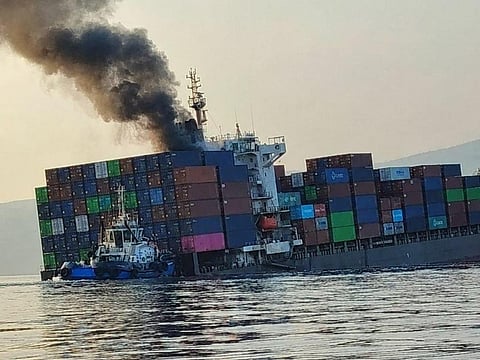
IRGC says cargo ship with 2,500 containers sank in Hormuz after naval mine strike
The IRGC Navy said on Wednesday that a container ship laden with more than 2,500 containers sank in waters south of the Strait of Hormuz after striking a naval mine and catching fire. No independent report exists to validate IRGC's claim of a mine strike in what Tehran claims as an "unauthorised" and "dangerous" route near Oman. IRGC-affiliated media posted footage of the sinking, showing the ship going up in smoke, while debris and cargo consistent with containers in the water.
Attacks on vessels intensify
Attacks on vessels in and around the Strait of Hormuz have intensified, with at least 10 ships struck since Sunday, the highest number over the period since the US-Israel war with Iran began.
Top Iran official says country must prepare for war as it negotiates
Iran must be prepared for war even as it negotiates with the U.S., the country's parliament speaker said Wednesday.
Mohammad Bagher Qalibaf said in a televised speech that his country's main concern is preventing the United States from attacking again. But, he added, a signed agreement with Washington is no guarantee.
"They break their promises," said Qalibaf. As a result, Iran must be prepared to fight "against a bullying enemy," and "we must truly fight courageously on the battlefield."
"That is when we will have achieved sustainable deterrence," he said. "America must be punished. America must change its behavior. It must understand that it has to come to terms with the Iranian people."
Tehran using unarmed 'spotters' to help target vessels in Hormuz: report
Iran's IRGC has shifted tactics by using "unarmed spotters", Reuters reported. A US military official, speaking anonymously, told the news agency agency that after the US destroyed much of Iran’s radar capability, the IRGC began using unarmed spotters in small boats to identify and track potential targets, including US naval vessels, in and around Hormuz.
The official described a previously unreported incident last week in which Iranian spotters on a dhow were "calling in" targets to the IRGC. US forces told the occupants to abandon the dhow, a traditional wooden sailing vessel, and then destroyed it. Maritime security analysis of attacks reported to UKMTO suggests Iran may already be targeting ships beyond the Strait itself.
Two senior Iranian officials told Reuters that Iran is using new tactics to keep oil prices high and influence the US midterm elections. They said the change involves both the type and the pace of attacks.
Iran’s own rhetoric matches this: Mohsen Rezaei, a powerful figure in the Tehran regime, told state TV that Iran targets five or six vessels every night and that Hormuz is under Iranian control. The "shuttle system" involving ship-to-ship transfers of crude oil outside Hormuz Strait is described as an explicit Iranian target.
Yemen's Houthis seek Chinese parts for ballistic missiles: report
Yemen's Iran-backed Houthi rebels are attempting to build a new advanced medium-range ballistic missile system with the help of Chinese parts, according to a new report released Wednesday by a group that tracks the use of weapons in conflict zones.
The report by the UK-based Conflict Armament Research group came as the Houthis, in their ongoing war with Saudi Arabia, are demonstrating remarkable ability to wreak havoc on one of the Middle East’s best equipped militaries.
The weaponry under development could help the group more precisely target the Saudis and Israel. By turning to China, it also appears to be a sign of increasing independence.
Iran claims mine sank cargo ship near Hormuz as shipping attacks escalate
Iran’s IRGC claimed a container ship laden with more than 2,500 containers was struck by a naval mine and sank south of the Strait of Hormuz.
The Guards claimed the commercial vessel was attempting what Tehran terms an “unauthorised and dangerous” route off the coast of Omani. It showed footage of a thick black smoke billowing out of a large containership listing heavily, a tug alongside.
Tehran Times posted on X a video showing floating debris consistent with containers late on Thursday. There's no immediate independent verification of the mine strike incident.
Crew rescued before Iranian-affiliated dhow's destruction
US forces destroyed an Iranian-affiliated dhow in the Gulf of Oman on October 6 after identifying it as conducting surveillance and targeting US Navy ships, US Central Command (CENTCOM) said in a post on X.
CENTCOM said the vessel’s crew members were safely removed before the dhow was destroyed, adding that efforts to repatriate them are ongoing.
The US military command also accused Iran’s Islamic Revolutionary Guard Corps (IRGC) of continuing to target civilian mariners and US Navy warships in regional waters over the past seven months.


